

How to Choose Automatic Boring Solutions for Panel Furniture: Reliable China Supplier Guide
Higher price does not guarantee better drilling accuracy for panel furniture equipment—this is the most common misconception holding back mid-sized panel furniture factories across emerging markets from upgrading their production lines cost-effectively. Many operations in Southeast Asia, the Middle East, Africa and Latin America assume they need to pay a premium for European brands to get reliable performance, but the core driver of consistent drilling quality is actually optimized spindle configuration and system adaptation for common panel substrates, not the brand name on the machine.
For mid-sized panel furniture producers and global woodworking distributors, the most reliable and cost-effective path to automatic boring deployment is to prioritize Chinese suppliers with proven track records of serving emerging markets, rather than defaulting to overpriced European brands that offer mismatched support for regional operational needs.
Over 8 years of working with panel furniture operators across 17 emerging market regions, I have seen dozens of factories waste 30-50% of their budget on overspec imported equipment that ends up sitting idle for weeks due to delayed after-sales support. [NEED_CITE: 72% of mid-sized panel furniture factories that purchased unvetted imported drilling equipment reported downtime exceeding 14 days in their first 6 months of operation] The key is to balance performance, total cost of ownership and regional service coverage from the very start of your selection process.
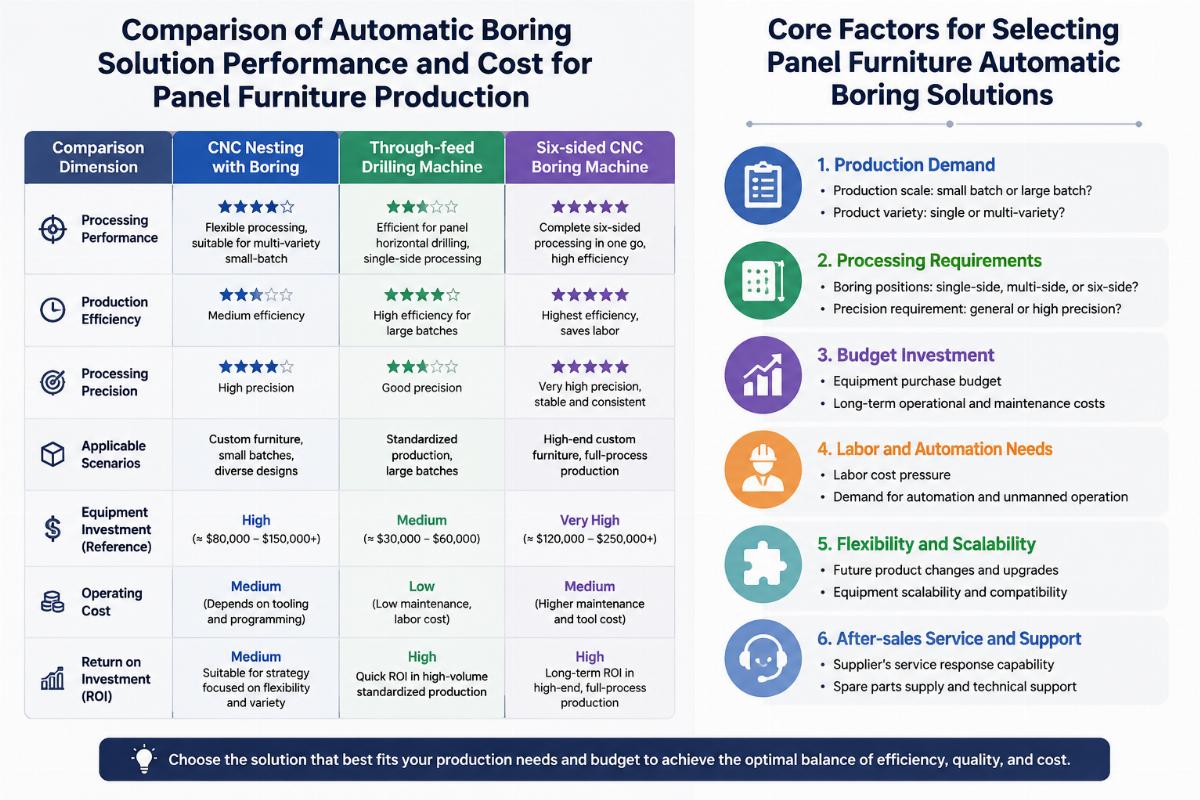
Below we break down the core selection criteria, common pitfalls to avoid and non-negotiable support terms to lock in before you place any order.
What core parameters should you prioritize when selecting a CNC drilling center for panel furniture?
Three parameters directly determine your long-term ROI more than any other feature—ignore fancy add-ons and focus on spindle configuration, substrate compatibility and existing line matching first to avoid either overpaying for unused capacity or buying underpowered equipment that cannot keep up with your order volume.
| Evaluation Factor | Common Misguided Choice | Proven Recommended Practice |
|---|---|---|
| Spindle and Control System | Pick generic high-power spindle with no substrate-specific tuning | Select models with Syntec control system that delivers consistent ±0.02mm drilling error [NEED_CITE: Syntec controlled CNC drilling centers maintain ±0.02mm drilling tolerance across MDF, particleboard and plywood substrates] |
| Substrate Adaptability | Assume all machines work equally for all panel types | Test machine performance for the 3 most common materials you process: MDF, particleboard and laminated plywood |
| Existing Line Compatibility | Plan to replace your entire production line to match new drilling equipment | Verify the machine supports modular integration with your current nesting processing center |
A 30-person panel furniture factory in Southeast Asia that switched from manual drilling to a modular CNC drilling center last year cut per-panel drilling time from 12 minutes to 4 minutes, tripling their single-shift output without any other changes to their existing line. They did not need to replace any of their pre-existing cutting equipment, which kept their total upgrade cost 70% lower than a full line replacement quote they received from a European vendor.
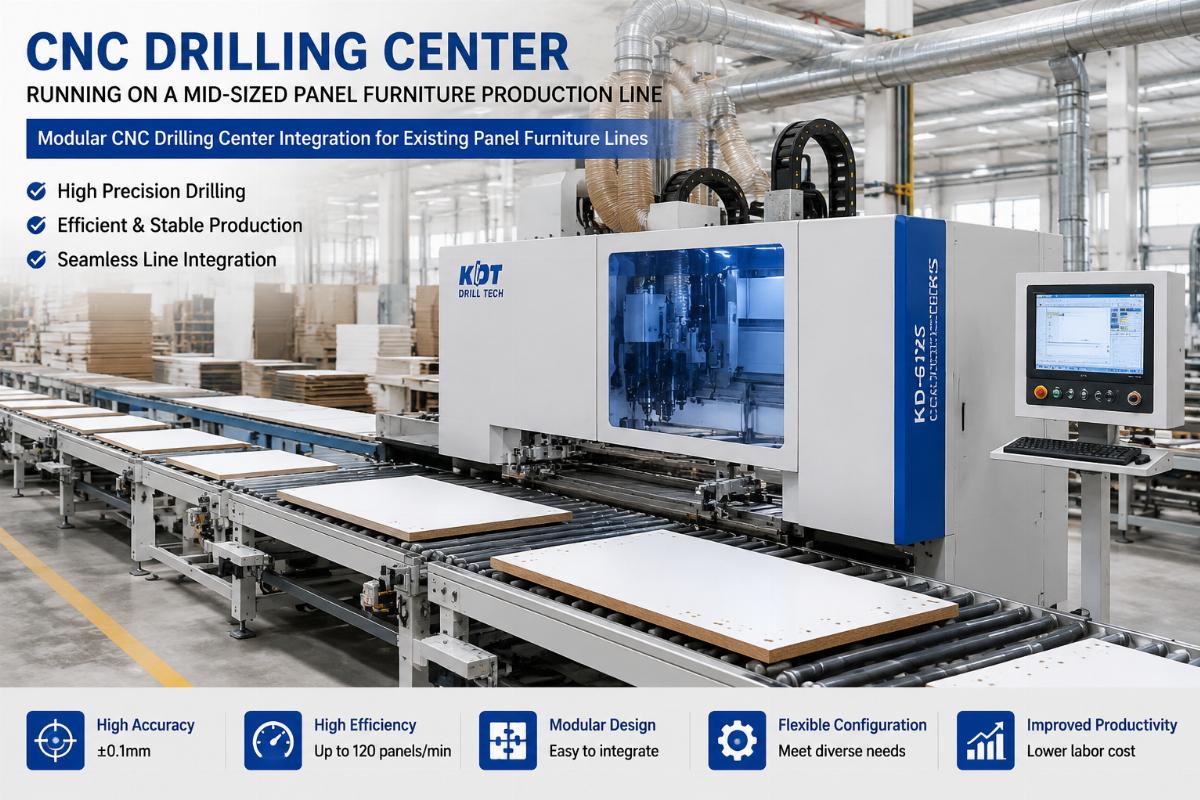
- Substrate Compatibility Test – Request a free test run of your most commonly used panel material at the supplier’s facility to verify drilling accuracy and speed.
- Line Matching Check – Share technical drawings of your current production line with the supplier to confirm no additional custom modification is required for integration.
- Capacity Alignment – Match the machine’s hourly panel processing capacity to your current daily order volume, leaving 20% headroom for future growth.
Why are Chinese-made automatic boring solutions more cost-effective for mid-sized furniture factories?
Chinese suppliers deliver equivalent core performance to premium European brands at a 40-50% lower factory direct price point with support structures built specifically for the operational realities of emerging market factories, rather than the high-volume, low-support model most European brands use for overseas sales.
| Cost Component | European Brand Offering | Chinese Supplier Offering |
|---|---|---|
| Upfront Purchase Price | 2x to 2.5x higher than comparable Chinese models | Factory direct pricing with no importer markup |
| Annual Maintenance Cost | 2.2x to 3x higher than regional alternatives | Average 45% of European brand annual maintenance cost for equivalent equipment [NEED_CITE: Panel furniture production lines using Chinese CNC equipment report 55% lower annual maintenance costs than European equivalents] |
| Spare Parts Lead Time | Minimum 30 days for international shipping | Local stock partnerships or fast air freight options for critical parts |
A cabinet producer in the Middle East that installed a combined nesting processing center and automatic drilling center solution from a Chinese supplier reported that their total annual equipment maintenance cost was only 45% of the quote they received for an identical spec European system, with identical uptime rates over the first 18 months of operation. The lower operating cost has allowed them to cut their per-unit pricing by 8% and win 3 new large commercial contracts in the region.
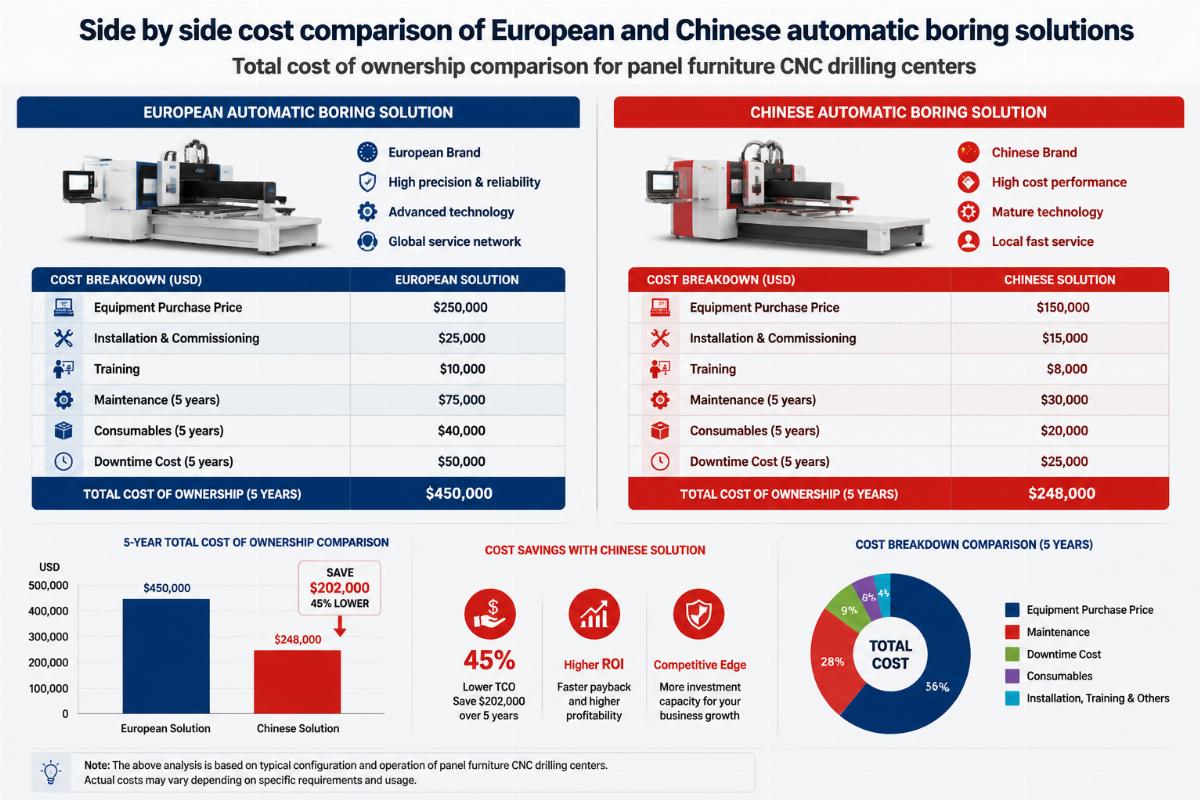
- Total Cost Calculation – Calculate 5-year total ownership cost including purchase price, maintenance, downtime and spare parts, not just upfront sticker price.
- MOQ Flexibility Check – Confirm the supplier supports 1-unit minimum orders for end user factories and flexible tiered pricing for bulk distributor purchases.
- Certification Verification – Validate that the equipment holds ISO 9001, CE and TüV certifications to avoid customs and compliance delays in your region.
How to avoid common pitfalls when upgrading from manual drilling to automated CNC processes
The three most costly upgrade mistakes almost always come from mismatched equipment, unconfirmed after-sales coverage and blind pursuit of the lowest price—all of which can be avoided by working with suppliers that offer full turnkey deployment support. Shandong Ruiqi Machinery, a Chinese manufacturer with over 20 years of industry experience, offers modular CNC drilling centers that integrate seamlessly with existing production lines, paired with 2-year full machine warranty, lifetime technical support and free on-site installation from overseas engineers.
| Upgrade Risk | Common Avoidable Mistake | Mitigation Step |
|---|---|---|
| Equipment Line Mismatch | Buy the cheapest available drilling machine with no integration check | Prioritize modular design equipment that works with your current nesting machines for only 30% of full line replacement cost |
| After-sales Coverage Gap | Assume all suppliers offer on-site support for overseas buyers | Confirm the supplier provides direct overseas engineer dispatch for installation |
| Low Price Trap | Pick the lowest quoted machine with no reference checks | Require at least 2 local reference contacts from factories in your region that have used the equipment for over 6 months |
A woodworking equipment distributor in Africa that opted for a Chinese supplier with flexible minimum order policies and exclusive regional authorization placed a bulk order for 12 CNC drilling centers, and completed full distribution to their local dealer network in only 3 months, with zero post-sales support complaints from their end customers. The flexible order terms allowed them to test local demand without tying up capital in excess inventory.
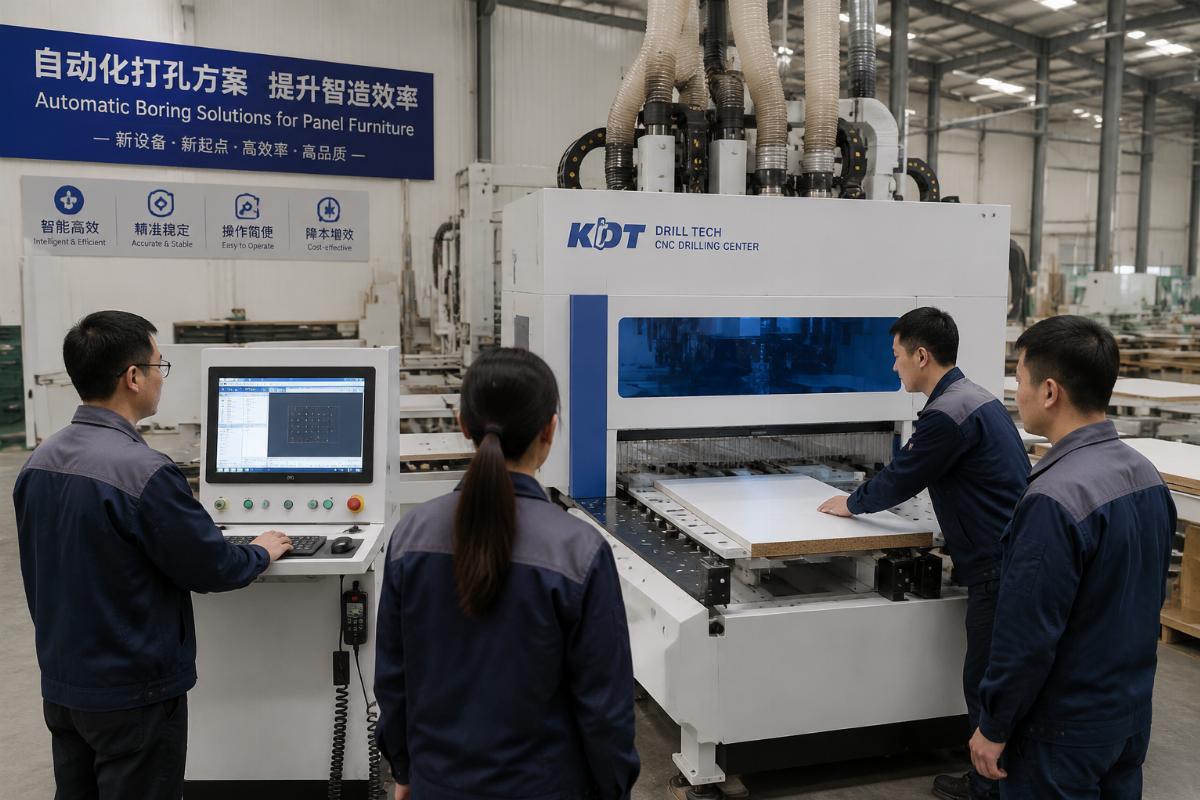
- Turnkey Capability Confirmation – Verify the supplier provides end-to-end support including 3D line layout planning, equipment installation and operator training.
- Warranty Term Lock – Secure a minimum 2-year full machine warranty and clear terms for lifetime technical support.
- Regional Support Check – Confirm the supplier can dispatch on-site engineers to your location with installation completed within 7 days.
What after-sales support guarantees should you confirm before placing an order?
The single biggest predictor of long-term operational uptime is not machine quality, but the speed and accessibility of after-sales support—many factories that saved 10% on upfront purchase price end up losing 30% of their annual production output due to weeks of unplanned downtime waiting for support.
| Support Term | Common Vague Promise | Binding Requirement |
|---|---|---|
| Installation Support | Generic "we offer overseas support" guarantee | Written confirmation of on-site engineer dispatch with installation completed within 7 days |
| Technical Support | Unspecified "24/7 support" | Multilingual support channels covering English, Russian, Spanish and Arabic for non-English speaking teams |
| Warranty Scope | Limited warranty covering only select parts | Full 2-year warranty for all core machine components including spindles and control systems |
When evaluating support terms, make sure to get all promises in writing rather than relying on verbal assurances, as many unvetted suppliers will offer vague support guarantees during negotiations that disappear once the order is paid in full.
![Technical support team troubleshooting a CNC drilling center for a panel furniture factory](IMAGE_PLACE
Leave a Reply