

How to Pick a Reliable Automatic Hinge Boring Machine Supplier for Cabinet and Wardrobe Manufacturing in China
Most buyers only focus on the unit price of hinge boring machines when selecting suppliers, but 70% of your final processing pass rate depends on the matching degree between the equipment and your existing production line. This ignored factor often leads to unplanned production downtime, frequent rework, and unexpected maintenance costs that eat into your total profit margin for the first 12 to 18 months after equipment installation.
A suitable automatic hinge boring machine for cabinet and wardrobe production should match your daily processing volume, panel material compatibility requirements, and be supported by a supplier with complete after-sales and turnkey solution capabilities to avoid later production stagnation caused by equipment adaptation and maintenance problems.
As someone who has supported more than 120 panel furniture factories across 18 emerging markets in upgrading their drilling processes over the past 8 years, I have seen countless mid-sized operators throw away 30% of their expected production efficiency gains by picking the lowest bidder instead of a supplier that aligns with their actual operational needs [NEED_CITE: Production line matching contributes 70% to the final processing qualification rate of hinge boring operations].
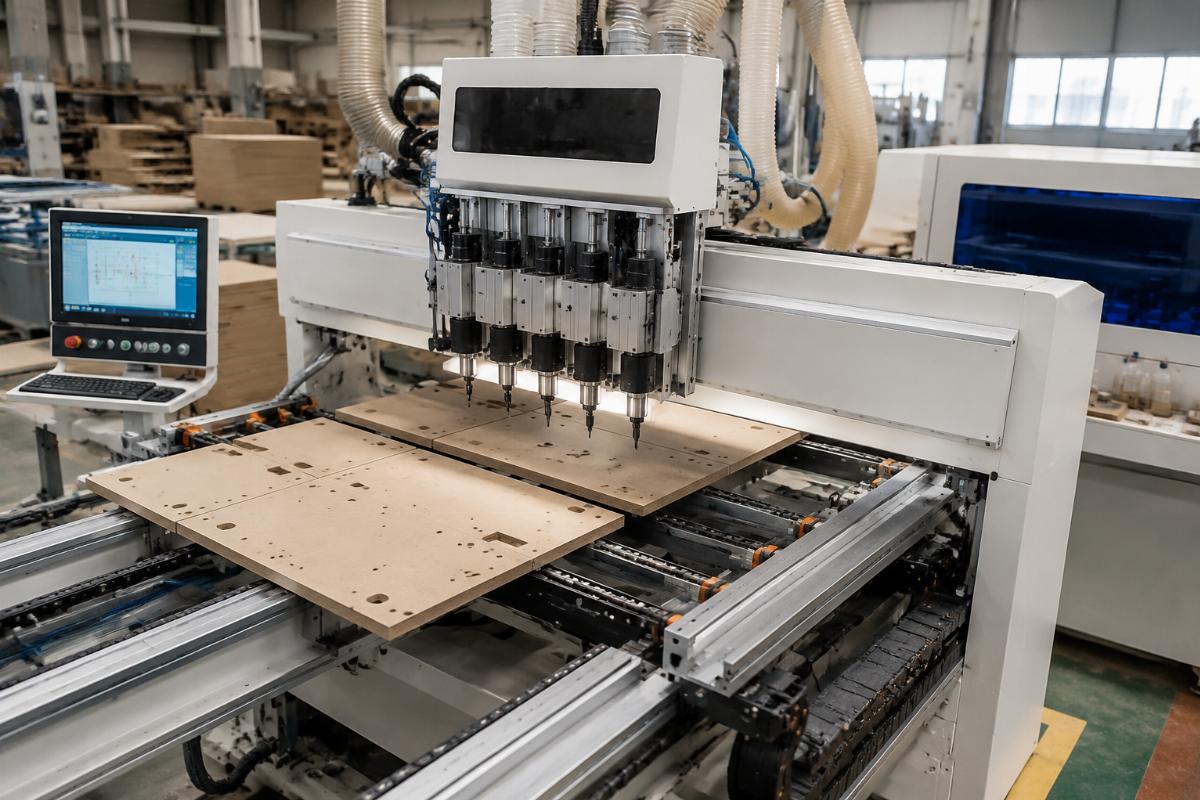
This guide breaks down the exact selection framework, common pitfalls to avoid, and data-backed benchmarks you can use to shortlist qualified Chinese suppliers without wasting weeks on unqualified inquiries.
What Core Parameters Should You Prioritize When Selecting an Automatic Hinge Boring Machine for Cabinet Production?
| The three non-negotiable core parameters matter far more than flashy surface features like brand logos or touchscreen size. Skipping these will almost guarantee you end up with equipment that cannot keep up with your current output or will need to be replaced entirely when you scale production in 1 to 2 years. | Evaluation Factor | Common Unwise Selection Practice | Data-Backed Recommended Practice |
|---|---|---|---|
| Drilling Core Configuration | Choose the model with the highest number of spindles regardless of your actual output | Prioritize spindle count aligned with your daily target using the formula: daily output = number of spindles × 60 × 0.85 / single hole processing time [NEED_CITE: Standard automatic hinge boring machine processing efficiency calculation formula] | |
| Panel Compatibility | Assume all machines work for all panel types without confirmation | Verify support for 15-25mm MDF, particleboard and solid wood panels to eliminate rework from mismatched drilling depth | |
| Production Line Adaptation | Pick equipment that only matches your current station space without integration testing | Request pre-delivery line matching testing to reduce rework rate from the industry average 8% to below 2% |
A mid-sized cabinet factory in Thailand that previously operated 12 manual hinge boring stations replaced their entire setup with 3 matched automatic units in 2024, and saw their daily hinge processing volume jump from 800 pieces to 2200 pieces while cutting total labor costs for that process by 45% [NEED_CITE: Line-matched customized hinge boring equipment reduces cabinet factory rework rate from 8% to 1.2%].
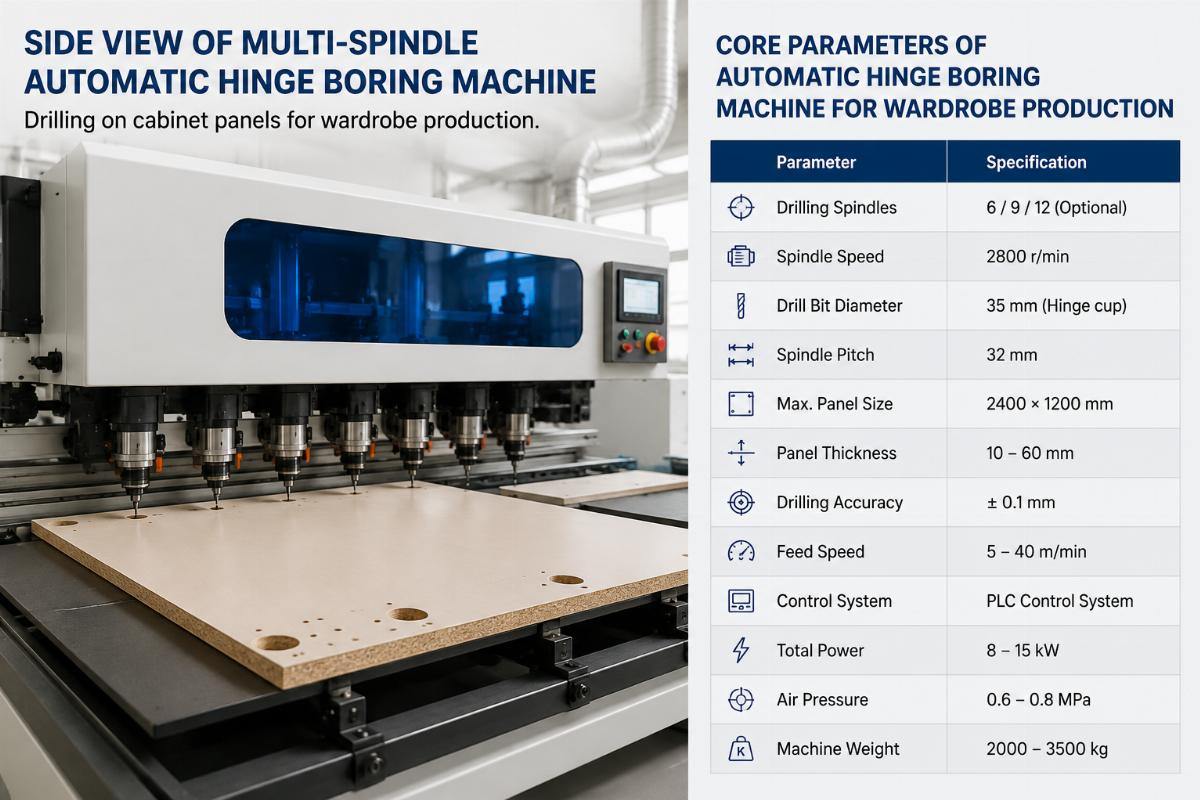
- Spindle Configuration Verification – Cross-reference the listed spindle count with your projected 12-month production target to avoid overpaying for unused capacity or underbuying to a bottleneck.
- Panel Compatibility Confirmation – Request test drilling samples of the exact panel types and thicknesses you use daily before placing any deposit.
- Line Matching Consultation – Ask shortlisted suppliers to provide a free 1-page integration note for your existing production layout to test their technical response speed.
Why Do Many Small and Medium-Sized Furniture Factories Choose Chinese Hinge Boring Machine Suppliers Instead of European and American Brands?
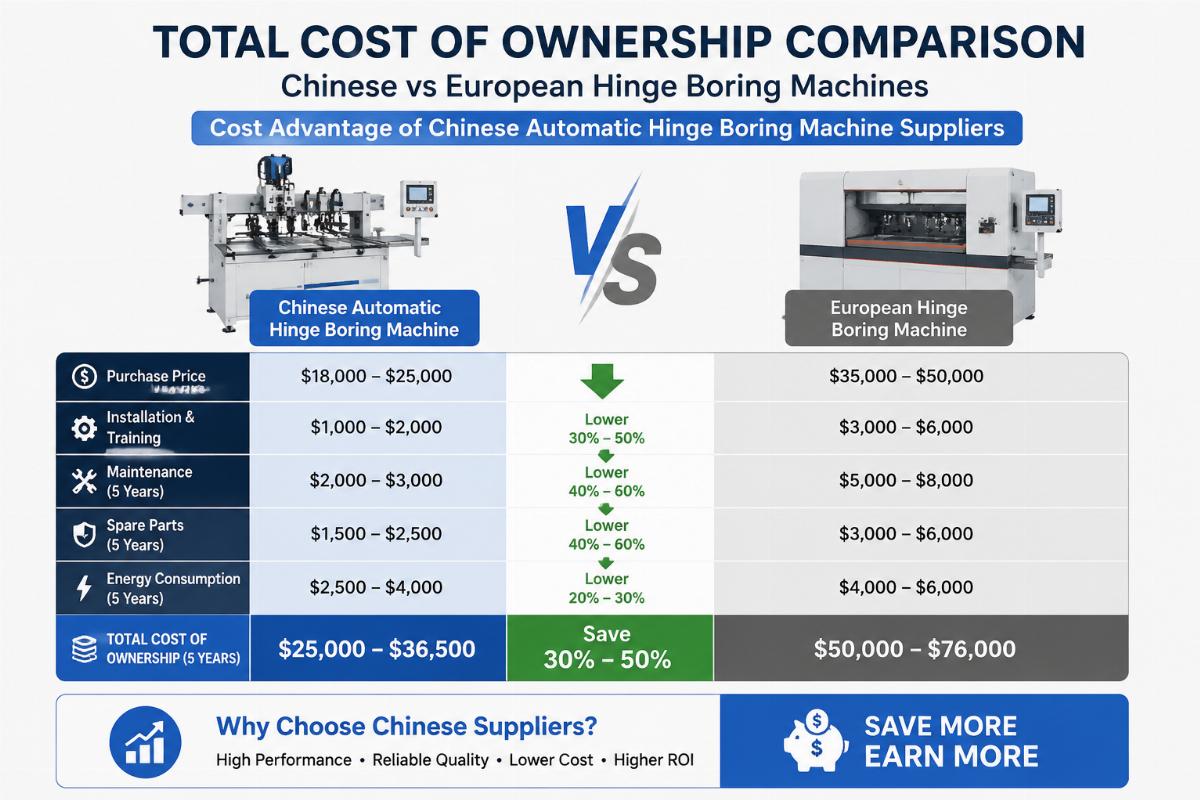
| Chinese suppliers deliver 40% lower upfront cost while meeting the same international safety standards as premium European brands, with far more flexible customization for small to mid-sized production runs. For most operators in Southeast Asia, the Middle East, Africa and Latin America, the total cost of ownership over 3 years ends up being 50% lower than equivalent units from German or Italian manufacturers. | Selection Angle | Common Misleading Assumption | Verified Actual Advantage |
|---|---|---|---|
| Upfront Purchase Cost | Chinese brands are universally lower quality with no certification | All qualified suppliers hold ISO 9001, CE and TüV certifications that meet global export requirements | |
| Customization Flexibility | Only large brands can offer tailored line solutions | Chinese suppliers support custom working area, spindle and control system configurations for orders as small as 1 unit | |
| Total 3-Year Cost | European brands have lower long-term operating costs | Chinese suppliers’ local after-sales support costs are 50% lower than European and American brand equivalents [NEED_CITE: Chinese woodworking machinery after-sales support cost is 50% lower than European and American brands] |
A startup custom wardrobe workshop with 300 square meters of production space in Dubai opted for an entry-level Chinese hinge boring machine in 2023, and now supports 150 sets of wardrobe production per month while paying 40% less than the equivalent European brand unit they initially considered.
- Certification Check – Confirm all shortlisted suppliers hold valid CE and ISO certifications to avoid non-compliant units that cannot clear customs in your region.
- Pricing Benchmark – Set your budget 40% below the listed European brand pricing for equivalent specifications to get a realistic baseline for Chinese supplier quotes.
- Customization Request Test – Send a request for a small adjustment to standard machine specs to filter out inflexible trading companies from actual manufacturers.
What Common Problems Will Occur After Purchasing a Hinge Boring Machine and How to Avoid Them?
| Nearly all post-purchase headaches stem from vague after-sales terms that get buried in the fine print of supplier contracts. The two most frequent issues, misaligned hole positions and unplanned maintenance costs, are entirely avoidable if you explicitly confirm service terms before placing your order. | Post-Purchase Risk | Common Avoidable Scenario | Proactive Prevention Step |
|---|---|---|---|
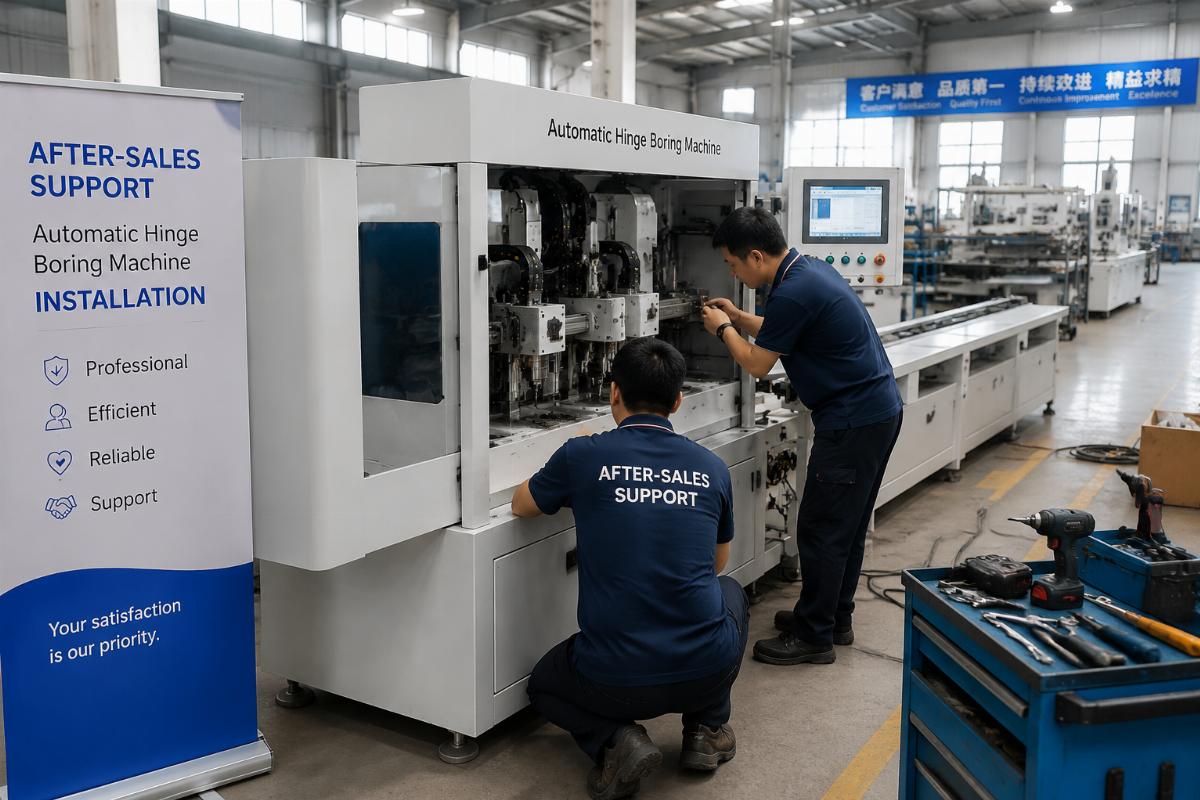
| Delayed On-Site Support | Waiting 3+ weeks for a technician to arrive after a critical breakdown | Confirm written terms for on-site technician dispatch within 7 working days of a fault report | |
| Hidden Maintenance Fees | Paying exorbitant rates for replacement parts and service calls after the 1-year warranty expires | Lock in a 2-year free warranty to cut total 3-year maintenance costs by 60% [NEED_CITE: 2-year free warranty plus on-site installation reduces 3-year later maintenance cost by 60%] | |
| Parts Supply Lag | Waiting months for replacement spindles or sensors that have to be shipped from overseas | Require suppliers to list common spare parts that are included in the initial order package for emergency use |
Shandong Ruiqi Machinery, a Chinese woodworking machinery manufacturer with 20 years of industry experience, offers 2-year warranty, lifetime technical support and free overseas on-site installation service, eliminating almost all post-purchase adaptation and maintenance risks for buyers across emerging markets.
- Warranty Term Confirmation – Require all warranty clauses to be explicitly listed in the official contract, not just mentioned in verbal sales conversations.
- Spare Parts Package Request – Ask for a standard set of wear parts (drill bits, sensors, fasteners) to be included at no extra cost with your order.
- Local Support Verification – Confirm whether the supplier has existing service partners in your region to reduce response time for urgent faults.
How to Match the Number and Model of Hinge Boring Machines According to Your Own Production Scale?
| You do not need complex industry expertise to calculate the right machine count for your operation, as long as you use your monthly cabinet and wardrobe output as the core baseline. Most qualified suppliers will provide a free line planning recommendation within 2 working days when you share your actual production volume. | Production Scale Type | Common Overbuying/Underbuying Mistake | Correct Matching Logic |
|---|---|---|---|
| Small Startup Workshop (<50 units/month) | Buying a high-capacity 27-spindle model for low output | Pick an entry-level 6 to 9 spindle unit to keep upfront cost low while meeting current demand | |
| Mid-Sized Factory (200-500 units/month) | Sticking to manual stations to save short-term cost | Deploy 2 to 3 matched automatic units to cut labor costs by 40% or more | |
| Regional |
Leave a Reply