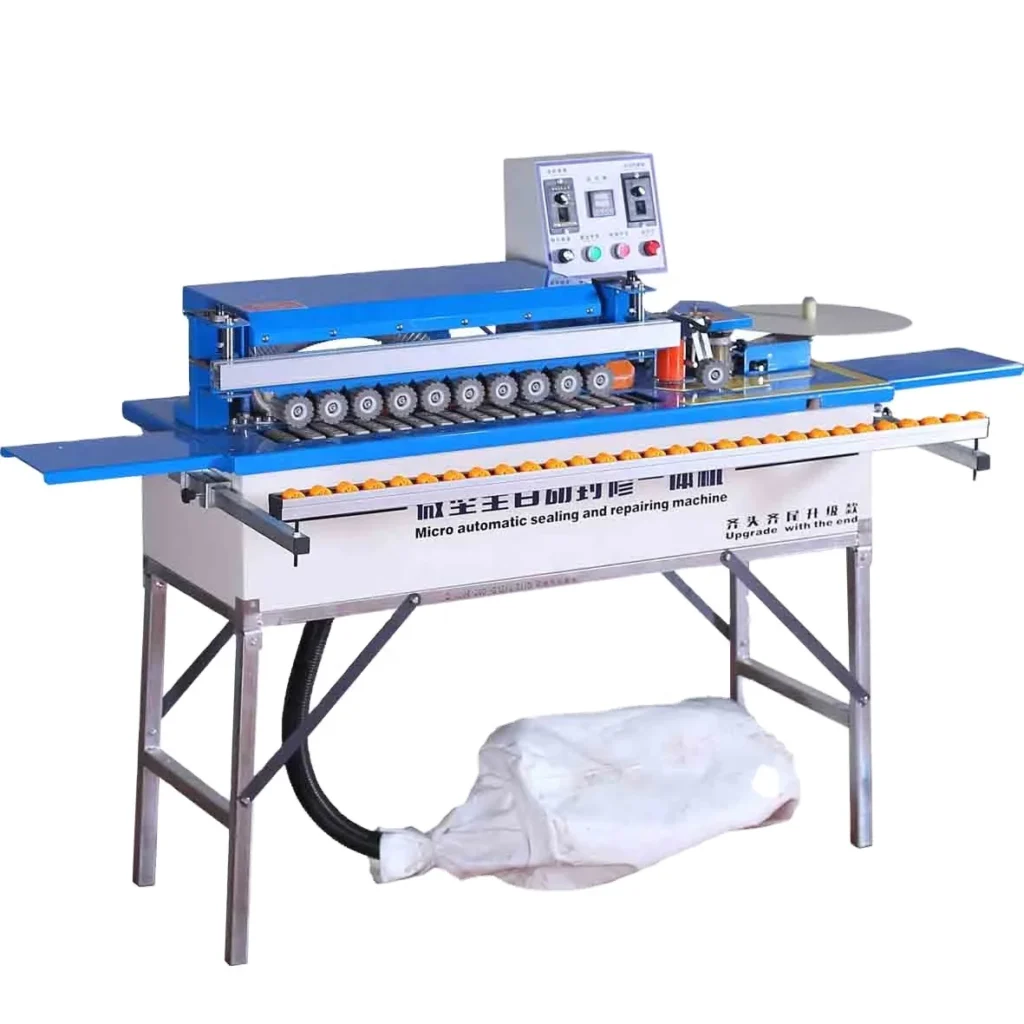
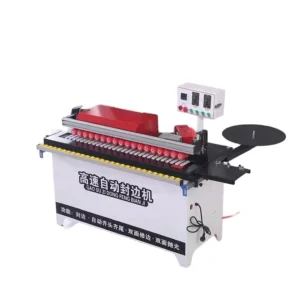
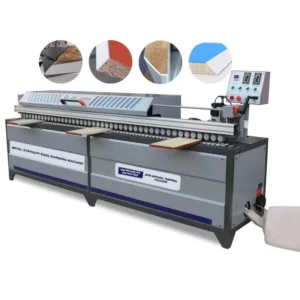
Compact Footprint, Full Automation — a miniature edge bander that delivers double-sided gluing, trimming, and polishing within a 120 cm frame, stocked for quick dispatch to small workshops.
Technical Specifications
| Parameter |
Value |
| Product Type |
Automatic Edge Banding Machine |
| Voltage |
220V |
| Total Suction Power |
1200W |
| Belt Drive Power |
25W |
| Transmission Power |
60W |
| Polishing Motor Power |
180W × 2 |
| Trimming Motor Power |
800W × 2 |
| Conveying Speed |
0–15 m/min |
| Edging Speed |
0–6 m/min |
| Edge Height Range |
10–60 mm |
| Edge Thickness Range |
0.3–3 mm |
| Overall Dimensions (L×W×H) |
120 × 54 × 72 cm |
| Net Weight |
81 kg (source value — verify against manufacturer catalog) |
| Gluing Device Rotation |
180° |
| Feed Mechanism |
Double-row rubber pressure wheels |
| Control Interface |
Independent function switches |
| Dust Extraction |
Integrated vacuum suction at trimming stations |
Application Suitability
| Application |
Material or Output |
| Custom cabinet door and carcass edge finishing |
MDF and particleboard with PVC edge banding (0.3–3 mm) |
| Curved shelving and radius panel components |
Plywood and MDF with veneer or PVC banding |
| Small-batch joinery production runs |
Solid wood panels with veneer edge banding |
| Workshop transition from manual to machine banding |
Standard sheet goods in constrained floor layouts |
Why the Voltage Question Must Come Before the Order
Confirm your workshop supply matches the machine's 220V requirement and verify frequency compatibility before committing to a purchase.
I have watched small joinery shops unbox an automatic edge banding machine for small workshop use only to find the motor hums at the wrong frequency, the glue pot never reaches temperature, and the feed motors stall under load. The unit was quoted without anyone asking whether the local grid runs at 50 Hz or 60 Hz, and the result was a machine sitting idle while electricians rigged transformer solutions that were never part of the plan. Voltage and frequency mismatches account for a significant share of early commissioning failures in exported woodworking equipment [NEED_CITE: voltage and frequency standards by export market]. This unit ships configured for 220V operation, and any deviation at your facility needs to be addressed before the crate leaves the factory floor.

Straight and Curved Edges in One Pass Setup
The gluing device rotates through 180 degrees, allowing the same machine to apply adhesive on straight panel runs and then pivot for curved profile work without swapping fixtures or adding secondary tooling. For a small shop handling both flat cabinet sides and radius shelving, this means one automatic edge banding machine for small workshop production covers the majority of daily edge finishing requirements without occupying additional floor area.
Independent Controls That Do Not Demand a Programmer
Each function — gluing, trimming, polishing, dust extraction — has its own dedicated switch on the control panel. Operators learn the sequence in a single shift rather than navigating nested menu trees. This matters when the person running the machine today may be training an apprentice tomorrow, and production cannot pause for a software tutorial.
What the Numbers Mean for Your Daily Output
The 0–6 m/min edging speed range lets you slow the feed for thick veneer on curved profiles, then open it up for standard PVC runs on straight particleboard panels. The dual 800W trimming motors with integrated dust suction handle both the upper and lower edge in one pass, leaving a clean finish that reduces hand-sanding downstream [NEED_CITE: edge trimming quality standards for furniture panel production]. The 0.3–3 mm edge thickness range covers everything from thin melamine foil to solid PVC nosing, so you are not buying separate machines for different banding materials. The double-row rubber pressure wheels maintain consistent panel alignment through the feed path, which directly affects how square the trim cuts land at the head and tail ends of each board.
The Real Cost of a Machine That Does Not Match Your Panels
A workshop running recycled-content particleboard will find that standard glue pot temperatures and feed speeds produce blistered edges and adhesion failures within the first week of production. The density of the substrate changes everything about how heat transfers through the panel and how the adhesive bonds under pressure. When an automatic edge banding machine for small workshop use arrives without tested parameters for your actual board stock, the operator spends weeks chasing settings that should have been established before shipping [NEED_CITE: substrate density effects on hot-melt adhesive bonding in edge banding].
Why This Source Reduces the Guesswork
Every unit undergoes a pre-shipment test run before crating, so the machine you receive has been verified under load rather than merely powered on. Voltage configuration is confirmed against your stated supply before production begins, eliminating the transformer problem described earlier. The four-stage quality process covers incoming materials, in-process assembly, finished product checks, and final dispatch verification. Engineers review your panel specifications and recommend configuration adjustments rather than shipping a generic setup. Factory visits are welcomed if you want to run your own material through the machine before it leaves [NEED_CITE: factory acceptance testing practices for exported woodworking machinery].
Documentation & Verification
- CE declaration of conformity covering electrical safety and machinery directive compliance
- Machine specification sheet confirming your voltage and frequency requirements
- Electrical schematic with confirmed voltage for local electrician reference
- Factory test record on your actual panel thickness and edge banding material
- Operation and maintenance manual written in your agreed language
- Spare parts list with part numbers for reordering consumables
Installation, Commissioning & Support
- Requires a dedicated 220V circuit with capacity exceeding the combined 1200W suction and motor loads
- Overall footprint of 120 × 54 × 72 cm fits standard workshop doorways for placement
- Integrated dust suction at trimming stations connects to your existing extraction system
- Independent function switches allow step-by-step commissioning of each station individually
- Double-sided adhesive system requires initial glue pot temperature calibration for your specific banding material
- Double-row rubber pressure wheels need tension adjustment based on your typical panel thickness range
What We Need to Move Forward
Provide your workshop's confirmed voltage and frequency so we can match the electrical configuration before building. Share the panel materials and edge banding types you run most often — MDF, particleboard, plywood, or solid wood — along with typical thickness ranges so we can verify the feed and trimming parameters against your actual stock. If you are planning a phased equipment expansion, let us know your existing machinery so we can confirm this unit fits your current workflow without creating a bottleneck.
Frequently Asked Questions
Q: Is this machine compatible with my local voltage and frequency?
A: The unit is configured for 220V operation. Before ordering, confirm your workshop supply voltage and whether your grid runs at 50 Hz or 60 Hz. We verify frequency compatibility and adjust motor and transformer specifications accordingly during the configuration stage, so the machine arrives ready for your local electrical infrastructure without aftermarket modifications.
Q: Can it handle both straight and curved edge banding without additional accessories?
A: Yes. The gluing device rotates 180 degrees to accommodate curved profiles, and the same feed mechanism handles straight panel runs. No separate fixtures or secondary machines are needed to switch between straight cabinet components and curved shelving or radius panels in your daily production schedule.
Q: What panel materials and edge banding types does it support?
A: The machine processes MDF, plywood, particleboard, and solid wood panels with PVC or veneer edge banding ranging from 0.3 to 3 mm in thickness and 10 to 60 mm in height. This covers standard furniture-grade sheet goods as well as thicker solid-wood nosing applications common in custom joinery work.
Q: What is the delivery lead time and how is the machine shipped?
A: Stocked models are available for prompt dispatch. We confirm availability at inquiry and provide a shipping timeline based on your destination port. The machine ships crated with protective packing, and we supply packing photographs before dispatch so you can verify condition prior to collection by the freight forwarder.
Q: What spare parts are included and how do I source replacements?
A: A spare parts list ships with every unit, identifying consumable and wear components by part number. Replacement items such as trimming blades, polishing wheels, and pressure wheel sets can be ordered directly. We recommend stocking critical consumables locally to minimize any interruption to your production schedule.