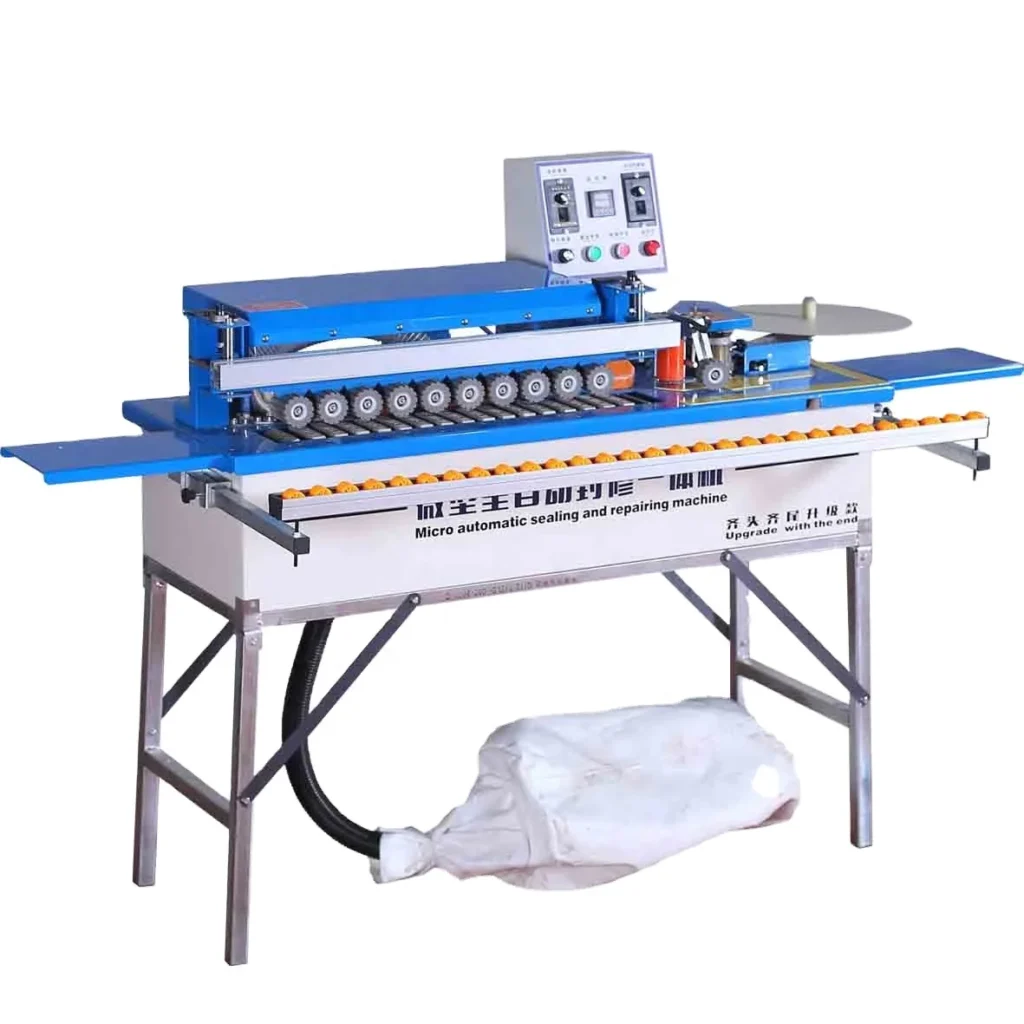
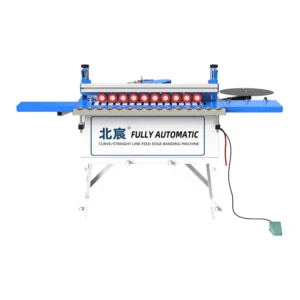
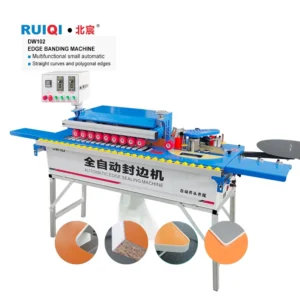
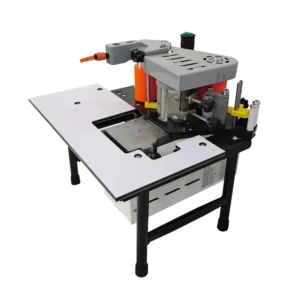
Compact Footprint, Single-Unit Ordering — This entry-level automatic edge banding machine arrives as a self-contained production cell, letting small joinery shops move from manual trimming to mechanized output without juggling incompatible auxiliary equipment.
Technical Specifications
| Parameter |
Value |
| Product Type |
Automatic Edge Banding Machine |
| Voltage |
220V (configurable from 110V to 440V) |
| Total Power |
2.88 kW (Suction 1200W + Belt 25W + Transmission 60W + Polishing 180W×2 + Trimming 800W×2) |
| Conveying Speed |
0-15 m/min |
| Edging Speed |
0-6 m/min |
| Edge Height Range |
10-60 mm |
| Edge Thickness Range |
0.3-3 mm |
| Overall Dimensions (L×W×H) |
120×54×72 cm |
| Net Weight |
81 kg (source value — verify against manufacturer catalog) |
| Gluing Method |
Double-sided adhesive |
| Trimming Configuration |
Up and down trimming (2×800W motors) |
| Polishing Configuration |
Cross polishing up and down (2×180W motors) |
| Edge Banding Type |
Straight and curved dual purpose |
| Gluing Device Rotation |
180 degrees |
| Feed Mechanism |
Double-row rubber pressure wheels |
| Dust Extraction |
Integrated vacuuming device |
| Control Panel |
Separate function controls |
Application Suitability
| Application |
Material or Output |
| Custom furniture panel finishing |
MDF and particleboard with PVC edge banding (0.3-3mm) |
| Small-batch cabinet production |
Plywood panels with straight and curved edge profiles |
| Joinery workshop startup runs |
Wood-based panels transitioning from hand-trimmed to machine-finished edges |
| Prototype and sample fabrication |
Solid wood panels requiring curved edge contouring |
Why the Voltage Question Should Come Before the Price for an Automatic Edge Banding Machine for Small Workshop
A machine that cannot plug into your shop's existing supply is a machine that does not work.
I have watched a container arrive in the Middle East only for the buyer to discover the edge bander required a three-phase connection while the workshop ran on single-phase power. The machine sat on the floor for three weeks while a transformer was sourced locally. That delay is not a shipping problem; it is a specification problem that happened before the order was placed [NEED_CITE: voltage and frequency standards by export market]. When evaluating an automatic edge banding machine for small workshop use, the first conversation should be about your incoming supply and plug configuration, not the feed speed or the price tag. Confirming the voltage, frequency, and phase requirement against your actual workshop electrical panel avoids the most common and most expensive commissioning failure in export machinery.

A Complete Cell in a 120-Centimeter Footprint
Small workshops do not have the floor space to accommodate separate gluing, trimming, and polishing stations linked by transfer conveyors. This machine consolidates the gluing, trimming, and cross-polishing sequence into one pass within a 120×54×72 cm frame. The operator feeds the panel at one end and receives a finished edge at the other, which is how an automatic edge banding machine for small workshop environments earns its keep. The integrated vacuuming device handles dust extraction at the point of generation, so a separate dust collector connection is not required to keep the workspace functional.
Straight and Curved Without Reconfiguration
The 180-degree rotation of the gluing device allows the same setup to handle both straight panel edges and curved contours. For a custom furniture shop producing rounded cabinet fronts or shaped shelving, this eliminates the need to maintain two separate machines or to swap tooling between jobs [NEED_CITE: edge banding process parameters for curved profiles]. The double-sided adhesive method bonds PVC banding in the 0.3-3mm thickness range to the substrate, and the up-and-down trimming stations follow the profile to remove excess material before the cross-polishing motors deliver the final finish.
How Feed Speed and Pressure Affect Edge Adhesion on Thin Panels
The 0-6 m/min edging speed range matters most when working with thinner substrates like 10mm MDF. At higher feed rates, the adhesive contact time decreases, which can result in incomplete bonding on porous surfaces. The double-row rubber pressure wheels maintain consistent contact force across the panel edge, compensating for minor thickness variations in the board stock. Meanwhile, the 0-15 m/min conveying speed on the return or preparation passes keeps overall handling time reasonable when processing a batch of cabinet sides. The two 800W trimming motors provide sufficient torque to shear PVC banding cleanly without tearing, which is critical when edge thickness reaches the upper 3mm limit.
The Cost of Mismatched Feed Height and Throughput
Buying a single machine without considering the panel sizes you actually process leads to a specific frustration: the machine physically cannot accept your most common board dimensions. A small shop cutting 18mm cabinet carcass panels needs to verify that the 10-60mm edge height range covers their banding stock with margin. If your design calls for 65mm solid wood edging on a tabletop, this machine will not accommodate it, and discovering that limitation after delivery means either reworking the design or sourcing a second machine [NEED_CITE: edge banding machine selection criteria for panel thickness]. The throughput question is equally practical — at 0-6 m/min edging speed, this unit suits batch sizes typical of custom work rather than continuous production runs.
Why Sourcing Here Reduces Commissioning Risk
The voltage customization from 110V to 440V is confirmed at the order stage, not assumed from a default setting, so the machine arrives matching your workshop supply. Multilingual control panels are available to match the language your operators actually read, preventing the stall that occurs when a commissioning technician cannot interpret the interface. Every unit passes a four-stage quality check including pre-shipment verification, meaning the machine is powered on, run with test material, and photographed before it leaves the factory. The engineer-led configuration process means the quotation you receive accounts for your panel dimensions, edge material, and local electrical standard rather than offering a generic catalog price. OEM branding and private labeling are available if you are a distributor stocking this model for regional resale.
Documentation & Verification
- CE declaration of conformity covering the complete machine assembly and electrical safety
- Factory test record showing edge banding results on your specified panel thickness and PVC grade
- Electrical schematic confirming voltage, phase, and plug type as configured for your destination market
- Operation and maintenance manual translated into the language your workshop team reads
- Spare parts list with part numbers matching the trimming and polishing motors installed on your unit
- Packing photographs documenting machine condition and crating before container loading
Installation, Commissioning & Support
- Requires a dedicated 220V circuit rated for at least 3 kW to handle the combined motor load with startup surge margin
- Overall dimensions of 120×54×72 cm fit through standard workshop doors and position against a wall with single-operator access
- Integrated dust extraction operates from the main power supply, eliminating the need for a separate dust collector connection
- First-run setup includes verifying the 180-degree gluing device rotation and calibrating the double-row rubber pressure wheel tension
- Separate function controls on the panel allow operators to isolate trimming or polishing stations during initial material testing
- Trimming cutters and polishing pads are standard consumables available through the supplied spare parts list
What to Include in Your Inquiry
To receive a configuration that matches your actual production environment, share the panel materials you process most frequently, the PVC or veneer edge banding thickness range you plan to use, and your workshop's incoming voltage and phase supply. If your output includes curved edge profiles, note the minimum radius you need to band so the engineering team can confirm suitability before quotation.
Frequently Asked Questions
Q: How do I know if this entry-level machine suits my current panel volume and leaves room to grow?
A: This unit handles edging speeds up to 6 m/min, which aligns with custom shops producing small batches rather than continuous line output. As your volume increases, the same product family offers higher-feed-rate models, so you can scale without changing your supplier relationship or retraining operators on an entirely different control system.
Q: What voltage and plug options are available, and will the control panel be in my language?
A: Voltage is configurable from 110V to 440V and confirmed against your workshop supply before production begins. The control panel uses separate function controls and can be labeled in your preferred language. This prevents the common failure where a machine arrives electrically compatible but operationally unreadable to the shop floor team.
Q: Can this machine handle both straight and curved edges on the same setup?
A: The gluing device rotates 180 degrees to accommodate curved profiles without requiring a separate machine or major reconfiguration. You switch between straight and curved work by adjusting the fixture position, making it practical for shops that produce both cabinet sides and shaped components on the same production day.
Q: What edge banding materials and thicknesses does this machine support?
A: The machine accepts PVC edge banding from 0.3mm to 3mm thick, applied via double-sided adhesive to MDF, particleboard, plywood, and solid wood panels within the 10-60mm edge height range. Confirm your specific banding stock with the engineering team to ensure the trimming and polishing stations are adjusted for your material.
Q: What arrives with the machine, and is assembly guidance provided?
A: The shipment includes the complete machine, operation manual in your agreed language, spare parts list, and pre-shipment test photographs. The 120×54×72 cm unit arrives assembled and requires only electrical connection, pressure wheel calibration, and a test run with your actual panel stock before production begins.