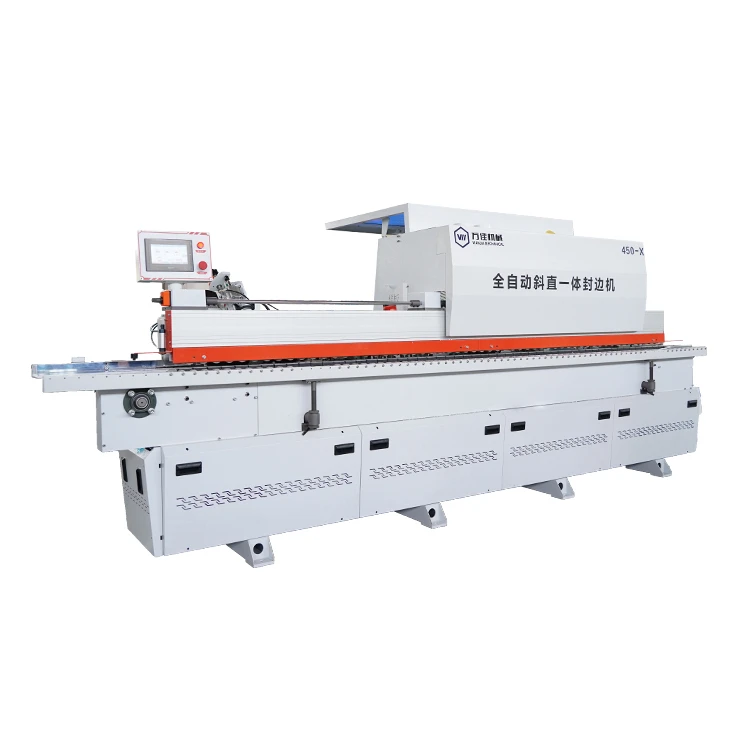
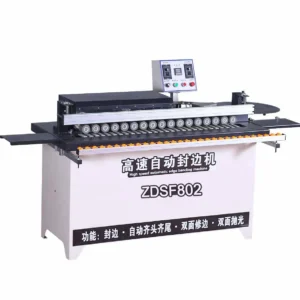
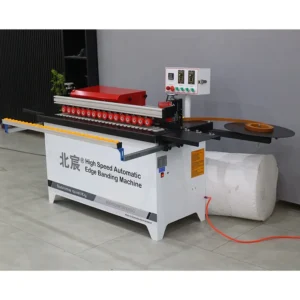
Voltage Confirmation Before Dispatch — This stocked edge banding machine ships with pre-verified 380V/50Hz three-phase configuration and multilingual control panel options, ensuring operators can commission the machine on day one without electrical or language barriers.
Technical Specifications
| Parameter |
Value |
| Product Type |
Automatic Edge Banding Machine |
| Overall Dimensions (L×W×H) |
435 × 92 × 165 cm |
| Total Installed Power |
17.5 kW |
| Voltage & Frequency |
380V / three-phase five-wire / 50Hz (configurable) |
| Conveying Motor |
380V / 2.2 kW with frequency converter |
| Feed Speed |
0–12 m/min (variable speed, inclined straight edge) |
| Glue Pot Capacity |
2000 mL |
| Glue Pot Operating Temperature |
150–170°C |
| Glue Pot Heating Power |
1.2 kW |
| Heat Gun Power |
2 kW |
| Air Source Pressure |
0.6–0.8 MPa |
| External Suction Port Diameter |
100 mm |
| Panel Thickness Range |
18 / 22 / 25 mm |
| Edge Strip Width |
20–50 mm |
| Edge Banding Thickness |
Up to 1.2 mm |
| Minimum Sheet Width |
>100 mm |
| Minimum Sheet Length |
>250 mm |
| Trimming Motor |
380V / 0.75 kW × 2 |
| Milling Motor B |
380V / 3.5 kW |
| Selection Motor A |
380V / 4 kW |
| Polishing Motor |
380V / 0.37 kW × 2 |
| Slotted Motor |
220V / 0.8 kW |
| Control Interface |
Xinjie industrial touch screen |
| Inverter System |
Xinjie Industrial Inverter (conveying, lifting, edge motors) |
| Edge Banding Material |
PVC |
| Warranty |
1 year |
Application Suitability
| Application |
Material or Output |
| Custom cabinet door edging |
MDF panels 18–25 mm with PVC edge banding |
| Small-batch wardrobe panel finishing |
Plywood and particleboard with curved and slanted edges |
| Joinery workshop first-machine upgrade |
Replacing hand-applied PVC edging on furniture components |
| Compact furniture factory production |
Straight, curved, and slanted edge profiles on board stock |
Why the Language on Your Touch Screen Matters Before the Crate Is Sealed
A control panel your operator cannot read will stall production longer than any shipping delay.
I once shipped an automatic edge banding machine in stock to a small workshop in South America. The crating was done, the paperwork was filed, and the machine arrived on schedule. But when the carpenter powered it up, the Xinjie touch screen displayed everything in English. He spent two days on video calls just trying to navigate the menu and set basic parameters. That machine sat idle while we arranged a language update remotely [NEED_CITE: common commissioning delays in export machinery]. Now, before any unit leaves the warehouse, the first question on the checklist is what language the operator reads.
This automatic curve slanted edge banding machine comes with a Xinjie industrial touch screen that supports multiple language configurations. Confirming the interface language, the printed manual language, and the video tutorial language before dispatch eliminates the most preventable cause of commissioning failure in small workshops transitioning from manual to machine-based production.

Ready for Immediate Dispatch to Growing Workshops
When a joinery shop decides to move beyond hand-applied PVC edge banding, waiting weeks for a machine to be built against an order can mean turning away jobs during the build period. This automatic edge banding machine in stock is held in the warehouse and prepared for fast dispatch, reducing the gap between commitment and first production run. The 435 cm overall length fits within a compact workshop footprint while still housing pre-milling, gluing, edge trimming, corner trimming, polishing, and slotting stations in a single pass.
Full Function Coverage Without a Full Line Investment
Small furniture makers often need both straight and curved edge capability but lack the floor space or budget for separate machines. This stocked model handles inclined straight edges at variable feed speeds and supports PVC edge banding up to 1.2 mm thick on panels ranging from 18 to 25 mm. The 2000 mL glue pot with a dedicated 2 kW heat gun maintains consistent adhesion temperature across MDF, plywood, and particleboard substrates. For a workshop producing custom cabinets in small batches, having all trimming and polishing functions in one unit means fewer material handling steps between stations [NEED_CITE: workstation consolidation in small-scale panel processing].
What the Feed Speed and Glue Temperature Mean for Your Panels
The 0–12 m/min variable feed speed, controlled through a Xinjie inverter on the conveying motor, allows operators to slow the feed for thicker PVC strips or curved profiles where adhesion time matters. Running too fast on a 1.2 mm PVC edge over a curved MDF panel can result in incomplete bonding at the radius. The glue pot maintains 150–170°C, which is the standard working range for EVA-based hot melt adhesives used with PVC edge banding. Below this range, the adhesive does not flow adequately into the substrate pores; above it, thermal degradation reduces bond strength. The dual 0.75 kW trimming motors and dual 0.37 kW polishing motors ensure that the trimmed edge is clean and the finished surface is smooth enough for downstream assembly without secondary hand-finishing. Panel thickness options of 18, 22, and 25 mm cover the most common stock dimensions used in cabinet and wardrobe production.
What Happens When Voltage and Frequency Are Skipped at Quotation Stage
An automatic edge banding machine in stock configured for 380V/50Hz three-phase five-wire will not start on a 220V single-phase workshop supply, and a 60Hz grid will run the motors outside their rated speed range. I have seen edge banders of this class arrive at destinations where the local supply did not match, and the buyer had to source a separate transformer or return the unit. The conveying motor, trimming motors, glue pot heater, and heat gun all draw from the same three-phase supply, so partial compatibility is not possible. Voltage and frequency confirmation should be documented in writing before the machine is wired at the factory [NEED_CITE: voltage and frequency standards by export market].
Why This Machine Ships With the Details Already Settled
The in-house manufacturing process includes four-stage quality control covering incoming material inspection, in-process checks, finished product testing, and pre-shipment verification. Each stocked unit undergoes a factory test run before crating. The configuration recommendation is engineer-led, meaning the quotation specifies the exact voltage, language, and panel thickness setup rather than leaving assumptions unresolved. Custom voltage options from 110V to 440V are available for markets outside the 380V/50Hz standard. The CE declaration of conformity and ISO 9001 certification are maintained across production, providing a documented quality baseline for importers who need to satisfy local compliance requirements.
Documentation & Verification
- CE declaration of conformity matched to the edge banding machine configuration shipped
- ISO 9001 certificate covering the manufacturing facility and QC process
- Electrical schematic confirming voltage, frequency, and wiring for your local supply
- Factory test record demonstrating edge banding on your specified panel thickness and PVC material
- Operation and maintenance manual printed in the operator's confirmed language
- Spare parts list with part numbers for trimming blades, polishing wheels, and glue pot seals
Installation, Commissioning & Support
- Requires a dedicated three-phase 380V circuit rated for the 17.5 kW total power draw
- Overall footprint of 435 × 92 cm needs a level concrete floor with clearance for panel infeed
- Ships KD packed with assembly manual and video teaching guide for on-site setup
- First commissioning includes setting glue pot to 150–170°C and calibrating feed speed for your PVC thickness
- 100 mm external suction port connects to your workshop dust extraction system before first run
- Consumable spare parts including trimming blades and polishing wheels ship with the machine
What to Include in Your Inquiry
Send your panel material type and thickness, the PVC edge banding width and thickness you use most often, and your workshop's local voltage and frequency. Let us know what language your operators read so the touch screen interface and manual can be configured before dispatch. If you have specific curved or slanted edge profiles in production, share a sample drawing so we can confirm compatibility during the pre-shipment test.
Frequently Asked Questions
Q: How fast can this automatic edge banding machine in stock ship from the warehouse?
A: Stocked units are prepared for dispatch after pre-shipment testing and voltage confirmation. The exact lead time to your port depends on shipping route and booking availability. We confirm the dispatch window once your voltage, language, and panel configuration are finalized and the pre-shipment test record is approved.
Q: What voltage options are available if my workshop does not use 380V/50Hz three-phase?
A: This machine supports voltage configuration from 110V to 440V. We confirm your local supply specifications in writing before the unit is wired. A mismatch between the machine wiring and your workshop grid will prevent commissioning, so this step is mandatory before dispatch.
Q: Can the touch screen and manual be provided in my operator's language?
A: Yes. The Xinjie industrial touch screen supports multilingual configuration, and we print the operation and maintenance manual in the language you specify. Confirming this before crating prevents idle time after delivery when the operator cannot navigate the control interface.
Q: Which spare parts ship with the machine for the first consumable change?
A: The spare parts list includes trimming blades, polishing wheels, and glue pot seals matched to the machine configuration. These ship inside the crate so your first consumable replacement does not require waiting on international freight. Reorder part numbers are listed in the documentation package.
Q: What PVC edge thickness and panel thickness can this model handle at the variable feed speed?
A: The machine handles PVC edge banding up to 1.2 mm thick and panels at 18, 22, or 25 mm thickness. The 0–12 m/min variable feed allows operators to reduce speed for thicker PVC or curved profiles where longer adhesive contact time improves bond quality on MDF and particleboard substrates.