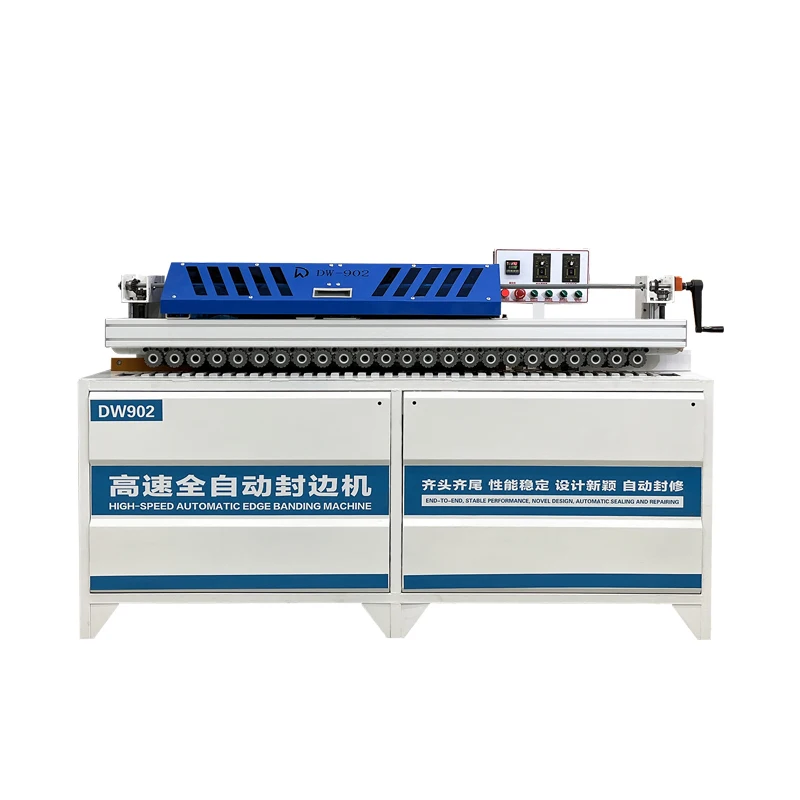
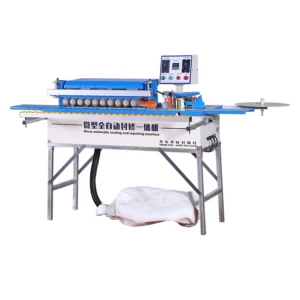
Ready-Stock Simplicity — DW902 units ship with confirmed voltage, language-matched controls, and pre-tested sample records so small workshops run production on day one.
Technical Specifications
| Parameter |
Value |
| Model |
DW902 |
| Product Type |
Automatic Edge Banding Machine |
| Total Power |
4000W |
| Voltage |
220V/380V/customization |
| Overall Dimensions (L×W×H) |
175×87×112 cm |
| Net Weight |
240 kg |
| Minimum Panel Length |
25 cm |
| Minimum Panel Width |
10 cm |
| Edge Banding Height |
5 cm |
| Edge Banding Thickness Range |
0.3–3 mm |
| Edge Feed Motor Power |
140W |
| Transmission Motor Power |
140W |
| Trimming Motor Power |
800W×2 |
| Trimming Spindle Speed |
24000 r/min |
| Polishing Motor Power |
380W×2 |
| Vacuum Power |
550W |
| Glue Pot Capacity |
4000 ml |
| Air Source Pressure |
0.5–0.8 MPa |
| Standard Functions |
Edge banding, trimming, polishing, automatic trimming, scraping, vacuuming |
| Design Feature |
Oblique and straight dual-purpose edge banding; double hot air design; feeding auxiliary slide plate; 4 groups of oblique pressure wheels; double row pressing wheels |
| Language Options |
Chinese and English standard; other languages customizable |
Application Suitability
| Application |
Material or Output |
| Cabinet door and carcass production |
MDF and particleboard with 0.3–3 mm PVC or veneer edge banding |
| Small-batch custom furniture |
Plywood and ecological board panels cut to varied dimensions |
| Home decoration joinery |
Solid wood board edge finishing in limited floor space environments |
| Workshop transition from manual trimming |
Mixed panel batches requiring single-operator workflow |
Why the Voltage Question Should Come Before the Price on an Automatic Edge Banding Machine in Stock
A machine wired for the wrong supply sits idle while you source a transformer — we verify voltage and frequency before the crate closes.
Small workshops ordering their first edge bander often focus on bed size and feed speed, leaving electrical compatibility as an afterthought. I have watched a cabinet maker in Southeast Asia receive a 380V unit when their shop ran on single-phase 220V, turning a fast-delivery purchase into a three-week delay [NEED_CITE: voltage and frequency standards by export market]. When you are evaluating an automatic edge banding machine in stock for quick dispatch, the conversation should start with what your workshop actually has at the panel, not what the catalogue lists as standard. The DW902 supports 220V, 380V, or custom configurations, and the confirmation happens at quotation stage — not on the dock.

Compact Footprint Without Sacrificing the Finishing Stations
The DW902 fits a banding, trimming, polishing, and scraping sequence into a 175 cm frame, which matters when a joinery shop is still running a sliding table saw and a drill press in the same bay. Entry-level machines sometimes drop scraping or polishing to keep the price down, forcing operators to hand-finish edges after the pass. This model keeps both stations integrated, so panels leave the outfeed side ready for assembly or packing without secondary bench work.
Small Panel Handling That Larger Models Overlook
Minimum panel width of 10 cm and minimum length of 25 cm put this machine in range for drawer sides, narrow shelving, and cabinet dividers that bigger edge banders simply drop off the feed chain. The feeding auxiliary slide plate and four groups of oblique pressure wheels hold shorter stock against the fence without the operator needing to jury-rig wooden extensions [NEED_CITE: small panel edge banding feed challenges]. For a workshop doing mixed custom work rather than long production runs of identical panels, that handling range determines how often the machine actually earns its floor space.
What the Trimming and Polishing Numbers Mean at the Bench
Two 800W trimming motors running at 24000 r/min produce a flush cut on both top and bottom edges in one pass, which is the difference between a visible glue line and a clean joint when panels meet at a corner. The 380W×2 polishing wheels follow immediately, taking off the micro-burrs that trimming leaves on PVC and melamine edges. Glue pot capacity of 4000 ml is sized for intermittent batch work rather than continuous line production — enough for a full morning of cabinet doors without stopping to reload adhesive, but not so large that glue degrades from sitting hot all week in a low-volume shop.
The Cost of Skipping Spare Parts on a First Machine
When a small shop buys a single edge bander without stocking trimming cutters or polishing wheels, the first worn consumable stops production entirely. I have seen a cabinet workshop down for five days waiting on a replacement cutter that should have been in the drawer beside the machine [NEED_CITE: edge bander consumable wear rates on MDF and particleboard]. The DW902 runs standard trimming and polishing consumables, but if you have none on hand, standard does not help you on a Friday afternoon with a delivery deadline. Every order should ship with a first-year spare parts kit matched to the materials you actually run.
Why Sourcing This Model Here Reduces Day-One Surprises
Pre-shipment testing runs your actual panel material through the machine before crating, so you receive a test record showing edge quality on your substrate rather than a generic factory sample. Voltage and plug configuration are documented on the electrical schematic before dispatch, eliminating the transformer scenario described above. Control panel language is set to your operator's requirement — English is standard, and other languages are configured before the machine leaves the floor [NEED_CITE: multilingual control panel configuration for export machinery]. The DW902 sits in a product family that extends upward, so when volume outgrows this footprint, the next model comes from the same supplier with familiar controls and spare parts overlap.
Documentation & Verification
- CE declaration of conformity matched to DW902 model and configuration
- Electrical schematic confirming your specified voltage and plug type before dispatch
- Factory test record showing edge banding results on your panel material and thickness
- Operation and maintenance manual in your chosen language with illustrated adjustment points
- Spare parts list identifying trimming cutters, polishing wheels, and feed chain components by part number
Installation, Commissioning & Support
- 175×87 cm footprint requires a level concrete floor with clearance on both infeed and outfeed sides
- 4000W total draw needs a dedicated circuit matching confirmed voltage at your panel
- Machine ships fully assembled; position, connect power and 0.5–0.8 MPa air supply, and run test panels
- Glue pot heating and double hot air system require initial temperature calibration for your banding material
- First-year spare kit covers trimming cutters, polishing wheels, and scraper blades based on your daily runtime
What to Share When Requesting a Quotation
Send the panel materials you run most often — MDF, particleboard, plywood, or solid wood — along with typical board thickness and edge banding thickness range. Confirm your workshop voltage and phase at the breaker panel, and specify the language your operator reads. If you have existing upstream equipment such as a sliding table saw or panel cutter, share the output dimensions so feed compatibility can be checked before the order is placed.
Frequently Asked Questions
Q: What is the smallest panel the DW902 can handle, and how does that compare to larger models?
A: Minimum panel dimensions are 25 cm length and 10 cm width, which covers drawer sides, narrow shelves, and cabinet dividers. Larger edge banders often require 30 cm or more on the feed chain, dropping small parts into a gap where they tilt or jam. If your work includes a high proportion of narrow components, this minimum size range keeps those parts on the machine rather than sending them to a hand-trimming bench.
Q: Can I order a single DW902 now and add more stations later as volume grows?
A: This model is a self-contained unit with banding, trimming, polishing, and scraping in one frame — stations are not modular add-ons. When throughput demands exceed what a single-operator machine can sustain, the next step is moving to a larger model in the same product family with higher feed speed and additional functions like pre-milling. The supplier relationship and spare parts overlap carry forward.
Q: What voltage and plug options are confirmed before dispatch?
A: The DW902 supports 220V, 380V, or custom voltage configurations, and the exact setup is confirmed at quotation stage against your workshop supply. An electrical schematic documents the wiring before the machine ships. This eliminates the scenario where a machine arrives configured for a supply the buyer does not have, requiring an external transformer or rewiring before first use.
Q: Which spare parts should I keep on hand for the first year?
A: Trimming cutters and polishing wheels are the primary consumables, and the quantity depends on your daily operating hours and the abrasiveness of your panel material. MDF wears trimming cutters faster than plywood. A first-year kit sized to your production volume ships with the machine so you are not waiting on replacement parts when the first cutter reaches end of life mid-run.
Q: How is the machine tested before it leaves the factory?
A: Each DW902 runs panel samples matching your specified material and thickness through a full banding, trimming, and polishing cycle before crating. You receive a factory test record documenting edge quality on your substrate, glue adhesion, and trimming flush. This is not a generic demonstration — it uses the same parameters your operator will set on day one of production.