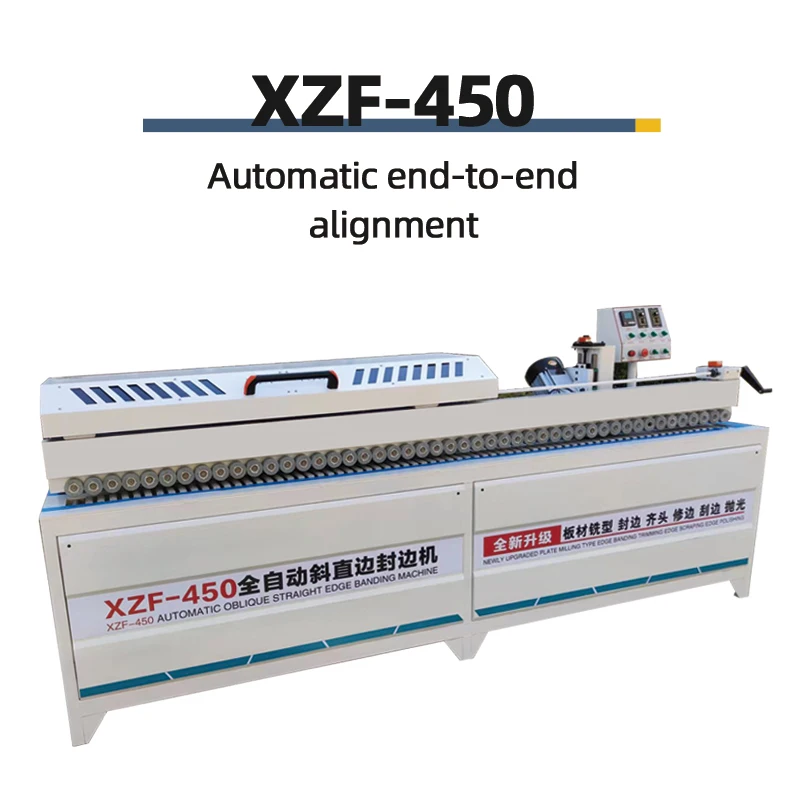
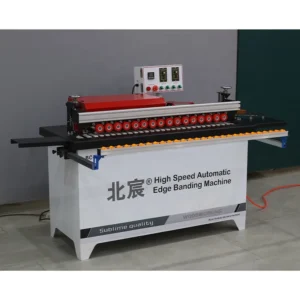
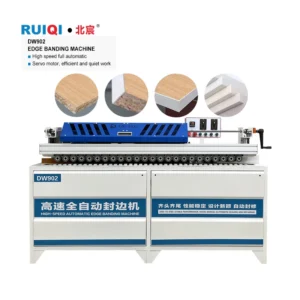
Compact Footprint — The XZF-450 is configured for small workshops where space and power limits rule out full-size production lines.
Technical Specifications
| Parameter |
Value |
| Model |
XZF-450 |
| Product Type |
45 Degree Automatic Edge Banding Machine |
| Total Power |
9.5 KW |
| Voltage |
380V / 415V |
| Feed Speed |
0–12 M/min |
| Pre-milled Motor |
4 KW |
| Trimming Power |
2.2 KW × 2 |
| Polishing Power |
0.4 KW × 2 |
| Vacuum Power |
550 W |
| Transmission Power |
180 W |
| Glue Pot Capacity |
4000 ml |
| Edge Banding Height |
0–50 MM |
| Edge Banding Thickness |
0.3–3 MM |
| Minimum Sheet Length |
30 CM |
| Minimum Sheet Width |
15 CM |
| Air Source Pressure |
0.5–0.7 Mpa |
| Overall Dimensions (L×W×H) |
300 × 65 × 135 CM |
| Net Weight |
430 KG |
| Standard Functions |
Plate milling, 30/45/60° edge banding, trimming, scraping, polishing, high-power vacuuming |
| Language Options |
Chinese, English (customizable to Spanish or other languages) |
| Plug Options |
EU, USA, AU, UK |
Application Suitability
| Application |
Material or Output |
| Custom cabinet door edging |
MDF and melamine-faced particleboard with PVC strip |
| Angled panel assemblies for furniture |
Plywood and blockboard requiring 45° bevel banding |
| Small-batch shelving and carcass production |
Particleboard and MDF with 0.3–3 MM melamine or veneer tape |
| Polymer door profile finishing |
Polymer composite panels with matching edge band |
| Joinery startup transitioning from hand trimming |
Solid wood boards and plywood up to 50 MM edge height |
Why the Voltage Question Must Come Before the Order
Confirming local voltage and frequency before production avoids a machine that sits idle on arrival.
I have seen small workshops receive edge banders wired for 380V/50Hz only to find their local supply runs 415V/60Hz — the motors overheat within the first week, and the glue pot thermostat drifts outside its set range. The 45 Degree Edge Banding Machine for Small Workshop ships with configurable voltage, but that option only works if the correct supply is confirmed during the quotation stage. Rushing past this step to meet a shipping deadline creates a problem that no amount of on-site troubleshooting can fix [NEED_CITE: voltage and frequency standards by export market].

Single-Pass Workflow at Workshop Scale
This 45 Degree Edge Banding Machine for Small Workshop completes pre-milling, gluing, end trimming, rough and fine trimming, scraping, polishing, and dust extraction in one feed cycle. For a joinery startup moving away from hand-held routers and contact cement, consolidating these steps into a single pass removes the inconsistency that comes from handling each panel multiple times across different benches.
Angle Flexibility Without a Second Machine
The adjustable 30/45/60 degree banding support means a small cabinet maker can produce beveled edges for angled carcase joints and standard 90-degree edges on the same machine. Switching between angles is a setup adjustment rather than a tooling change, which matters when batch sizes are small and the next panel may require a completely different profile [NEED_CITE: CE machinery directive requirements for edge banding equipment].
What the Spec Sheet Numbers Actually Mean on the Floor
The 4 KW pre-milling motor removes a thin layer from the panel edge before glue application — this is what keeps the glue line invisible on particleboard and MDF, substrates where a raw sawn edge would otherwise show through the banding tape. The 0–12 M/min feed speed range is deliberately moderate; at small-batch volumes, a controlled feed gives the operator time to inspect edge adhesion and trim quality in real time rather than chasing throughput. The 4000 ml glue pot holds enough adhesive for a full shift of intermittent runs without constant refills, and the 2.2 KW × 2 trimming motors provide enough torque to clean-cut PVC and veneer tape without chipping on the exit side. Edge banding thickness coverage from 0.3 to 3 MM means the machine handles everything from thin melamine tape to thicker solid-wood lipping strips.
The Cost of Skipping the Material Question
Recommending an entry-level edge bander without asking what substrate the customer actually runs is a mistake I have watched play out more than once. High-density particleboard wears trimming blades far faster than standard MDF, and a machine configured for light-duty use will show visible glue lines on denser boards within the first production run. When the blade dulls, the scrape station cannot compensate, and panels start coming off the line with rough edges that fail assembly inspection. The XZF-450 handles these substrates, but only if the blade spec and feed rate are matched to the material before the first batch runs [NEED_CITE: substrate density effects on trimming blade life].
Why Source This Machine Here
In-house manufacturing with patented cutting mechanisms means tolerance claims are backed by verifiable production records, not brochure figures. The product family spans entry-level to full-function models, so a workshop that outgrows this unit can move to a higher-tier machine from the same supplier without re-learning the control interface. Voltage, plug type, and control panel language are configured as standard options rather than special requests. A four-stage quality control process covers incoming material, in-process assembly, finished product, and pre-shipment verification. Engineer-led configuration means the quotation arrives with a specific setup recommendation based on the buyer's stated panel materials and production volume, typically within 24 hours.
Documentation & Verification
- CE declaration of conformity covering the XZF-450 electrical and mechanical safety requirements
- ISO 9001 certificate for the manufacturing quality management system
- Machine specification sheet with confirmed voltage, plug type, and language
- Factory test record run on your specified panel thickness and edge banding material
- Electrical schematic and voltage confirmation document for local electrician reference
- Operation and maintenance manual in the agreed language with spare parts list
Installation, Commissioning & Support
- Requires a level concrete floor supporting 430 KG concentrated load across the 300 CM frame length
- Dedicated 380V/415V three-phase circuit with appropriate breaker rating for the 9.5 KW total draw
- Arrives partially assembled; feed chain and polishing hoods require on-site alignment
- First-run commissioning includes glue pot temperature calibration and trimmer adjustment for your banding tape
- Operator training covers feed speed selection for different panel materials and angle setups
- Wear items list provided: trimming blades, scraper inserts, and polishing wheels with reorder codes
- Compressed air supply at 0.5–0.7 Mpa required; air line sizing confirmed before dispatch
What to Include in Your Inquiry
To get a configuration that matches your actual production, share the panel materials you run most often, the edge banding tape type and thickness, and your local voltage and frequency. If you are replacing a manual process, let us know your current daily panel count and available floor space so we can confirm whether this footprint fits your layout.
Frequently Asked Questions
Q: What is the smallest workshop footprint this machine requires and what are the installation conditions?
A: The XZF-450 measures 300 × 65 × 135 CM and weighs 430 KG. You need a level concrete floor, a dedicated three-phase circuit matching the confirmed voltage, and compressed air at 0.5–0.7 Mpa. Allow clearance on the infeed and outfeed sides for panel handling and operator access during setup and trimming inspection.
Q: Can I start with basic 90-degree edge banding and add 45-degree capability later?
A: The 30/45/60 degree angle support is built into the machine from the start. You do not need to add hardware later. If your initial production only requires straight 90-degree edges, you can use the angle adjustment when beveled panels enter your order book without any retrofit.
Q: How do I confirm the correct voltage and plug type for my country before ordering?
A: The machine supports 380V and 415V configurations with EU, USA, AU, and UK plug options. Provide your local supply voltage, frequency, and plug standard during the quotation stage so the electrical system is built to match and verified in the pre-shipment test.
Q: What does the upgrade path look like as production volume grows?
A: The product family includes higher-tier models with faster feed speeds and additional finishing stations. Because the control interface and operating logic carry across the range, operators transition without retraining. Your existing tooling setups and maintenance routines transfer directly to the next machine up.
Q: Is sample edge banding testing available before I commit to an order?
A: Yes. Send your actual panel material and preferred edge banding tape to the factory for a processing test. The sample run verifies glue adhesion, trim quality, and scrape finish on your specific substrate before the machine enters production and ships.