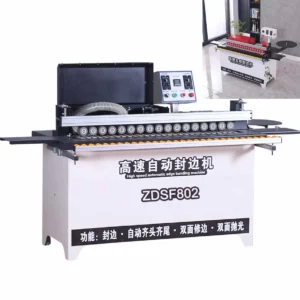
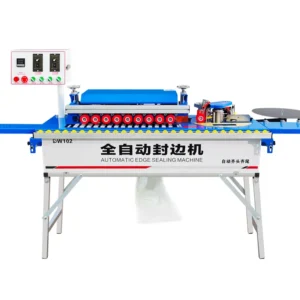
Stocked for Dispatch — Voltage and plug verified before crate closes, preventing the on-site failures that stall small workshop commissioning.
Technical Specifications
| Parameter |
Value |
| Product Type |
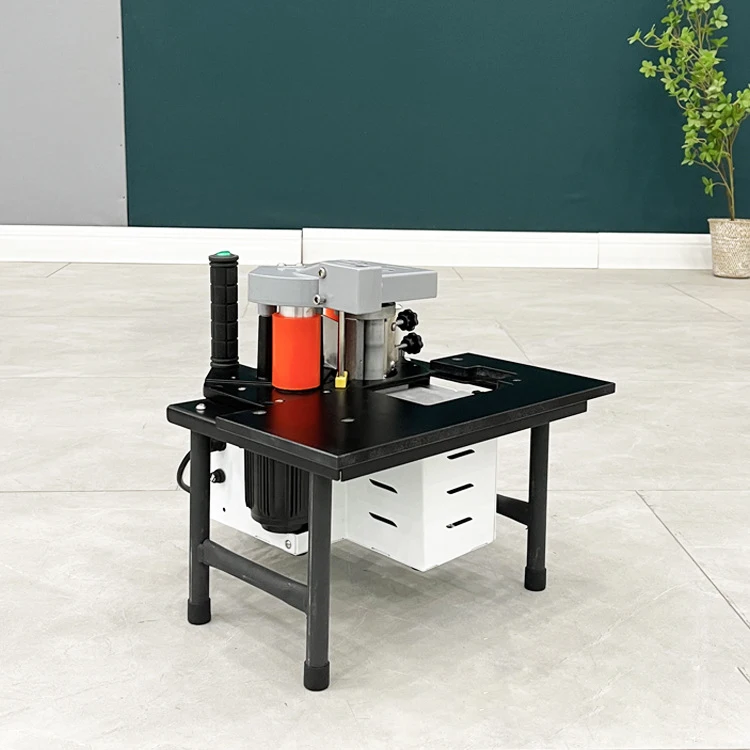
Portable Edge Banding Machine |
| Shape of Edge-banding Plates |
Curved, Straight, and Special-shaped Sheet |
| Edge Thickness Range |
0.3–3 mm |
| Edge Sealing Speed |
0–6 m/min |
| Edge Sealing Height (Panel Thickness Range) |
7–60 mm |
| Gluing Method |
Double-sided gluing |
| Glue Pot Volume |
1000 ml |
| Machine Weight |
14 kg |
| Plug Options |
EU / AU / UK / USA / CN |
| Control System |
Manual / handheld operation |
| Assembly State |
Fully assembled, portable unit |
| Warranty |
1 year |
Application Suitability
| Application |
Material or Output |
| Joinery workshop transitioning from manual edge banding |
MDF and plywood panels with PVC or veneer banding |
| Custom furniture prototyping and small-batch runs |
Particleboard and solid wood panels with curved or shaped edges |
| On-site carpentry and installation finishing |
Pre-cut boards requiring portable edge finishing at job sites |
| Cabinet door and drawer front edging |
MDF stock with 0.3–3 mm PVC banding on straight and radiused edges |
The Voltage Mistake That Costs You Two Weeks on Site
Confirm your local supply before the machine leaves the factory, not after it arrives.
I have watched a compact edge bander sit idle on a Dubai workshop floor for fourteen days because the unit shipped with a 380V configuration into a 415V three-phase supply. The inverter tripped on first power-up, and a step-down transformer had to be air-freighted at the buyer's cost. Every cabinet order in that shop backed up until the correct voltage was restored [NEED_CITE: voltage and frequency standards by export market]. With a portable edge banding machine in stock, the electrical check is straightforward — single-phase household supply covers this class of equipment, and plug type is selected at dispatch. The risk is not the machine itself but the assumption that "standard" voltage means the same thing in every market.

What a Compact Footprint Actually Buys Your Workshop
For a joinery startup moving from hand-applied banding to a consistent machine finish, floor space is often the first constraint. This portable edge banding machine in stock weighs 14 kg and operates from a benchtop or mobile stand, meaning you can relocate it between workstations or carry it to a job site. The 1000 ml glue pot holds enough adhesive for intermittent runs without frequent refills, and double-sided gluing applies bond to both the panel edge and the banding strip simultaneously — a step that eliminates the uneven adhesion common with manual iron-on methods.
Honest Positioning for Light-Duty and Prototype Work
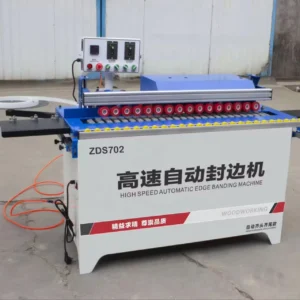
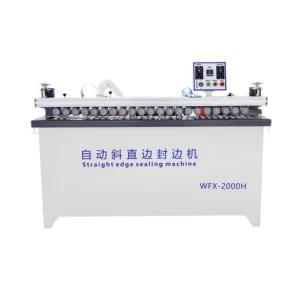
Entry-level machines are sometimes pushed into production volumes they were never engineered for, and that mismatch shows up as motor overheating and inconsistent feed pressure. This unit is explicitly positioned for low-volume curved and shaped edging — prototype batches, one-off custom pieces, and on-site finishing where a full-size automatic line is impractical. When your throughput grows beyond what a handheld feed rate can sustain, the logical next step is a benchtop or floor-standing automatic edge bander from the same product family, keeping your operator training and glue chemistry consistent across the transition [NEED_CITE: equipment scaling considerations for small furniture workshops].
Reading the Specs That Actually Matter at the Bench
The 0.3–3 mm edge thickness range covers the majority of PVC and veneer banding used in cabinet and furniture production — anything outside this window typically requires a dedicated heavy-duty trimming station found only on automatic lines. Panel thickness capability from 7 to 60 mm accommodates standard MDF, plywood, and particleboard stock used for carcass panels, shelving, and door fronts. Feed speed up to 6 m/min is deliberate: at this scale, the operator controls feed rate by hand, which allows real-time adjustment around curves and radiused edges where a fixed-speed roller feed would cause banding lift. The manual control system keeps commissioning simple — no PLC configuration, no parameter menus to navigate before first use.
When the Wrong Configuration Reaches Your Dock
A portable edge banding machine in stock ships fast, but speed means nothing if the plug does not fit your wall socket or the manual arrives in a language your operator cannot read. Commissioning stalls, the banding material is wasted during trial runs, and the project timeline slips [NEED_CITE: CE machinery directive requirements for industrial equipment]. Beyond the plug itself, operating without the correct language on the control reference means maintenance intervals are missed and glue pot temperature is guessed rather than set — both of which produce edge adhesion failures that only surface when the assembled furniture reaches the end customer.
Why Procurement Lands Here
Voltage and plug configuration are confirmed order-by-order rather than assumed from a regional default, which eliminates the transformer-air-freight scenario described above. Pre-shipment testing records document glue application and edge adhesion on your specified panel thickness before the crate closes. The machine arrives fully assembled — no bench alignment, no belt tensioning, no wiring verification on your floor. A one-year warranty with spare parts list ships inside the crate, so consumable and wear components are identifiable from day one. Factory visits are welcomed before or after order placement, and engineer-led configuration recommendations are provided within 24 hours of inquiry.
Documentation & Verification
- CE declaration of conformity covering portable edge banding equipment class
- Factory test record on your panel thickness and edge banding material before dispatch
- Electrical schematic confirming voltage, frequency, and plug type as built
- Operation and maintenance manual supplied in the agreed language at shipment
- Spare parts list with part numbers for glue pot, feed rollers, and trimming accessories
Installation, Commissioning & Support
- Benchtop or floor stand placement — no dedicated foundation or anchoring required for 14 kg unit
- Single-phase power connection using the confirmed regional plug; no dedicated circuit breaker panel needed
- Arrives fully assembled; operator can begin glue pot heat-up and first test run on day of delivery
- Glue pot temperature and feed pressure adjusted manually during commissioning for your specific banding material
- One-year warranty covers mechanical and electrical components with documented spare parts list in crate
Before You Request a Quote
Let us know your workshop's supply voltage and frequency so the correct plug and internal wiring are matched before dispatch. Tell us which panel materials and edge banding thicknesses you run most often — this determines whether the 0.3–3 mm range covers your full scope or whether a secondary automatic unit is needed for heavier stock. If you are planning a phased equipment investment, describe your current daily output so we can position this portable edge banding machine in stock as a bridge solution with a defined upgrade path.
Frequently Asked Questions
Q: Is this portable edge bander in stock and ready to ship?
A: Stocked units are available for dispatch with lead times that are confirmed at order placement. Before shipment, each unit undergoes pre-dispatch testing on the buyer's specified panel thickness and edge banding material, and voltage and plug configuration are verified to match the destination country's supply standard.
Q: What voltage and plug options are available for my country?
A: The unit supports single-phase supply with plug options including EU, AU, UK, USA, and CN configurations. Voltage and frequency are confirmed directly with each buyer before the machine is wired and packed, preventing the on-site inverter failures that occur when assumptions are made about local supply standards.
Q: Can this machine handle curved edges, and what is the minimum radius?
A: Yes — the machine is rated for curved, straight, and special-shaped edges within the 0.3–3 mm banding thickness and 7–60 mm panel thickness range. Minimum practical curve radius depends on banding stiffness and operator feed control, which is adjusted by hand rather than a fixed-speed roller system.
Q: What is the upgrade path when my production volume outgrows a portable unit?
A: The product family includes benchtop and full-function automatic edge banders that share the same glue chemistry and operator workflow principles. Transitioning keeps your consumable supply chain intact while adding fixed-speed feed, pre-milling, and multi-station trimming for higher daily throughput.
Q: Does the machine arrive fully assembled, and what glue type should I use?
A: The unit ships fully assembled and requires no bench alignment or wiring on arrival. The 1000 ml glue pot is compatible with standard hot-melt EVA adhesives commonly used for PVC and veneer banding; specific glue temperature and open-time recommendations are included in the operation manual supplied with the machine.