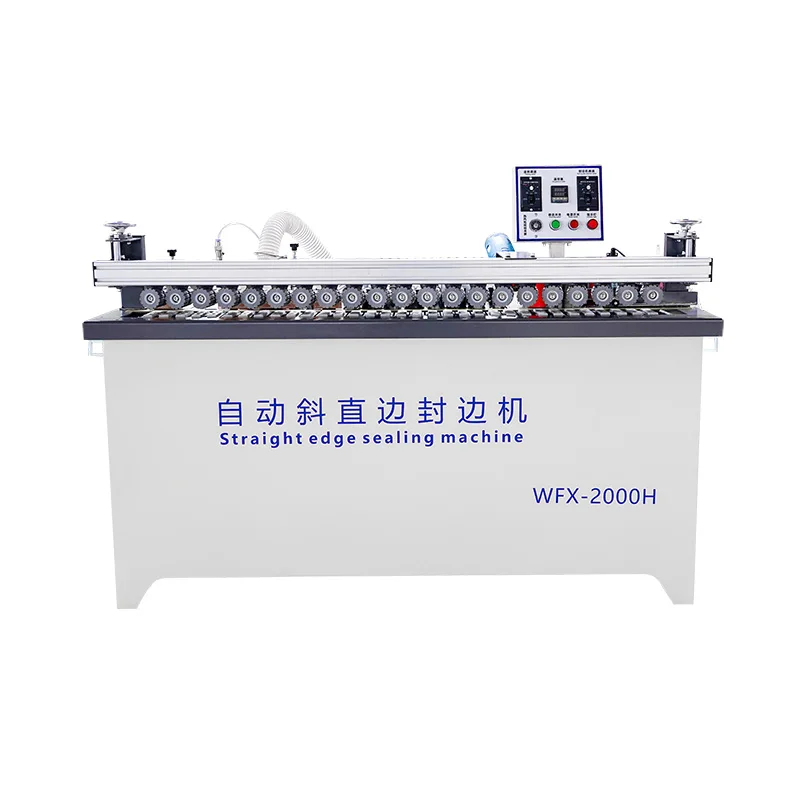
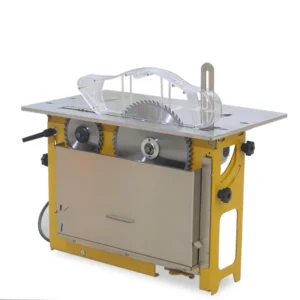
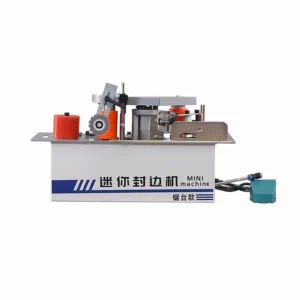
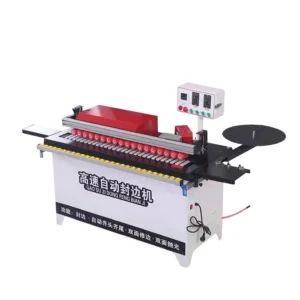
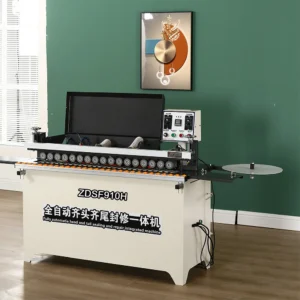
Ready to Ship — This unit sits on the floor tested, crated, and waiting for voltage confirmation before it leaves the warehouse, cutting typical multi-week lead times down to days for small workshops needing their first automatic edge banding machine in stock.
Technical Specifications
| Parameter |
Value |
| Model |
WF-2000 (WF-2000H variant also available with same functions and configurations, more sturdy build) |
| Product Type |
Automatic Edge Banding Machine |
| Overall Dimensions (L×W×H) |
2100×600×630 mm (WF-2000); 2100×600×1100 mm (WF-2000H) |
| Net Weight |
137 kg (WF-2000); 149 kg (WF-2000H) |
| Rated Voltage |
220V (frequency to be confirmed with buyer) |
| Rated Power |
6.17 kW |
| Rated Air Pressure |
0.4–0.6 MPa |
| Plate Feeding Speed |
0–14 m/min |
| Panel Thickness Range |
18–25 mm |
| Edge Strip Thickness |
up to 1.2 mm |
| Feed Mechanism |
Automatic plate feeding with stable transmission |
| Gluing Method |
Hot air heating throughout process |
| Trimming |
Elastic profiling trimming (no damage to plate) |
| Pressing |
8 pressing rollers |
| Additional Functions |
Slotting, edge banding, polishing |
| Dust Extraction |
Self-contained vacuum device |
| Pressure Beam |
Aluminum alloy, manually adjustable up and down |
| Warranty |
One year |
Application Suitability
| Application |
Material or Output |
| Small custom cabinet shop |
MDF and plywood panels with PVC edge banding |
| Joinery workshop transitioning to machine edge finishing |
Particleboard with veneer edge strip |
| Startup furniture maker with limited floor space |
Solid wood panels up to 25 mm thickness |
| On-site mobile woodworking operation |
Compact footprint requiring portable edge bander under 150 kg |
Why the Voltage Question Comes Before Everything Else
Confirm your workshop's single-phase supply matches the machine nameplate before the crate leaves the factory — not after it arrives.
I spent years running quality checks on lines in Dubai and Riyadh, and the pattern is always the same. A small joinery shop orders its first automatic edge banding machine in stock from an overseas supplier, the price looks right, and the container ships. Two weeks later the electrician plugs it in and the motor windings burn out within minutes because the local grid runs 230V at 60 Hz while the machine was built for 220V at 50 Hz [NEED_CITE: voltage and frequency standards by export market]. The shop owner then waits for an air-freighted step-down transformer while a cabinet order deadline slips past. Locking down voltage and frequency on paper before production starts is the single cheapest insurance policy a buyer can get.

Small Footprint, Full Workflow in One Pass
A workshop with under fifty square metres of production floor does not have room for separate glue pots, trim stations, and dust collectors hooked together with hose runs. The WF-2000 packs gluing, pressing, profiling trim, and polishing into a 2.1-metre frame that one person can wheel into position. Hot-air heating keeps the adhesive at working temperature across the full feed path, so edge bond strength stays consistent from the first panel to the last without a separate pre-heating station.
Dispatch Speed Without Sacrificing Pre-Shipment Checks
Stocking a compact edge bander means the unit has already run through the factory's four-stage QC cycle — incoming material inspection, in-process checks, finished product verification, and a pre-shipment test on actual panel stock. When a buyer asks for an automatic edge banding machine in stock, the lead time collapses from build-plus-test to crate-and-ship. The machine arrives with a factory test record showing how it performed on the panel thickness range the buyer specified, not a generic pass stamp.
Reading the Numbers That Actually Matter on the Shop Floor
The 18–25 mm panel thickness range tells a cabinet maker exactly which stock this machine will handle: standard 18 mm MDF for carcase sides, 25 mm shelving, and most plywood used in wardrobes. Anything below 18 mm will not engage the pressure beam firmly enough for clean trimming. The 0–14 m/min feed speed is variable, letting the operator slow down on curved or short off-cuts and open up on long runs of straight shelving. Eight pressing rollers spread contact force evenly across the edge strip, which matters when banding 1.2 mm PVC — fewer rollers leave high and low spots that show up under raking light after assembly. The elastic profiling trimmer follows the panel contour rather than shearing flat, so it will not gouge into melamine faces or thin veneer substrates [NEED_CITE: edge trimming methods and surface protection in panel processing].
What Happens When a Small Shop Buys the Wrong Entry Point
Ordering a machine with a larger panel range or higher feed speed than the shop actually needs sounds like planning ahead, but it often backfires. Bigger machines draw more current, sometimes pushing a small workshop's single-phase supply past its breaker rating. They also weigh significantly more, meaning the unit cannot be moved for floor cleaning or repositioned when the shop adds a second saw. When the operator only runs 18 mm MDF with PVC banding, paying for a model rated for 50 mm solid wood is wasted capacity that sits idle and complicates maintenance [NEED_CITE: equipment oversizing risks in small-scale manufacturing].
Why Sourcing This Unit Through the Stock Channel Makes Sense
Every machine leaves the floor with voltage confirmed in writing — the 220V rating is matched to the buyer's declared supply before the crate is sealed. The WF-2000 and its heavier WF-2000H variant share the same function set, so a buyer can choose the sturdier build without re-learning controls. Hot-air gluing, profiling trim, and built-in vacuum are all standard, meaning no auxiliary equipment purchases are needed to start producing finished panels. A one-year warranty backs the mechanical and electrical assemblies, and spare parts lists ship inside the crate so the operator knows what to reorder before consumables run dry.
Documentation & Verification
- CE declaration of conformity matching the WF-2000 export configuration
- ISO 9001 certificate covering the manufacturing facility
- Electrical schematic confirming 220V wiring and breaker ratings
- Factory test record run on buyer-specified 18–25 mm panel stock
- Operation and maintenance manual in the agreed operator language
- Spare parts list with reorder codes for glue rollers and trim blades
Installation, Commissioning & Support
- Requires a dedicated 220V circuit rated above the 6.17 kW draw with proper earthing
- 137 kg base model can be positioned by two people; WF-2000H at 149 kg may need a pallet jack
- Manual pressure beam adjustment covers 18–25 mm; set once per batch thickness change
- Self-contained vacuum unit plugs into the machine — no external ductwork required
- 0.4–0.6 MPa air supply needed; connect a standard workshop compressor with moisture trap
- First-run parameter sheet included for PVC and veneer banding at common feed speeds
What to Share Before Requesting a Dispatch Quote
Send your workshop's confirmed voltage and frequency, the panel materials you run most often, and the edge strip types in your current job book. Note your available floor space and whether the machine needs to pass through a standard doorway on arrival. If your operator reads a language other than English, specify it upfront so the control panel labels and manual match.
Frequently Asked Questions
Q: Is this machine in stock and how fast can it ship?
A: The WF-2000 is held as an automatic edge banding machine in stock and can dispatch once voltage and manual language are confirmed in writing. Typical preparation includes a pre-shipment test on your specified panel thickness, then crating. Exact ship dates depend on your destination port and chosen freight method, which the quotation will state clearly.
Q: Does the 220V rating match my country's single-phase supply?
A: Many markets run 220V, 230V, or 240V at either 50 Hz or 60 Hz. The machine is built to the 220V rating, so share your local grid specification before dispatch. If a mismatch exists, the factory can advise on a compatible transformer or adjust the motor winding configuration where possible.
Q: What edge banding materials does the WF-2000 handle?
A: The machine processes PVC and veneer edge strips up to 1.2 mm thick. Hot-air gluing provides consistent adhesion across MDF, plywood, particleboard, and solid wood panels within the 18–25 mm thickness range. ABS banding compatibility depends on the specific glue cartridge loaded; confirm with the supplier before ordering consumables.
Q: How do I assemble and commission the unit on arrival?
A: The machine ships as a single assembly — no major sub-frame bolting is required. Connect the dedicated 220V circuit, attach the compressed air line at 0.4–0.6 MPa, and run the included first-run parameter sheet. The operation manual covers glue temperature settings, feed speed adjustment, and trimmer alignment in your agreed language.