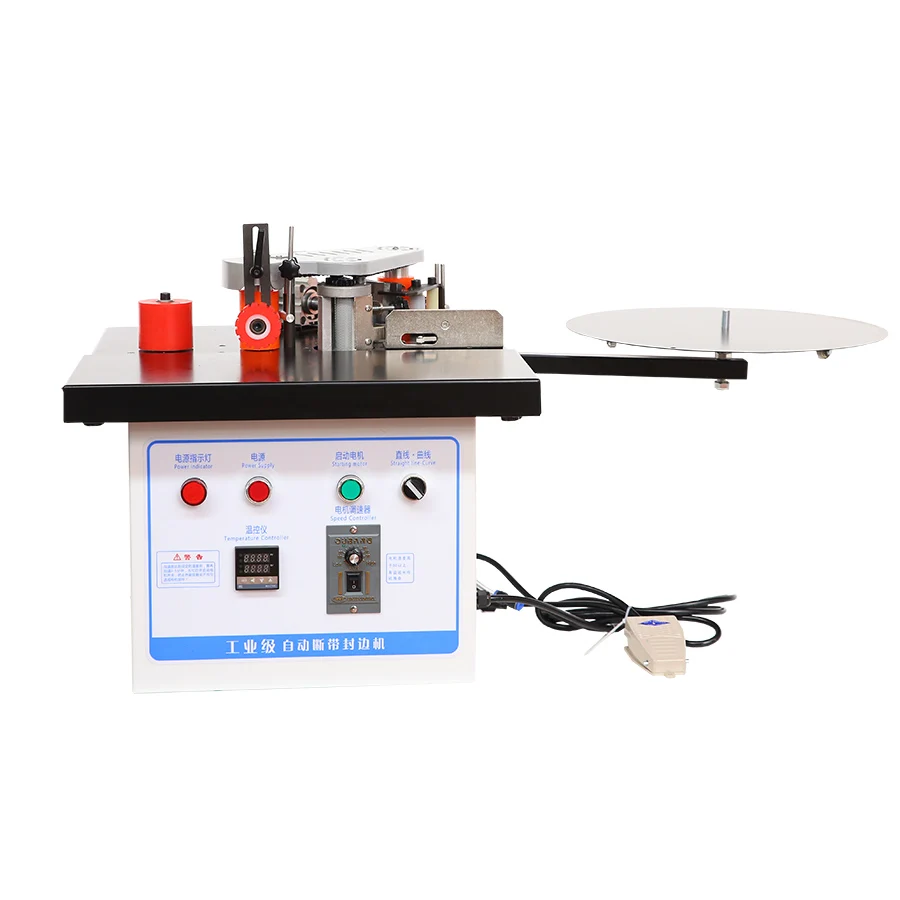
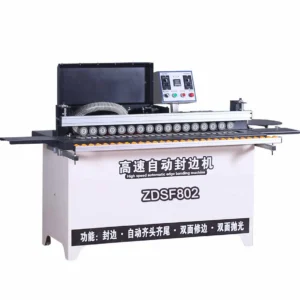
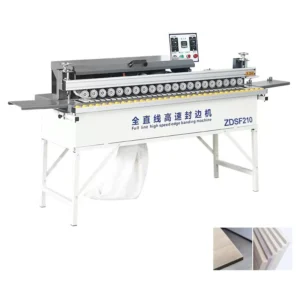
Ready-stock availability — confirmed 220V units prepared for fast dispatch, each verified on bench before crating.
Technical Specifications
| Parameter |
Value |
| Product Type |
Mini Edge Banding Machine |
| Model |
ZDSF50 Mini Edge Banding Machine |
| Function |
Double side gluing for Straight, Curved and Shaped Edges |
| Rated Voltage |
220V |
| Power |
1.2kW |
| Rated Air Pressure |
0.4-0.6 MPa |
| Strip Thickness Range |
0.5-1.5 mm |
| Sheet Thickness Range |
10-60 mm |
| Glue Pot Capacity |
1000 ml |
| Heating Time |
5-10 min |
| Edge Banding Speed |
0-6 m/min |
| Overall Dimensions (L×W×H) |
54×54×56 cm |
| Machine Weight |
26 kg |
| Glue Application |
Glue-coated rollers, double-sided |
| Pressure Rollers |
Adjustable, rubber material |
| Strip Transport |
Adjustable bayonet according to edge strip height |
| Belt Breaking |
Pneumatically controlled, foot switch for curved edges; automatic travel switch for straight edges |
| Heating System |
4 heating tubes |
Application Suitability
| Application |
Material or Output |
| Small workshop straight edge banding |
MDF and particleboard panels 10-60 mm thick with PVC strips 0.5-1.5 mm |
| Curved cabinet door edge finishing |
Plywood and shaped MDF profiles with veneer or PVC banding |
| Joinery startup edge processing |
Solid wood panels and blockboard with standard PVC edge strips |
| Secondary backup edge bander for small cabinet shops |
Mixed board materials on low-volume custom runs |
Why the Voltage Question Should Come Before the Price on Any Mini Edge Banding Machine in Stock
A machine that cannot plug into your workshop's supply is dead weight on arrival.
Last month I shipped an edge bander to an Indonesian customer with the control panel set to default English. The operator could not read the interface, and commissioning stalled for two days while we sorted out a language pack remotely. That was not a machine fault — it was a preparation fault. The same principle applies to voltage. Before you look at any Mini Edge Banding Machine in stock, confirm that 220V matches your local supply and that the frequency is compatible [NEED_CITE: voltage and frequency standards by export market]. A unit that is otherwise perfectly suited to your workload becomes a costly mistake if it arrives and trips your breaker or burns out a motor within the first week.
Fast Dispatch Without Cutting the Preparation Steps
Holding inventory means a unit can leave the warehouse quickly, but speed only matters if the machine arrives ready to run. Each ZDSF50 Mini Edge Banding Machine is tested on a sample panel before packing, with the glue pot brought up to temperature and the feed path verified on the actual strip thickness you specify. A unit tagged as Mini Edge Banding Machine in stock still goes through the same pre-shipment checks as a built-to-order unit. The difference is lead time, not inspection depth.
Language and Controls Confirmed Before Crating
The control panel on this unit is straightforward — a few switches and a temperature dial — but labels and indicators still need to match what your operator reads natively. When I now process a stock order, I confirm the language requirement at the same time I confirm voltage. This takes an extra ten minutes on the quotation stage and saves days of confusion on the workshop floor [NEED_CITE: operator interface language requirements in export markets].
Reading the Specs That Actually Matter for a Compact Edge Bander
The 1000 ml glue pot with four heating tubes reaches working temperature within five to ten minutes, which suits short-run production where you cannot afford to wait half an hour for the adhesive to melt before your first panel. The sheet thickness range of 10-60 mm covers most standard furniture boards, but if you regularly run 6 mm backs or 80 mm solid timber tops, this unit sits outside those boundaries. The adjustable bayonet for strip transport means the operator sets the guide height to match the edge strip, keeping the strip square to the panel face — a small adjustment that determines whether the finished edge sits flush or overhangs. The pneumatic belt breaking, controlled by a foot switch on curved work, leaves both hands free to guide the panel, which matters when you are following an irregular contour.

What Happens When a Small Workshop Buys the Wrong Edge Bander Class
A joinery shop moving from hand-applied edge banding to a machine often underestimates the volume they will push through within a year. A unit rated for intermittent use ends up running daily production shifts, and wear on the glue rollers and pressure bearings accelerates beyond what the design intended [NEED_CITE: equipment duty cycle versus actual workshop usage patterns]. The ZDSF50 is built for low-volume custom work and startup operations. If your daily output consistently exceeds what a compact manual-feed edge bander can handle, the right call is to step up to a full automatic line machine rather than push a small unit past its design envelope.
Why Procurement Through This Channel Works for Stock Orders
Each ZDSF50 unit in inventory has its specification sheet and electrical schematic on file, so you can review the wiring diagram against your local supply before committing. The four-stage QC process applies to stock units the same way it applies to production runs — incoming material inspection, in-process assembly checks, finished product testing, and a final pre-shipment verification with photographs. Custom voltage confirmation is handled at the quotation stage, not left to chance at the dock. Operation and maintenance manuals are prepared in the language you specify, and a spare parts list ships with every unit so you know exactly which consumables to reorder and when.
Documentation & Verification
- CE declaration of conformity covering the ZDSF50 Mini Edge Banding Machine
- Machine specification sheet with confirmed 220V electrical data and 1.2kW rating
- Electrical schematic showing wiring layout and component identification
- Factory test record on your specified sheet thickness and strip material before dispatch
- Operation and maintenance manual in the agreed language with the unit
- Packing photographs showing crate condition and accessory placement before collection
Installation, Commissioning & Support
- Requires a dedicated 220V circuit rated for at least 1.2kW continuous draw with proper earthing
- Compact 54×54×56 cm footprint fits a standard bench or small floor stand without special foundations
- Arrives assembled — operator mounts the glue pot, loads the strip reel, and connects the air supply at 0.4-0.6 MPa
- First-run commissioning includes setting the adjustable bayonet to match your strip height and verifying roller pressure on your actual panel stock
- Glue pot heating tubes and rubber pressure rollers listed on the spare parts sheet with reorder intervals
- Daily maintenance limited to glue residue wipe-down and roller inspection after each shift
What to Include with Your Inquiry
Send the sheet materials and thicknesses you plan to run most often, along with the PVC or veneer strip thickness range. Confirm your workshop voltage and frequency so the unit can be verified against your supply before dispatch. If your operators require a specific language on documentation, note that at inquiry stage so the manual is prepared in time.
Frequently Asked Questions
Q: What voltage options are available and is 220V compatible with my country's supply?
A: The ZDSF50 is stocked at 220V. Before ordering, share your local voltage and frequency so we can confirm direct compatibility or discuss adjustment options. Running a 220V unit on a mismatched supply risks motor damage and voids the warranty, so verification happens at the quotation stage, not after delivery.
Q: How do I band curved and shaped edges with this mini unit?
A: The pneumatic belt breaking system includes a foot switch that lets you control the strip cut-off hands-free while guiding the panel along a curve. Set the adjustable bayonet to match your strip height, feed slowly, and follow the contour with steady pressure against the rubber rollers. Practice on an offcut first to judge the feed rhythm.
Q: What is the lead time from order to dispatch for a single unit?
A: Stock units are prepared for dispatch once voltage and language requirements are confirmed, documentation is prepared, and the pre-shipment test is completed on your specified material. Typical turnaround is measured in days rather than weeks, though exact timing depends on current inventory levels and the complexity of your language and documentation requirements.
Q: What glue types are compatible with the 1000 ml glue pot?
A: The four-tube heating system is designed for standard EVA hot-melt adhesives commonly used in edge banding. The glue pot reaches working temperature within five to ten minutes. Consult the adhesive manufacturer's data sheet for the recommended application temperature, and adjust the pot thermostat accordingly to match your specific EVA grade.
Q: Can this mini unit handle my production volume, or should I consider a larger model?
A: The ZDSF50 is designed for small workshops, custom furniture makers, and joinery startups handling low-volume and intermittent runs. If your daily throughput involves continuous straight-edge production across multiple shifts, a full-function automatic edge bander with higher feed speed and additional trimming stations will serve your output better over time.