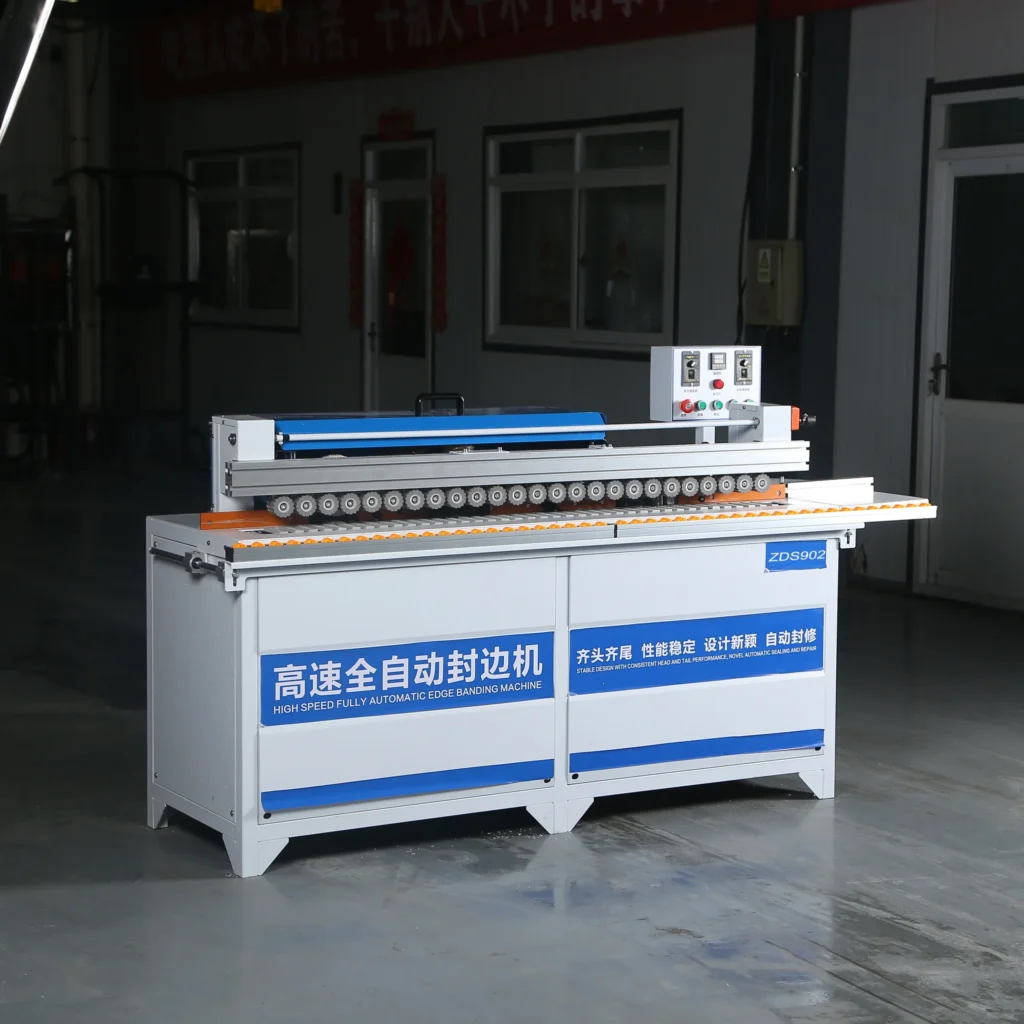
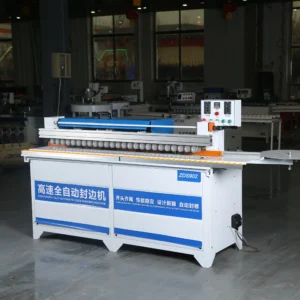
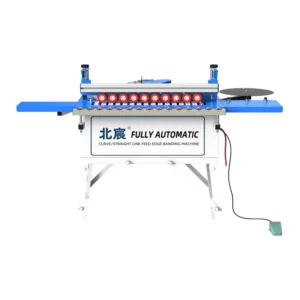
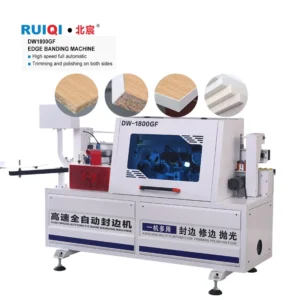
Ready Stock Dispatch — Compact automatic PVC edge banding machine held in stock for fast order and dispatch, sized specifically for small workshops stepping up from manual edge finishing.
Technical Specifications
| Parameter |
Value |
| Product Type |
Automatic PVC Edge Banding Machine |
| Voltage |
220V |
| Total Power |
4200W |
| Overall Dimensions (L×W×H) |
207×60×122 cm |
| Net Weight |
245 kg |
| Edge Banding Type |
Linear Edge Banding Machine |
| Edge Band Height Range |
0–35 mm |
| Edge Band Thickness Range |
0.5–2.5 mm |
| Glue Pot Capacity |
4000 ml |
| Pressure System |
Integrated pressure beam with double rows of pressure wheels |
| Conveyor Belt Material |
Silicone |
| Edge Strip Cutting Device |
Pneumatically controlled |
| Polishing Configuration |
Up and down dual polishing motors |
| Trimming Configuration |
Double high-speed trimming motors (top and bottom) |
| Control System |
Intelligent temperature control |
| Key Features |
High-speed sealing and repair, double-sided gluing, independent operating platform |
Application Suitability
| Application |
Material or Output |
| Custom cabinet door edge finishing |
MDF and particleboard panels with PVC edge banding |
| Small-batch wardrobe panel processing |
Plywood panels with 0.5–2.5 mm PVC strips |
| Joinery workshop first-machine upgrade |
Flat panel stock transitioning from hand-held edge banders |
| Low-to-medium volume furniture production |
Standard board thicknesses with linear edge profiles |
Why Voltage Confirmation Matters Before You Place the Order
A machine that cannot run on your local supply is not a bargain — it is dead weight on the workshop floor.
I have watched small workshop owners lose weeks waiting for a transformer or rewiring after a machine arrived with the wrong voltage specification. The frustration is not just about the delay; it is about the rent, the labor, and the customer orders piling up while the machine sits silent [NEED_CITE: voltage and frequency standards by export market]. When you are buying an automatic edge banding machine for small workshop use, the electrical match must be confirmed before production starts, not after the crate is opened.

What Fast Dispatch Actually Means for Your Workshop
When a small cabinet maker receives a rush order for thirty kitchen carcasses, waiting eight weeks for a machine build is not an option. This automatic PVC edge banding machine is held in ready stock, meaning the lead time shrinks from a production cycle to a dispatch and freight window. For workshops running tight schedules, that difference determines whether you take the job or turn it away.
The Footprint Question Small Workshops Cannot Ignore
A 207 cm length and 60 cm width means this machine fits against a wall in a single-bay workshop without dominating the floor plan. At 245 kg net weight, it sits stable during operation but can still be repositioned with a pallet jack when you rearrange the production flow. Small joinery shops rarely have the luxury of dedicating an entire zone to edge banding, and this footprint leaves room for the sliding table saw and drilling station to coexist in the same space.
Reading the Specifications That Actually Affect Your Edge Quality
The 4000 ml glue pot capacity is significant for a machine in this class — it means fewer refill interruptions during a continuous run of panels, which keeps the glue temperature stable and the bead consistent across every edge. When the pot runs low mid-run, temperature drops and you get starved glue joints that fail at the assembly bench.
The double-sided gluing system applies adhesive to both the panel edge and the PVC strip simultaneously. This matters because PVC is less porous than wood veneer; applying glue to only one surface can leave a visible starved line along the joint [NEED_CITE: edge banding adhesion standards for PVC on particleboard].
The pneumatically controlled edge strip cutting device removes the variable of operator hand pressure from the cut moment. A pneumatic cutter fires at consistent force every cycle, which means the strip end is square and the overhang is predictable — trimming motors then have a uniform amount of material to clean up rather than compensating for an uneven cut.
The integrated pressure beam with double rows of silicone pressure wheels keeps the panel flat and the strip tight against the edge through the entire feed path. Silicone wheels grip without marking the panel surface, which matters when you are running melamine-faced boards where any scuff becomes a reject.
The Cost of Skipping Configuration Checks at the Entry Level
Buying on price alone at the entry level is where small workshops lose money they cannot afford to lose. I have seen a custom cabinet maker buy the cheapest edge bander available, ignore the fact that 18 mm particleboard with PVC strip demands more glue volume than the machine could deliver, and end up with panels delaminating at the customer's kitchen [NEED_CITE: common causes of edge banding failure in small-scale furniture production]. Three days of rework wiped out the savings on the purchase. The machine was not wrong for every job — it was wrong for the job he actually had. Matching glue pot capacity, pressure system capability, and trimming motor speed to your real daily material mix is the configuration work that prevents expensive lessons.
What Buying From Ready Stock Gets You
The machine ships from stock, so the typical multi-week production lead time is eliminated — you receive a unit that has already been assembled and passed through pre-shipment verification. The 220V specification is confirmed before dispatch, matched to your local supply standard so the machine is ready to commission on arrival. Intelligent temperature control arrives calibrated, reducing the setup variables your operator needs to manage on day one. The silicone conveyor belt and pneumatic cutting system are installed and tested, not boxed as loose components for your team to figure out. And because this model sits within a broader product family, moving to a higher-specification machine later means staying with the same supplier rather than starting a new vendor relationship from scratch.
Documentation & Verification
- CE declaration of conformity matched to this machine class and export market
- Factory test record using your specified panel thickness and PVC strip material
- Operation manual in your preferred language covering temperature settings and maintenance
- Electrical schematic confirming 220V wiring, breaker rating, and dedicated circuit requirement
- Spare parts list covering trimming blades, polishing wheels, and glue pot consumables
- Packing photographs documenting machine condition prior to crating
Installation, Commissioning & Support
- 207×122 cm footprint requires a level concrete floor with clearance for panel infeed and outfeed
- 4200W total draw demands a dedicated 220V circuit with appropriate breaker rating
- Machine arrives fully assembled; position, level, connect power and compressed air
- First-run commissioning covers glue temperature calibration and feed speed alignment
- Operator training addresses double-sided gluing setup and pneumatic cutter adjustment
- Initial spare parts package includes trimming blades and polishing wheels for early consumable needs
Before You Request a Quote
To make sure this machine fits your actual production, share the panel materials and thicknesses you run most often, the PVC edge band width and thickness you use daily, and your local voltage and frequency standard. If you already have a sliding table saw or boring machine on the floor, mention the make and model so we can confirm feed height compatibility and workflow sequence.
Frequently Asked Questions
Q: What voltage options are available, and is 220V suitable for my country's electrical standard?
A: This machine is configured at 220V as standard for ready-stock dispatch. Before ordering, confirm your local supply voltage and frequency so we verify compatibility. If your workshop runs a different standard, voltage customization is available but may affect dispatch timing since the unit would need to be reconfigured and retested before shipment.
Q: What panel thickness and edge band materials does this machine handle?
A: The machine processes PVC edge banding from 0.5 to 2.5 mm thick and up to 35 mm in height. It is designed for MDF, particleboard, and plywood panels commonly used in custom cabinet and furniture production. For specific panel thickness ranges, confirm with the engineering team during the quotation stage to ensure the pressure beam and feed system match your material.
Q: How quickly can this machine be dispatched from stock after order confirmation?
A: Ready-stock models are prepared for dispatch once payment and specification confirmation are complete. The actual delivery timeline depends on freight destination and shipping method chosen. Because the machine is pre-assembled and tested, there is no production build cycle adding weeks to the lead time as there would be with a custom-order unit.
Q: Is assembly required on arrival, and what support is provided for first-time setup?
A: The machine ships fully assembled. On arrival, you position it, connect power and compressed air, and run commissioning checks. Installation guidance is provided covering leveling, electrical connection to the 4200W supply requirement, and initial temperature calibration for the intelligent control system.
Q: What spare parts and consumables should I order together with the machine?
A: We recommend ordering an initial consumable package including trimming blades for the double high-speed motors, polishing wheels for the dual up-and-down units, and replacement silicone pressure wheels. The spare parts list provided with your quotation specifies exact part numbers so reordering later is straightforward.