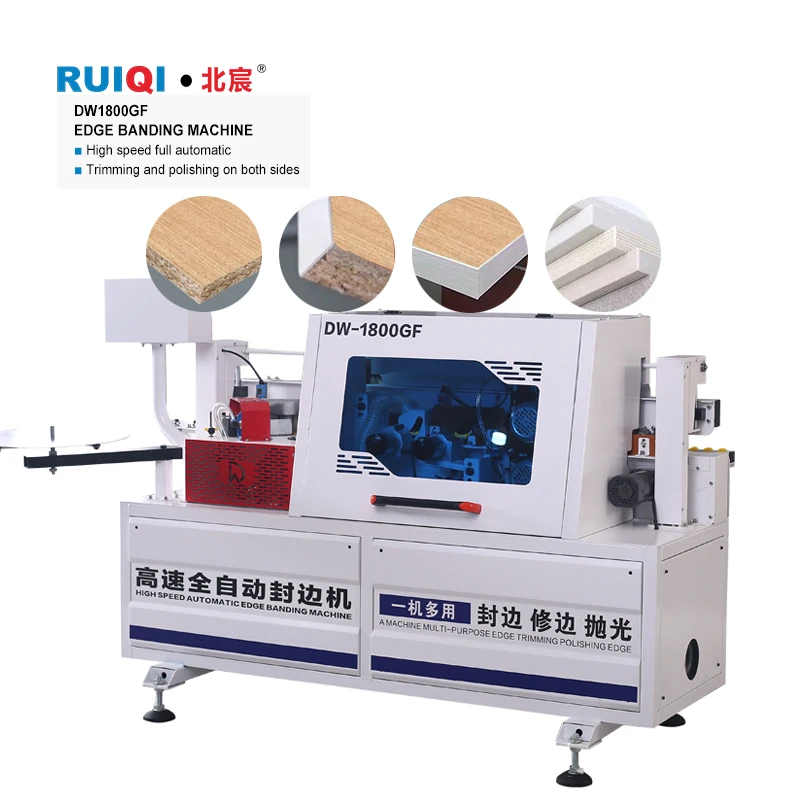
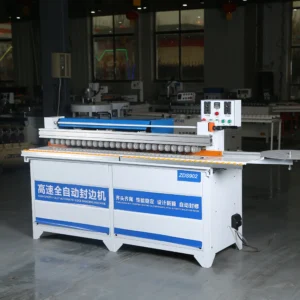
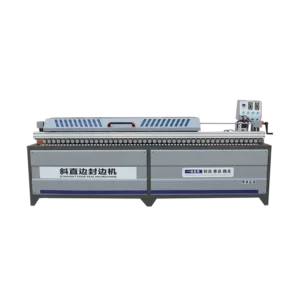
Ready-to-ship availability — DW1800 units are tested, configured, and staged for dispatch so your workshop can transition from manual edge banding to automated production without waiting through a build cycle.
Technical Specifications
| Parameter |
Value |
| Model |
DW1800 |
| Product Type |
Automatic Edge Banding Machine |
| Total Power |
4.9 kW |
| Voltage & Frequency Options |
380V / 220V / 415V (50Hz/60Hz — confirm before dispatch) |
| Feed Speed |
0–14 m/min |
| Edge Banding Height |
0–50 mm |
| Edge Banding Thickness |
0.3–3 mm |
| Minimum Sheet Length × Width |
20 cm × 10 cm |
| Trimming Motor Power |
800 W × 2 at 24000 r/min |
| Polishing Motor Power |
380 W × 2 |
| Edge Motor Power |
160 W |
| Transmission Power |
180 W |
| Vacuum Power |
550 W |
| Glue Pot Capacity |
4000 ml |
| Air Source Pressure |
0.4–0.6 MPa |
| Overall Dimensions (L×W×H) |
220 × 65 × 125 cm |
| Net Weight |
320 kg |
| Mobile Table Guide |
Roll-ball differential structure |
| Table Surface Treatment |
Oxidation treatment |
| Mobile Workstations |
High-strength extruded aluminum alloy |
| Key Features |
Double-sided gluing, top/bottom trimming, top/bottom polishing, front/rear alignment, flexible edge scraping, dust suction, profile tracking for four-corner rounding |
Application Suitability
| Application |
Material or Output |
| Small-batch cabinet door production |
MDF and plywood panels with PVC edge banding |
| Joinery workshop upgrade from manual banding |
Particleboard shelving and carcass components |
| Custom furniture startup runs |
Solid wood panels and ABB boards up to 50 mm edge height |
| PVC panel edging for interior fit-out |
PVC panels and organic glass plates with 0.3–3 mm banding |
| Small workshop batch processing |
Mixed substrate runs requiring quick changeover between material types |
Why the Voltage Question Should Come Before the Price
An automatic edge banding machine in stock is useless if it cannot plug into your workshop's power supply.
I have watched small workshop owners in South America and Southeast Asia take delivery of entry-level edge banders, only to discover the machine was wired for 380V three-phase while their facility runs on 220V single-phase. The machine sits idle for weeks while electricians scramble to install new lines or source step-up transformers. Orders pile up, customers walk away, and the investment that was supposed to accelerate production becomes a costly floor ornament. [NEED_CITE: voltage and frequency standards by export market] That is why every DW1800 quotation I prepare starts with a voltage and frequency confirmation — not as a line item buried in the fine print, but as a hard gate before the order moves forward.

Stocked Configurations That Match Your Power Grid
The DW1800 is available with voltage configurable from 110V to 440V, and the stock range covers 380V, 220V, and 415V options. When you request an automatic edge banding machine in stock, the first thing we verify is your local supply voltage and frequency. This is not a generic checkbox exercise. A 220V/60Hz market like parts of Central America requires different motor winding and transformer specifications than a 380V/50Hz market in continental Europe, and getting this wrong means the glue pot never reaches temperature or the trimming motors run at incorrect speeds.
Language and Controls That Do Not Stall Your First Day
Control panel language is another detail that seems minor until your operator stares at an interface in a script they cannot read. The DW1800 ships with Chinese and English language panels as standard, with other languages available on request. For a small workshop bringing on its first automated edge bander, the operator may have years of hand-banding experience but zero exposure to machine control menus. A panel in their working language means commissioning takes hours instead of days, and the first production run actually produces usable parts rather than a pile of scrapped panels with torn edge banding. [NEED_CITE: CE machinery directive requirements for operator interface language]
Reading the Numbers That Actually Matter for Small Shops
Feed speed of 0–14 m/min gives a small workshop flexibility that high-volume machines cannot offer. At lower speeds, an operator learning the machine can watch how the PVC banding feeds into the glue station and adjust pressure before committing to a full batch. The trimming stations run at 24000 r/min with 800 W motors on both top and bottom — this spindle speed is what produces a clean shear cut on PVC and wood veneer banding rather than a torn or chipped edge that requires hand cleanup. The 4000 ml glue pot capacity is sized for intermittent production: enough to run a batch of cabinet doors without constant refilling, but not so large that glue degrades from sitting heated for hours during slow days. The roll-ball differential table guide keeps panels aligned as they move through each station, which directly affects whether the trimming cutters meet the banding at the correct position across the full panel width.
The Hidden Cost of Skipping Configuration Verification
Buying an entry-level edge bander without confirming these details upfront creates a cascade of problems. The machine arrives, the electrician spends days rewiring, the first test panel comes out with uneven glue because the pot never stabilized at the right temperature under incorrect voltage, and the operator cannot navigate the error codes on a panel in an unfamiliar language. [NEED_CITE: common causes of commissioning failure in imported woodworking machinery] By that point, the workshop is weeks behind schedule and the owner starts questioning whether automating was the right decision at all. The machine itself was never the problem — the configuration mismatch was.
What Ready Stock Actually Means at This Level
The DW1800 sits in the product range as the smallest viable step from hand banding to machine banding, and stocking it means a joinery workshop can order, receive, and commission within a compressed timeline rather than waiting through a multi-week build cycle. The 320 kg weight and 220 cm footprint fit into workshops where floor space is already tight and a forklift may not be available — two people and a pallet jack can position it. Extruded aluminum alloy workstations resist the humidity swings common in small, un-climate-controlled shops, and the oxidation-treated table surface prevents the rust staining that cheap steel tables leave on light-colored melamine panels. Every unit goes through a four-stage quality check covering incoming material inspection, in-process assembly verification, finished product testing, and pre-shipment running verification with your specified panel thickness and banding material. [NEED_CITE: four-stage quality control in woodworking machinery manufacturing]
Documentation & Verification
- Voltage confirmation sheet matching your local supply signed before dispatch
- Operation manual in agreed language covering glue pot temperature ranges and feed speed adjustment
- Electrical schematic with circuit identification for 4.9 kW total load and breaker sizing
- Factory test record showing trimming quality on your specified panel material and banding thickness
- CE declaration of conformity included with shipping documents
- Spare parts list with trimming blades, polishing wheels, and glue pot components itemized
Installation, Commissioning & Support
- Requires a level concrete floor with 220 × 65 cm clear footprint plus operator access on three sides
- Dedicated circuit rated for 4.9 kW at confirmed voltage, separate from other machinery loads
- Arrives fully assembled — connect power, compressed air at 0.4–0.6 MPa, and dust extraction ducting
- First-run calibration covers glue pot temperature, feed speed ramp-up, and trimming depth on your stock material
- Trimming blades and polishing wheels are the primary wear items — replacements identified in the spare parts list
- Daily maintenance centers on glue pot cleaning and dust extraction port clearance
Tell Us What You Need Before You Order
To match the right DW1800 configuration to your workshop, share your local voltage and frequency, the primary panel materials and edge banding types you run, and the languages your operators read. If you have existing upstream saws or downstream boring machines, let us know the panel sizes they output so we can confirm the DW1800's minimum sheet dimensions and feed height work with your current flow.
Frequently Asked Questions
Q: What voltage options are stocked and how do I confirm before dispatch?
A: The DW1800 is stocked in 380V, 220V, and 415V configurations with 50Hz or 60Hz frequency options. Before we ship, you receive a voltage confirmation sheet listing your exact local supply. We match the motor windings and control transformer to that specification. If your workshop sits in a region with unstable voltage, tell us — we can discuss whether a stabilizer is advisable upstream of the machine.
Q: Can the control panel language be set to my operator's language?
A: Chinese and English are standard on every DW1800 panel. Other languages are available on request, and this must be confirmed at order stage so the correct interface board is installed before the machine leaves the factory. Switching languages after arrival requires a component swap, which delays commissioning and may require a service visit.
Q: What is the maximum edge banding thickness and panel size this machine handles?
A: The DW1800 handles edge banding from 0.3 to 3 mm thick and 0 to 50 mm tall. Minimum sheet size is 20 cm long by 10 cm wide. There is no strict upper panel length limit, but panels exceeding the 220 cm machine length will require outfeed support. For shops running full-size 244 cm sheets regularly, we discuss whether a larger model in the range is a better fit.
Q: How fast can a stocked unit be dispatched and what are the shipping options?
A: Stocked DW1800 units are ready for crating once voltage and language are confirmed. Dispatch timing depends on your chosen shipping method and destination port. We provide packing photographs before the crate leaves the factory, and the 320 kg weight and compact footprint mean it can ship LCL or share a container with other equipment from your order.
Q: What spare parts come with the machine and how do I order replacements?
A: Each DW1800 ships with a spare parts list identifying trimming blades, polishing wheels, and glue pot seals specific to your machine's serial number. A basic consumable kit is included in the crate. Replacement orders reference that same list so you receive exactly matching components, and we confirm availability before you commit to the order.