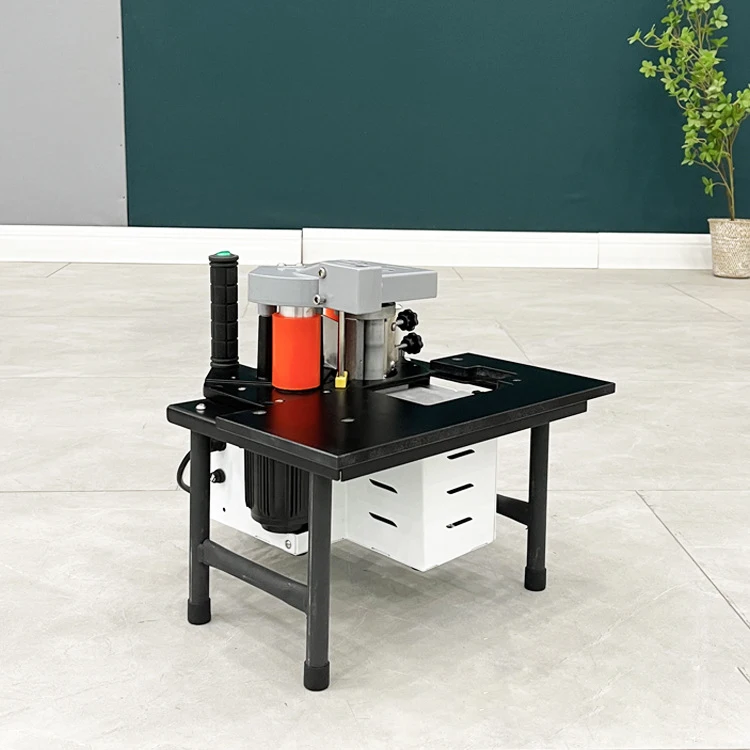
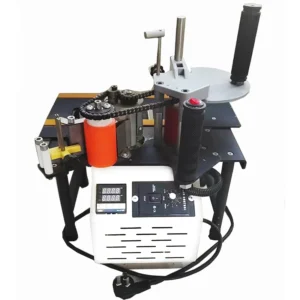
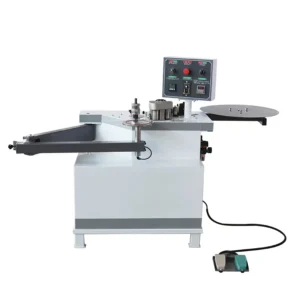
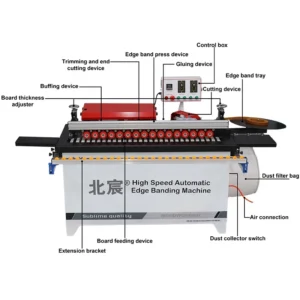
Ready from stock — Portable Edge Banding Machine configured to your local plug standard and dispatched within days, not weeks, so your workshop starts producing edges the moment it arrives.
Technical Specifications
| Parameter |
Value |
| Product Type |
Portable Edge Banding Machine |
| Shape of Edge-banding Plates |
Curved, Straight and Special-shaped Sheet |
| Edge Thickness Range |
0.3–3mm |
| Edge Sealing Speed |
0–6 m/min |
| Edge Sealing Height (Panel Thickness Range) |
7–60mm |
| Gluing Method |
Double-sided gluing |
| Glue Pot Volume |
1000ml |
| Machine Weight |
14kg |
| Assembly State |
Portable / Handheld |
| Plug Options |
EU / AU / UK / USA / CN |
| Logo Customization |
Available |
Application Suitability
| Application |
Material or Output |
| Custom cabinet curved panel finishing |
MDF and plywood with PVC edge banding |
| Small-batch joinery edge sealing |
Particleboard and blockboard with veneer banding |
| On-site furniture installation touch-up |
Solid wood panels with 0.3–3mm banding material |
| Startup workshop first-stage production |
Melamine-faced board with standard PVC edges |
Why Plug Type Should Be Settled Before You Confirm the Order
A portable edge banding machine in stock is only useful if it actually runs on your workshop's electrical supply the day you unbox it.
I have watched small joinery shops lose entire production days because a handheld unit arrived with a plug that did not fit their outlet, or worse, a motor wound for a frequency their local grid does not supply. The machine sits on a bench, the operator stares at it, and the only option is to source a transformer or wait for a replacement — meanwhile, panels pile up unfinished. Confirming voltage and plug standard in writing before the crate closes eliminates this failure entirely [NEED_CITE: voltage and frequency standards by export market].

Dispatch Timing That Matches Small-Workshop Cash Flow
Small workshops and joinery startups cannot absorb multi-week production delays on auxiliary equipment. When a cabinet maker decides to move from hand-trimming to machine-applied banding, the gap between decision and delivery is dead time where old methods persist. This Portable Edge Banding Machine in stock is staged for quick release, meaning the lead time you face is measured in transit days, not manufacturing queues. You place the order, the unit is tested against your confirmed voltage, and it leaves the warehouse while your operator is still clearing bench space.
Curved Edges Without Committing Floor Space to a Full Line
Straight panel edges are straightforward on any automatic edge bander, but curved cabinet doors and radius shelving demand a different approach. A portable edge banding machine in stock at this weight class — 14kg, carried to the workpiece rather than fed through a conveyor — lets you handle special-shaped panels on a flat bench without dedicating three metres of linear floor space to a curved-capable station. The double-sided gluing method and 1000ml pot give you enough continuous run time to complete a batch of curved doors before stopping to refill, and the 0.3–3mm edge thickness range covers both PVC for moisture-prone bathroom cabinets and veneer for visible-end-grain shelving [NEED_CITE: edge banding material compatibility with substrate types].
What 0–6 m/min Actually Means on the Shop Floor
Feed speed on a handheld unit is governed by the operator's hand, not a variable-frequency drive. The 0–6 m/min range here tells you two practical things. First, at the lower end you can slow-walk a glue-heavy PVC band around a tight radius without the material lifting or bubbling. Second, at the upper end you can run a long straight edge on a wardrobe side panel at a pace that keeps a one-person shop productive through a batch of twenty carcasses. The 7–60mm panel thickness range is the more consequential number: it means 18mm standard cabinet stock sits comfortably in the middle of the band, while thicker solid-wood worktops up to 60mm remain within reach without swapping to a separate machine. Double-sided gluing applies adhesive to both the panel edge and the banding simultaneously, which matters when bonding veneer to end-grain surfaces where single-sided contact often starves the joint.
When a Cheaper Plug Adapter Becomes an Expensive Mistake
Shops that accept whatever plug happens to be on the machine often discover the problem only after the first burnout. A portable unit wound for 220V/50Hz fed through an adapter into a 110V/60Hz circuit will run hot, the glue pot will struggle to hold temperature, and the banding will peel on cooling. The failure is not dramatic — it is a slow drift in bond quality that shows up as warranty callbacks on finished cabinets months later. Specifying the correct plug and winding at order stage costs nothing; replacing a motor or chasing delamination complaints costs considerably more [NEED_CITE: CE machinery directive requirements for industrial equipment].
Why Stock Availability Matters at This Scale
Small workshops buy one machine at a time, and each machine must earn its bench space before the next purchase is justified. A portable edge banding machine in stock means your trial of machine-applied banding can begin this month, not next quarter. When the unit arrives configured to your voltage with an operation manual in your operator's language, the learning curve compresses from weeks of trial-and-error into a single afternoon of test runs on scrap stock. You confirm the glue temperature suits your banding material, you dial in your hand-feed speed on a straight edge, then you move to a curve — and by the next morning your operator is banding production panels.
Documentation & Verification
- Factory test record showing glue temperature stability on your specified banding thickness
- Electrical schematic matching your confirmed plug type and local frequency
- Operation manual in your agreed language covering glue pot refill and roller adjustment
- Pre-shipment packing photographs showing your unit serial-matched to the crate
- CE declaration of conformity available on request before dispatch confirmation
Installation, Commissioning & Support
- 14kg weight requires no floor anchoring — set on any flat, stable bench near a grounded outlet
- Plug configured to your local standard so no adapter or transformer is needed at first power-on
- Glue pot filled and heated on your scrap panel stock to confirm temperature-band compatibility
- Feed speed practiced on a straight offcut before the operator attempts a curved profile
- Spare glue roller and scraper blade included for the first maintenance cycle
Before You Request a Quote
Tell us the edge banding material you currently use — PVC, ABS, or veneer — and the thickness you run most often. Confirm your workshop voltage and frequency so the motor and plug are wound correctly before packing. If your panels include curves, note the tightest radius you produce so we can advise on feed technique at dispatch.
Frequently Asked Questions
Q: Which plug and voltage will be configured for my country before shipping?
A: Your local voltage and frequency are confirmed in writing before the unit is packed. We configure EU, AU, UK, USA, or CN plugs as standard, and the motor winding is matched to your grid so no transformer or adapter is needed on arrival.
Q: What edge banding materials does this portable unit handle?
A: The 0.3–3mm thickness range covers standard PVC, ABS, and wood veneer banding. Glue pot temperature should be adjusted to match the specific material — we recommend a test run on your actual banding stock before starting production panels.
Q: Is this machine suitable for my daily panel volume, or should I consider an automatic edge bander?
A: This unit is built for low-volume and on-site finishing where a full-size automatic line is impractical. If your daily output consistently exceeds what one operator can hand-feed in a shift, a stationary automatic edge bander with conveyor feed would be the appropriate step up.
Q: How is the machine packed, and what is the dispatch lead time from stock?
A: Each unit is packed with protective crating and photographed before sealing. Because the portable edge banding machine is held in stock, dispatch follows voltage confirmation and pre-shipment testing — typically measured in days rather than production weeks.
Q: What spare parts and consumables should I order with the machine?
A: We recommend ordering an additional glue roller and scraper blade alongside your first glue and banding consumables. This covers the initial maintenance cycle so your workshop is not waiting on a parts shipment mid-production.