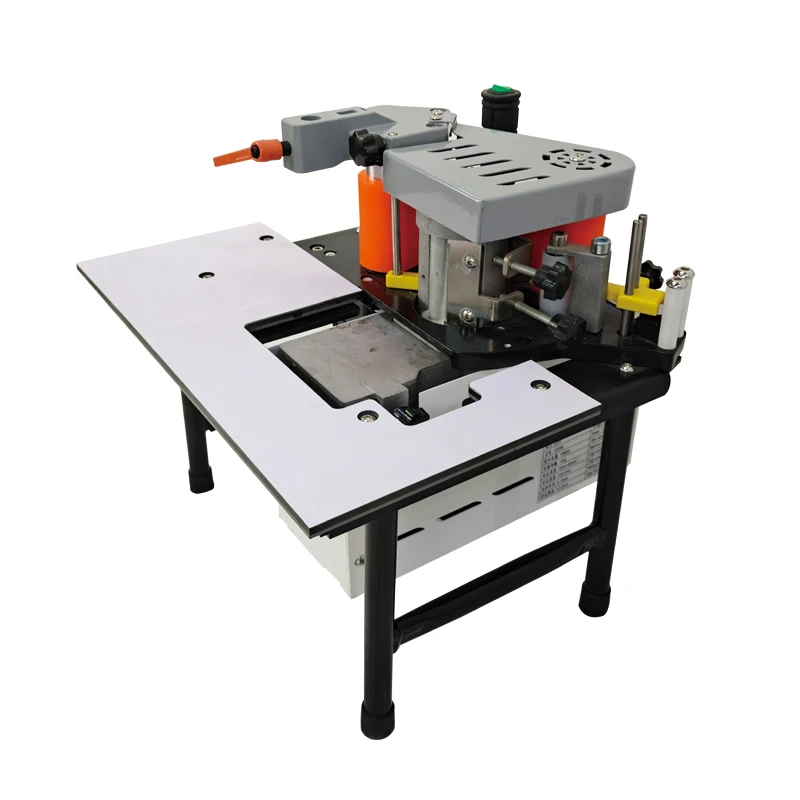
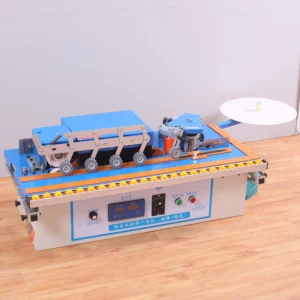
Benchtop edge banding, ready to ship — ST-30 units are tested on buyer-supplied panel samples before dispatch, with voltage and plug confirmed to match local workshop power.
Technical Specifications
| Parameter |
Value |
| Product Type |
Portable Edge Banding Machine |
| Total Power |
1000W |
| Voltage & Frequency |
220V/380V/customization (frequency 50Hz/60Hz to be confirmed) |
| Minimum Sheet Length |
25 cm |
| Minimum Sheet Width |
3 cm |
| Edge Banding Height Range |
0–50 mm |
| Edge Banding Thickness Range |
0.3–3 mm |
| Edge Trimming Power |
20W |
| Air Source Pressure |
0.5–0.8 MPa |
| Glue Pot Capacity |
1000 ml |
| Suitable Edge Banding Materials |
ABS, PVC, Melamine, Veneer |
| Overall Dimensions (L×W×H) |
38×35×35 cm |
| Net Weight |
12 kg |
| Plug Options |
EU, USA, AU, UK |
| Language Options |
Chinese, English (customizable to Spanish or other languages) |
| Assembly State |
Portable, benchtop operation |
Application Suitability
| Application |
Material or Output |
| Custom cabinet edge finishing |
MDF, particleboard with PVC and ABS banding |
| Curved countertop edging on-site |
Plywood and solid wood panels with veneer |
| Small-batch furniture workshop runs |
Melamine-faced board with 0.3–3 mm banding |
| Interior decoration site work |
Straight and curved panel edges in confined spaces |
Why Voltage and Frequency Confirmation Must Come Before Dispatch
A portable edge banding machine in stock fast delivery means nothing if it arrives wired for a grid it cannot plug into.
I have seen compact edge banders sit in shipping crates for weeks because the buyer ordered a 220V/50Hz unit for a region running on 60Hz, and the glue pot heater could not reach stable operating temperature. The motor ran, but the adhesive never cured properly on the panel edge. Small workshops lose days of production waiting for a transformer or a replacement unit [NEED_CITE: voltage and frequency standards by export market]. When you need a Portable Edge Banding Machine in stock fast delivery, the first question should always be about your workshop's exact supply specification — not the lead time.

Dual-Mode Banding for Straight and Curved Profiles
The ST-30 handles both straight and curved edge profiles within a single benchtop footprint. Workshops that process shaped cabinet components or curved countertop sections no longer need separate dedicated machines for each profile type. The 0–50 mm banding height range covers standard panel thicknesses encountered in custom furniture and interior fit-out work, keeping the operator at a single workstation throughout the job.
Compact Footprint Without Sacrificing Banding Range
Despite a 38×35×35 cm body and 12 kg weight, the machine accepts edge banding materials from 0.3 mm veneer up to 3 mm PVC and ABS. The 1000 ml glue pot sustains small-batch runs without frequent refill interruptions. For joinery startups moving from hand-held trimmers to a repeatable edge banding process, this balance between portability and material range means the machine fits the bench today and still handles the material mix tomorrow [NEED_CITE: CE machinery directive requirements for small woodworking equipment].
How Edge Thickness and Glue Capacity Shape Daily Output
The 0.3–3 mm banding thickness range determines which materials the machine can process in a single setup. Thicker ABS banding at the upper end requires the glue pot to maintain consistent temperature across the full contact surface; the 1000W total power supports this thermal demand for sustained runs. The 1000 ml glue pot capacity translates to fewer refill stops during a batch of cabinet sides or shelving units, though operators processing high-density moisture-resistant board should verify adhesive cure time on sample material before committing to a full production run. Air source pressure at 0.5–0.8 MPa drives the pressure roller contact force, which directly affects bond quality on curved profiles where clamping geometry is less forgiving than straight edges.
The Hidden Cost of Skipping the Sample Panel Test
When a buyer orders a single portable unit without sending panel samples for a pre-shipment test, the first real production run becomes the test. If the substrate is high-density moisture-resistant board rather than standard particleboard, the glue may cure too slowly or too quickly for the feed rate, causing banding to lift at the edges. The entire batch of panels then requires rework — stripping the banding, cleaning residual adhesive, and re-running each piece. For a small workshop with limited buffer stock, this delays downstream assembly and installation schedules [NEED_CITE: common edge banding adhesion failures on non-standard substrates].
Why Procurement Verification Matters Here
Every ST-30 leaves the facility with voltage and plug type confirmed in writing against the buyer's local supply specification — 220V or 380V, with EU, USA, AU, or UK plug options. The operation manual ships in the agreed language, whether English, Spanish, or another requested option. Pre-shipment testing runs the buyer's actual panel material through the machine before crating, so adhesion and trim quality are verified before the unit leaves Shandong. Spare parts identification covers the glue pot, trimming blade, and pressure roller for reorder planning.
Documentation & Verification
- CE declaration of conformity specific to portable woodworking edge banding equipment
- Factory test record on buyer-supplied panel material before dispatch
- Electrical schematic confirming voltage, frequency, and plug configuration
- Operation and maintenance manual in the agreed workshop language
- Spare parts list identifying glue pot, trim blade, and pressure roller part numbers
Installation, Commissioning & Support
- Requires a stable benchtop surface supporting at least 20 kg including clamped workpiece
- Dedicated 220V or 380V circuit matching confirmed frequency before first power-on
- Arrives fully assembled — operator mounts unit to bench and connects air supply at 0.5–0.8 MPa
- First-run glue temperature and pressure roller settings calibrated on sample panel during commissioning
- Trimming blade alignment checked using 20W edge trimmer on buyer's specified banding thickness
Before You Request a Quote
To configure the correct ST-30 for your workshop, share your local voltage and frequency specification, the panel materials and edge banding types you process most often, and whether your work is primarily straight-edge, curved, or mixed. If you can send a sample panel with the substrate and banding material you use, we will run a pre-shipment test and provide the results before you commit to the order.
Frequently Asked Questions
Q: How do I confirm the correct voltage and plug type before ordering?
A: Share your workshop's supply voltage, frequency (50Hz or 60Hz), and the plug standard in your region. The ST-30 is available in 220V and 380V configurations with EU, USA, AU, or UK plug options. Voltage and frequency are confirmed in writing before production begins to prevent commissioning delays on arrival.
Q: What edge banding materials and thicknesses does this machine handle?
A: The machine processes ABS, PVC, melamine, and veneer banding from 0.3 mm to 3 mm thick, with a banding height range of 0–50 mm. This covers most materials used in custom cabinet and furniture edge finishing for MDF, particleboard, plywood, and solid wood panels.
Q: Can the control panel and manual be provided in my local language?
A: The standard language options are Chinese and English, with customization available for Spanish and other languages. The operation and maintenance manual ships in the agreed language so your operator can follow setup, daily use, and maintenance procedures without translation delays.
Q: What is the minimum panel size this machine can process?
A: The minimum sheet length is 25 cm and the minimum width is 3 cm, making the unit suitable for small offcuts and narrow components common in custom furniture and shelving work. Panels shorter or narrower than these limits cannot be reliably fed and clamped.
Q: How can I test the machine on my own material before committing?
A: Send a sample panel with your typical substrate and the edge banding material you plan to use. We run a pre-shipment test on that exact combination, document the adhesion and trim results, and share the record before you confirm the order.