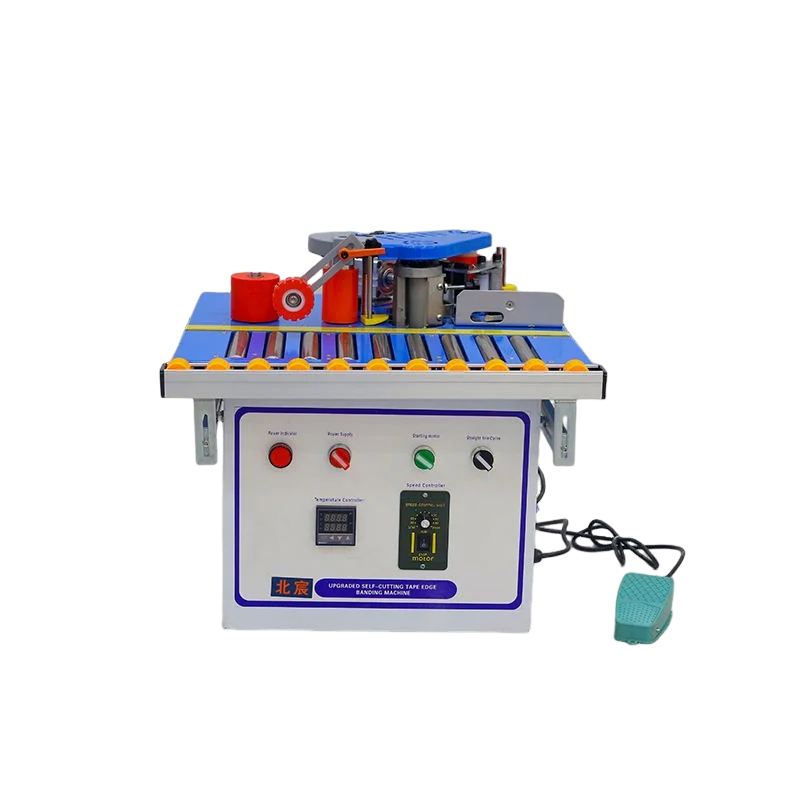
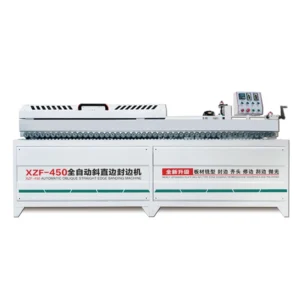
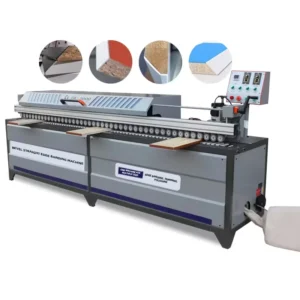
Compact Workshop Entry — Designed for joinery startups moving off hand tools, this portable edge bander matches realistic small-batch output without overcommitting floor space or capital.
Technical Specifications
| Parameter |
Value |
| Product Type |
Portable Edge Banding Machine |
| Total Power |
1000W |
| Voltage Options |
220V / 380V / Customizable |
| Edge Banding Profile |
Curved and Straight |
| Minimum Sheet Length |
250 mm |
| Minimum Sheet Width |
30 mm |
| Edge Banding Height Range |
0 – 50 mm |
| Edge Banding Thickness Range |
0.3 – 3 mm |
| Edge Trimming Power |
20W |
| Air Source Pressure |
0.5 – 0.8 MPa |
| Machine Footprint |
500 × 500 × 470 mm |
| Machine Weight |
23 kg |
| Glue Pot Capacity |
1000 ml |
| Language Options |
Chinese, English standard; Spanish, French, or custom available |
| Plug Options |
EU, USA, AU, UK |
| Assembly State |
Fully assembled, ready to operate |
Application Suitability
| Application |
Material or Output |
| Joinery workshop edge sealing |
MDF, particleboard, plywood panels with PVC or ABS strip |
| Custom furniture repair and rework |
Solid wood board and ecological board with wood veneer banding |
| Small-batch cabinet prototyping |
Melamine-faced board with 0.3–3 mm edge tape on curved or straight profiles |
| On-site installation finishing |
Prefabricated panel adjustment and edge touch-up at fit-out locations |
Why Voltage Confirmation Must Happen Before You Commit
A portable edge banding machine that arrives with the wrong voltage is a 23 kg paperweight sitting in your loading bay.
I have watched small workshop owners unpack equipment only to discover the motor hums but never reaches operating temperature, or worse, trips the breaker on first startup. The issue traces back to a quotation stage where nobody asked whether the workshop runs single-phase 220V or three-phase 380V, and whether local frequency is 50 Hz or 60 Hz. For a portable edge banding machine for small workshop environments, that conversation has to happen in writing before the machine leaves the factory [NEED_CITE: voltage and frequency standards by export market]. Glue pot heaters in particular are sensitive to voltage mismatch — too low and the adhesive never reaches application temperature, too high and you burn through heating elements within weeks.

Footprint Reality for a Growing Workshop
When a joinery startup begins moving from hand-applied edge banding to machine-assisted production, the first constraint is usually floor space rather than budget. This unit occupies a 500 × 500 mm footprint, which means it fits against a wall beside your sliding table saw without disrupting material flow. The 23 kg weight keeps it stable during straight-edge work while still allowing two people to relocate it when the workshop layout needs rethinking. For a portable edge banding machine for small workshop use, that balance between stability and mobility matters more than most spec sheets suggest.
Dual Profile Capability Without a Second Machine
Curved edge work is where most entry-level machines expose their limits. A straight-only bander forces you back to hand-trimming the moment a cabinet door has a radius or a shaped shelf needs edge treatment. This unit handles both curved and straight profiles within the same setup, so a custom furniture maker taking on a commission with rounded corners does not need to justify a second, dedicated curved-edge machine. The 0–50 mm banding height range covers standard cabinet and shelving panel thicknesses encountered in a workshop at this production stage [NEED_CITE: standard panel thickness ranges in custom joinery].
Reading the Specs That Actually Matter on the Shop Floor
Glue pot capacity directly determines how long you can run before stopping to reload. A 1000 ml pot suits intermittent small-batch work — roughly enough adhesive for a run of cabinet carcasses before you need to pause and refill. If your daily volume involves continuous edge banding for eight hours straight, this capacity will feel limiting, which is exactly the signal that production has outgrown a portable configuration.
Edge banding thickness compatibility from 0.3 to 3 mm covers PVC, ABS, and wood veneer materials commonly stocked by small workshops. Thicker veneer stock at the upper end of that range requires careful glue temperature management to achieve full adhesion across the bonding surface.
Air source pressure between 0.5 and 0.8 MPa is required for the trimming and finishing mechanisms. Before connecting, verify your workshop compressor actually delivers stable pressure within that window — undersized compressors cause inconsistent trim quality that shows up as uneven edges on finished panels.
The Real Cost of Skipping the Material Conversation
Buying a compact edge bander without confirming your primary board substrate and edge tape material leads to predictable problems. PVC banding on particleboard requires different glue temperature settings than wood veneer on MDF, and a workshop that switches between materials without adjusting will see adhesion failures on one or the other [NEED_CITE: adhesive temperature requirements by edge banding material]. The resulting rework — stripping failed edge tape, re-cleaning the panel edge, re-applying — consumes more labor hours than running the machine correctly in the first place. Small workshops feel this loss more acutely because every reworked panel represents a larger share of daily output.
Why Sourcing This Configuration Here Makes Sense
Full voltage and plug customization is confirmed in writing before production, so the machine that arrives matches your workshop electrical environment rather than requiring a local transformer.
Language customization on the control panel and in the operation manual means your operator reads instructions in a language they actually understand, reducing commissioning delays.
Every unit ships with a factory test record documenting performance on panel thicknesses within your specified range, giving you a baseline to reference during installation.
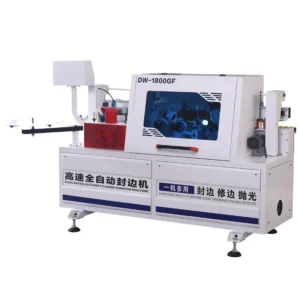
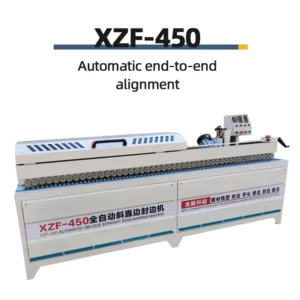
The product family spans from this portable entry point through to full-function automatic edge banders, meaning your next machine purchase stays within the same supplier ecosystem as volume grows.
Engineer-led configuration review happens before quotation, not after — ensuring the machine proposed actually matches your material mix and daily throughput expectations.
Documentation & Verification
- CE declaration of conformity covering portable edge banding equipment category
- Electrical schematic reflecting your confirmed voltage and plug configuration
- Factory test record on your specified panel and edge tape combination
- Operation and maintenance manual in your chosen language
- Spare parts list with part numbers for glue pot heaters and trimming blades
Installation, Commissioning & Support
- Requires a dedicated circuit matching confirmed voltage rating; avoid sharing with high-draw equipment like sliding table saws
- Arrives fully assembled — place on a level surface within the 500 × 500 mm footprint and connect power and air supply
- First startup should include glue temperature calibration for your specific edge banding material and board substrate
- Compressor must deliver stable 0.5–0.8 MPa; install a dedicated regulator if your main line serves multiple machines
- Daily maintenance involves clearing adhesive residue from the glue pot and checking trim blade alignment on both profiles
What to Prepare Before Requesting a Quote
Send your primary board materials, edge banding types, and typical panel dimensions so the configuration recommendation matches actual workshop conditions. Confirm your local voltage, phase, and frequency in writing — this is the single most important detail for avoiding startup problems. If you are evaluating this as a first step before scaling to higher-volume equipment, mention your expected production growth timeline so the upgrade path can be mapped from the start.
Frequently Asked Questions
Q: What production volume is this portable edge banding machine realistically designed for?
A: This unit suits intermittent small-batch work, custom one-off commissions, and prototype runs rather than continuous daily production. If your workshop is edge banding panels for multiple hours every day, that is the signal to evaluate the next tier in the product family. The 1000 ml glue pot and portable format are optimized for flexibility over sustained throughput.
Q: How do I confirm voltage and plug type match my workshop electrical system?
A: Provide your local voltage, phase configuration, and frequency in writing during the inquiry stage. The machine is built to your confirmed specification — 220V, 380V, or a custom arrangement — with the correct plug type for your region. A dedicated circuit is recommended to avoid voltage drops from other equipment affecting glue temperature stability.
Q: Can the control panel and manual be provided in my local language?
A: Chinese and English are standard options, with Spanish, French, and other languages available on request. The language choice covers both the machine control interface and the printed operation manual. Confirming this early ensures your operator can follow setup and maintenance procedures without translation delays during commissioning.
Q: What is the upgrade path when production volume exceeds this machine capacity?
A: The product family extends from this portable configuration through to full-function automatic edge banding machines with pre-milling, multi-stage trimming, and higher feed speeds. Staying within the same product range means familiar controls, compatible spare parts sourcing, and an established supplier relationship. Your engineer contact can map the transition point based on your actual production data.
Q: How do I verify edge banding thickness compatibility with my materials?
A: The machine accepts edge banding from 0.3 to 3 mm thick, covering standard PVC, ABS, and wood veneer strips. Send samples of your typical edge tape and board substrate so a factory test can confirm adhesion quality at the correct glue temperature. The test record ships with your machine as a reference for your workshop settings.