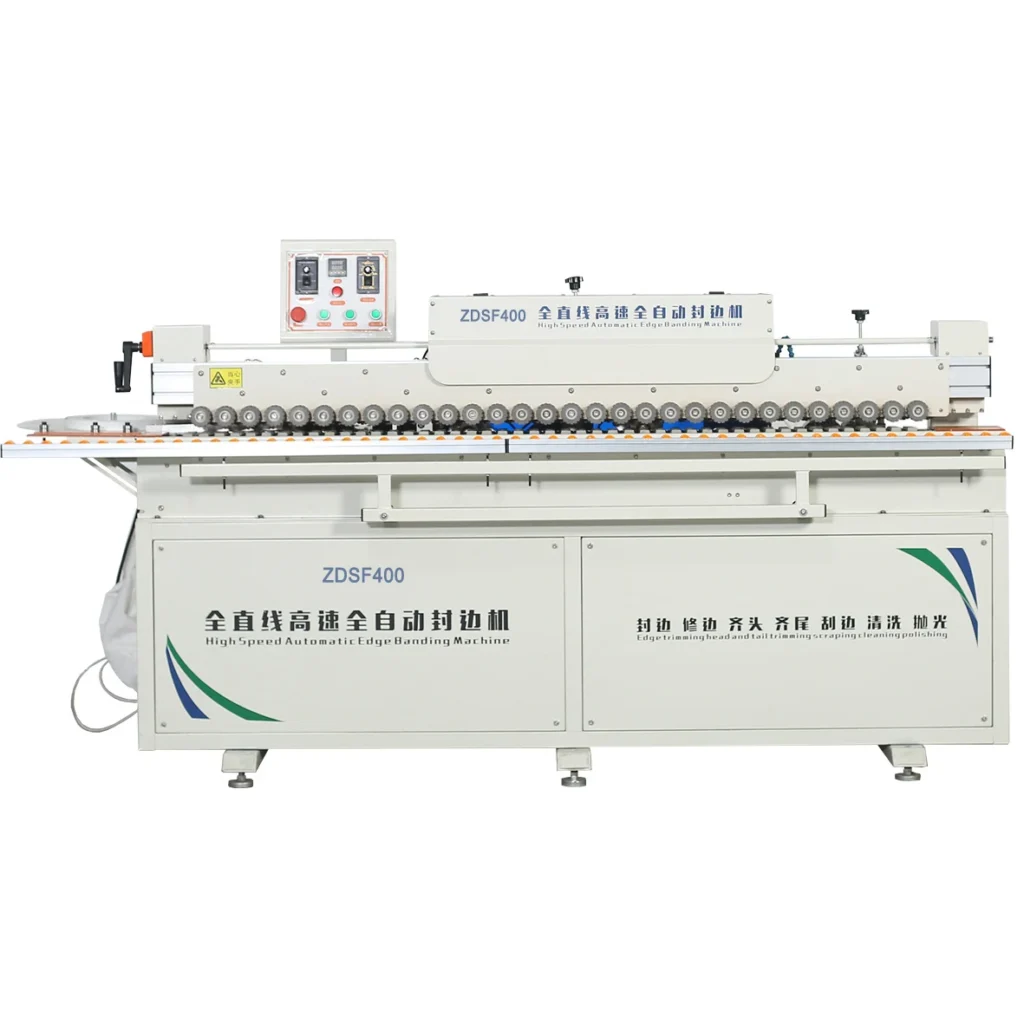
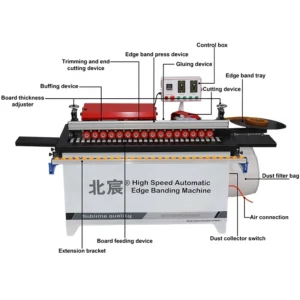
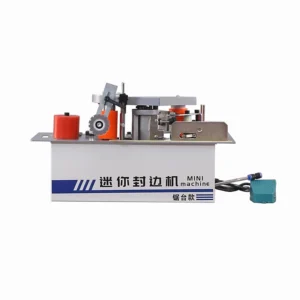
Compact Single-Phase Entry — a 220V straight-line automatic edge banding machine in stock for small workshops ready to move beyond manual edge finishing without rewiring the shop.
Technical Specifications
| Parameter |
Value |
| Product Type |
Straight Line High-Speed Automatic Edge Banding Machine |
| Model |
ZDSF400 |
| Function Stations |
Gluing, End Cutting, Trimming, Scraping, Polishing, Vacuuming |
| Edge Type |
Straight Line |
| Rated Voltage |
220V |
| Rated Power |
3kW |
| Rated Air Pressure |
0.4-0.6MPa |
| Strip Thickness Range |
1-3mm |
| Sheet Thickness Range |
10-55mm |
| Feed Speed |
0-14m/min |
| Glue Pot Capacity |
1000ml |
| Glue Heating Power |
800W |
| Trimming Motor Power |
800W × 2 (24,000 RPM) |
| Polishing Motor Power |
180W × 2 (5,500 RPM) |
| Suction Power |
550W |
| Overall Dimensions (L×W×H) |
240 × 70 × 120 cm |
| Net Weight |
370kg |
| Assembly State |
KD packing with user manual and video guidance |
| Warranty |
1 year (factory-defect spare parts replacement) |
Application Suitability
| Application |
Material or Output |
| Small furniture workshop edge finishing |
MDF, particleboard, plywood panels |
| Custom cabinet door and carcass production |
PVC and veneer edge banding (1-3mm) |
| Joinery operations transitioning from manual to machine |
Standard sheet stock (10-55mm thickness) |
| Low-to-medium volume straight-line panel processing |
Solid wood panels with compatible banding |
Why the Voltage Question Should Come Before the Price
Confirm your workshop supply matches the machine before you confirm the order — not after it arrives.
I spent years on the assembly floor watching machines get built, tested, and crated. The ones that caused the most grief overseas were not the complex ones. They were the basic models shipped to a country where the grid did not match the motor winding. A small cabinet shop in Southeast Asia once received a three-phase unit when their facility only had single-phase drops. The machine sat on their floor for weeks while they arranged an electrician and a phase converter, losing production time they could not afford [NEED_CITE: voltage and frequency standards by export market]. The ZDSF400 is rated for 220V single-phase, which removes that particular headache for workshops running on standard local supply. Finding an automatic edge banding machine in stock that actually matches your electrical infrastructure is a more practical starting point than comparing feed speeds.

Smallest Footprint That Still Does the Full Job
A workshop with limited floor space does not need a twelve-meter line to get clean edges on cabinet panels. The ZDSF400 fits into a 240 × 70 cm footprint and runs six stations in sequence: gluing, end cutting, rough and fine trimming, scraping, polishing, and vacuuming. That means an operator feeds a panel at one end and pulls a finished piece off the other without moving it between machines. For a small shop running custom cabinet orders, this automatic edge banding machine in stock gives you the complete edge finishing cycle in a single pass without requiring a dedicated production zone.
Single-Phase Power Without Compromising the Trim
The 3kW total rated draw is low enough to plug into a standard 220V workshop circuit without a dedicated three-phase drop. The trimming motors still run at 24,000 RPM, which is where clean edge quality comes from — slower spindle speeds leave chatter marks on PVC banding that show up under cabinet lighting. The polishing motors operate at a separate 5,500 RPM to burnish the edge without melting the material. This balance matters when your electrical infrastructure is fixed and you cannot add capacity without a panel [NEED_CITE: CE machinery directive requirements for industrial equipment].
Reading the Specs That Actually Matter at the Bench
The sheet thickness range of 10-55mm covers standard MDF, particleboard, and plywood used in cabinet and furniture work. The 1-3mm strip thickness range handles both thin PVC for a clean modern look and thicker veneer banding for solid-wood-look pieces. Feed speed adjusts from 0 to 14 m/min, letting a new operator start slow and build pace as they learn how the glue pot and feed belt behave with different materials. The 1000ml glue pot with 800W heating element reaches working temperature in roughly five to ten minutes — short enough that you do not lose a full morning waiting for the machine to warm up before the first panel goes through. The 0.4-0.6 MPa air pressure requirement is within the range of a small workshop compressor, so you are not forced to buy a larger air system just to run the edge bander.
What Happens When You Skip the Configuration Check
A machine that arrives with a control panel in a language your operator cannot read sits idle while someone translates the interface by trial and error. A unit whose voltage rating does not match the local grid either burns out the motor on first startup or refuses to run at all. I have watched small workshops absorb both of these hits because they ordered from a catalog page without a configuration conversation [NEED_CITE: common commissioning delays in imported woodworking machinery]. The cost is not the machine — it is the weeks of lost production and the emergency electrician call.
Why Ordering Here Reduces the Guesswork
Voltage and frequency are confirmed against your local supply before the machine ships, not assumed from a shipping destination. The operation and maintenance manual is produced in the language you agree on during the ordering process, so your operator can read it on day one. The ZDSF400 is part of a product family that extends upward, meaning if your volume grows beyond what a single-phase entry machine can sustain, you move to the next tier without changing suppliers or relearning a different control philosophy. Every unit goes through pre-shipment testing with your specified panel thickness and banding type, and the test record ships with the machine. KD packing keeps freight costs contained while the included video guidance walks your team through reassembly on the shop floor.
Documentation & Verification
- Factory test record run on your specified sheet thickness and banding type before dispatch
- Electrical schematic and voltage confirmation sheet matching your local supply standard
- Operation and maintenance manual in your agreed language for operator readiness
- Spare parts list covering trimming blades, polishing wheels, and glue pot components
- Packing photographs and customs documentation support for smooth import clearance
Installation, Commissioning & Support
- Requires a level floor area of approximately 240 × 70 cm with clearance for panel infeed and outfeed
- Dedicated 220V single-phase circuit rated for at least 3kW continuous draw with proper grounding
- KD-packed unit arrives with video-guided reassembly covering belt alignment and glue pot mounting
- First-run parameter setting covers glue temperature, feed speed, and trimming depth for your specific banding material
- Trimming blade and polishing wheel replacement intervals documented in the manual for ongoing maintenance scheduling
What to Share When You Are Ready to Order
Send your typical panel material, the sheet thicknesses you run most often, and the banding type and thickness you plan to use. Confirm your workshop voltage and frequency so the machine is built and tested to match. Let us know what language you need for the control panel and manual so your operator is not guessing on arrival.
Frequently Asked Questions
Q: What is the smallest workshop setup this machine is designed for, and when should I consider a higher-tier model?
A: The ZDSF400 is built for workshops running low-to-medium daily volume on standard panel thicknesses with a single operator feeding and unloading. When your daily panel count grows to the point where feed speed becomes a bottleneck or you need continuous multi-shift operation, that is the signal to look at the next tier in the product family for higher throughput and additional automation.
Q: Is 220V single-phase sufficient for continuous daily use, or do I need three-phase?
A: The 3kW rated draw is designed to run on standard single-phase 220V supply throughout a normal workday. The trimming and polishing motors are sized for this input. If your workshop already has three-phase available and you want to explore a higher-capacity model, that conversation happens at the configuration stage before any order is confirmed.
Q: How do I confirm the control panel language before the machine ships?
A: Language preference is discussed and locked in during the specification confirmation step, which happens before production. The agreed language applies to both the control panel interface and the printed operation manual, so your operator can read every label and instruction on day one without improvising translations.
Q: What panel materials and edge banding types work within the machine's range?
A: The 10-55mm sheet thickness range covers standard MDF, particleboard, plywood, and solid wood panels used in furniture and cabinet work. The 1-3mm strip thickness range handles PVC banding for modern finishes and veneer banding for wood-look applications. Confirming your specific material combination during the inquiry ensures the glue pot and feed settings are matched before testing.
Q: How long is typical dispatch lead time, and can I order a single unit?
A: Stocked models are available for fast dispatch, and single-unit orders are standard — there is no minimum order quantity forcing you to buy more than you need. Shipping options and estimated dispatch timing are quoted upfront during the ordering process so you can plan your workshop schedule around the delivery window.