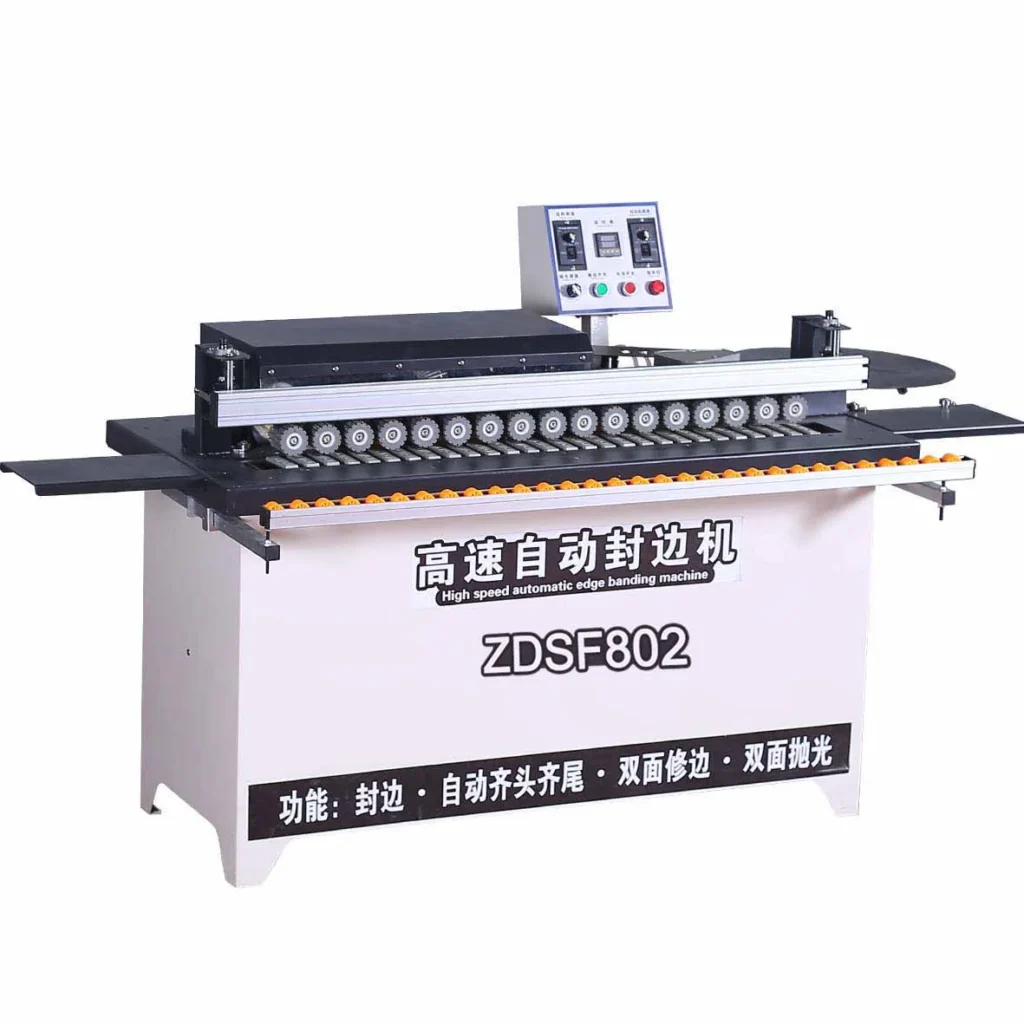
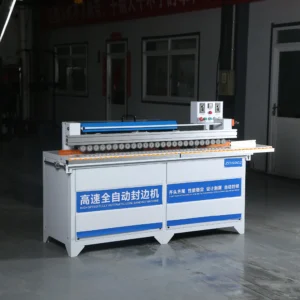
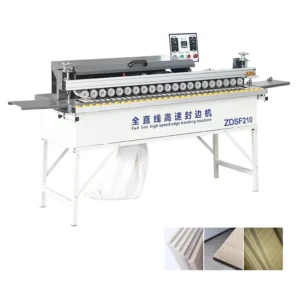
Dispatch-Ready Configuration — F802 ships fully assembled with pre-dispatch voltage verification, eliminating the dead-on-arrival risk that stalls small workshop startups.
Technical Specifications
| Parameter |
Value |
| Model |
F802 |
| Product Type |
Automatic Edge Banding Machine |
| Function Sequence |
Automatic plate feeding, end cutting, head & tail trimming, upper & lower polishing |
| Edge Type |
Straight line |
| Rated Voltage |
220V |
| Rated Power |
4 kW |
| Rated Air Pressure |
0.4–0.6 MPa |
| Strip Thickness Range |
0.5–2.5 mm |
| Sheet Thickness Range |
10–50 mm |
| Feed Speed |
0–10 m/min |
| Glue Pot Capacity |
4000 ml |
| Heating Power |
1000W (5–10 min heat-up) |
| Trimming Motor Power |
800W × 2 |
| Polishing Motor Power |
180W × 2 |
| Dust Extraction |
Built-in 1200W vacuum |
| Pressure Beam |
One-piece integrated, double-row silicone pressure wheels |
| Overall Dimensions (L×W×H) |
130 × 65 × 75 cm |
| Machine Weight |
150 kg |
| Control Interface |
Digital display for glue pot temperature, independent switches |
| Assembly State |
Fully assembled |
| Warranty |
1 year |
Application Suitability
| Application |
Material or Output |
| Small joinery workshop first automation |
MDF and particleboard panels up to 50 mm with PVC edge strips |
| Startup cabinet maker straight-line runs |
Plywood and melamine-faced board with 0.5–2.5 mm veneer or PVC banding |
| Custom furniture low-volume edge sealing |
Solid wood panels and composite substrates requiring single-pass trimming and polishing |
| Compact workshop panel processing |
Board stock from 10 mm minimum through 50 mm maximum thickness |
Why Voltage Confirmation Must Happen Before the Invoice Clears
A 4 kW edge bander that cannot power up on arrival wastes three weeks before production even starts.
I once shipped an automatic edge bander overseas without locking down the exact local voltage and frequency with the buyer. The machine arrived, the client wired it in, and nothing happened — the workshop supply was 60 Hz while the motor was wound for 50 Hz. The unit sat dead on the floor while we arranged electrical modifications. That Automatic Edge Banding Machine in stock for fast delivery becomes a heavy paperweight if the fundamentals are wrong [NEED_CITE: voltage and frequency standards by export market]. The F802 carries a 220V rating as standard, and the schematic is confirmed against the buyer's local supply before the crate is sealed. This step takes minutes and prevents weeks of downtime that no small workshop can absorb.

Ready Stock Means Your Workshop Starts Earning Sooner
Small shops do not have the luxury of eight-week lead times while a backlog of unfinished cabinet orders piles up. The F802 Automatic Edge Banding Machine is held in stock and dispatched as a fully assembled unit, so the machine that arrives on your floor is the machine you switch on. There is no KD reassembly, no hunting for missing fasteners, and no guessing how the pressure beam aligns. For a joinery workshop transitioning from hand-held trimmers, this means your operator can begin edge sealing panels on the day the crate is opened.
A Compact Footprint That Fits Where Production Actually Happens
At 130 × 65 × 75 cm and 150 kg, this unit occupies roughly the floor space of a standard workbench. Startup cabinet shops and small furniture makers typically operate in rented or shared workshop spaces where every square meter counts. The built-in 1200W vacuum dust collector removes the need for a separate external extraction system, saving both floor space and the cost of ductwork installation [NEED_CITE: workshop dust extraction requirements for small-scale woodworking]. You plug in the machine, connect your compressed air line at 0.4–0.6 MPa, and the entire edge sealing process runs within a single station.
Reading the Spec Sheet Against Your Actual Panel Stock
The 10–50 mm sheet thickness range covers the majority of MDF, particleboard, and plywood stock used in cabinet and furniture production, but the lower bound matters. If your workshop routinely processes 8 mm backs or thin divider panels, this machine will not feed them reliably — you need to verify your thinnest common panel before ordering. The 0–10 m/min feed speed gives the operator fine control, which is important when learning the machine: start slow on your first batch of MDF panels, observe how the double-row silicone pressure wheels grip the sheet, and increase speed only once the edge trim quality is consistent. The 4000 ml glue pot holds enough adhesive for extended sealing runs without constant refills, which directly affects your daily throughput on straight-line cabinet components. The two 800W trimming motors handle head and tail cutting with enough torque to shear through 2.5 mm PVC cleanly, while the 180W polishing motors produce the final surface finish that determines whether the edge is acceptable for visible cabinet faces.
The Hidden Cost of Skipping the Specification Check
When a small workshop buys a single machine without mapping it to the rest of the production flow, mismatches surface only after the first week of operation. An edge bander that feeds at 10 m/min may outpace a manual panel saw upstream, creating a bottleneck at cutting rather than sealing. Panels that are slightly under 10 mm will slip under the pressure beam and produce inconsistent glue lines, forcing rework that erodes the margin on every cabinet [NEED_CITE: common edge banding defects in small-scale furniture production]. If the control panel language does not match the operator's reading ability, commissioning stalls until someone can translate the temperature and speed settings — a problem that is entirely avoidable if language options are confirmed before dispatch.
Why Sourcing This Machine Here Makes Sense for Small Shops
Voltage and frequency are confirmed in writing against your local supply before the machine leaves the factory, which eliminates the dead-on-arrival scenario. The F802 ships with a pre-shipment test record showing actual panel runs at your specified thickness, so you can verify edge quality before the crate is sealed. A four-stage quality check covers incoming components through final dispatch verification, catching tolerance drift before it reaches your workshop. The operation and maintenance manual is provided in your agreed language, which means your operator does not need to decipher technical instructions through translation apps. Engineering-led configuration support ensures the machine is matched to your actual panel range and production volume rather than sold as a generic unit.
Documentation & Verification
- Electrical schematic and voltage confirmation document matched to your local supply standard
- Factory test record on your specified panel thickness and edge strip material before dispatch
- Operation and maintenance manual provided in the language agreed at order confirmation
- Spare parts list with consumable part numbers included for long-term planning
- CE declaration of conformity available for customs clearance in regulated markets
- Machine specification sheet confirming all rated parameters at point of shipment
Installation, Commissioning & Support
- Requires a dedicated 220V circuit rated for the 4 kW total power draw with appropriate breaker sizing
- Compressed air supply must deliver 0.4–0.6 MPa cleanly to the pneumatic strip-breaking system
- Arrives fully assembled at 150 kg — position on a level floor with clearance for panel infeed and outfeed
- Glue pot requires 5–10 minutes heat-up to operating temperature before first sealing run of the day
- Digital temperature display and independent switches allow the operator to set parameters without PLC programming
- Built-in 1200W vacuum collector requires only periodic emptying of the dust bag during standard shifts
- One-year warranty covers component faults with replacement parts dispatched against the included spare parts list
Before You Request a Quote
To confirm the F802 is the right fit, share the panel materials you process most often — MDF, particleboard, plywood, or solid wood — along with the typical thickness range and edge strip type. Let us know your local voltage and frequency so we can verify compatibility before quoting. If you are replacing a manual edge trimming process, describe your current daily panel volume so we can assess whether the 0–10 m/min feed speed aligns with your workflow.
Frequently Asked Questions
Q: What voltage options are available, and will you confirm compatibility before shipping?
A: The F802 is rated at 220V standard. Before dispatch, we request your local voltage and frequency details and provide a written confirmation document along with the electrical schematic. If your supply falls outside the standard rating, we discuss available configuration options at the quotation stage so the machine powers up correctly on arrival.
Q: Is this Automatic Edge Banding Machine in stock and what is the dispatch lead time?
A: The F802 is stocked as a fully assembled unit ready for dispatch. Lead time for a single-unit order is typically measured in days rather than weeks, depending on destination and shipping method chosen. We confirm the exact dispatch date at order placement so you can plan your workshop schedule around the delivery window.
Q: What panel thickness and edge strip materials can the F802 handle?
A: The machine processes sheet stock from 10 mm to 50 mm thick and accepts edge strips from 0.5 mm to 2.5 mm. Compatible materials include PVC and veneer banding applied to MDF, particleboard, and plywood. If your workshop regularly runs panels below 10 mm, let us know so we can advise on suitability before you order.
Q: Do I need an external dust extraction system for daily operation?
A: The F802 includes a built-in 1200W vacuum dust collector, so a separate external extraction system is not required for standard operation. The integrated unit handles trimming and polishing debris at the source. For high-volume continuous production over extended shifts, you may consider supplementary extraction, but the built-in system is sufficient for the small workshop volumes this machine is designed for.
Q: What does the one-year warranty cover and how are parts supplied?
A: The warranty covers component faults arising under normal operating conditions for one year from dispatch. A spare parts list with part numbers ships with the machine so you can identify consumables and order replacements directly. If a fault occurs, we provide troubleshooting guidance and dispatch replacement parts against the documented parts list.