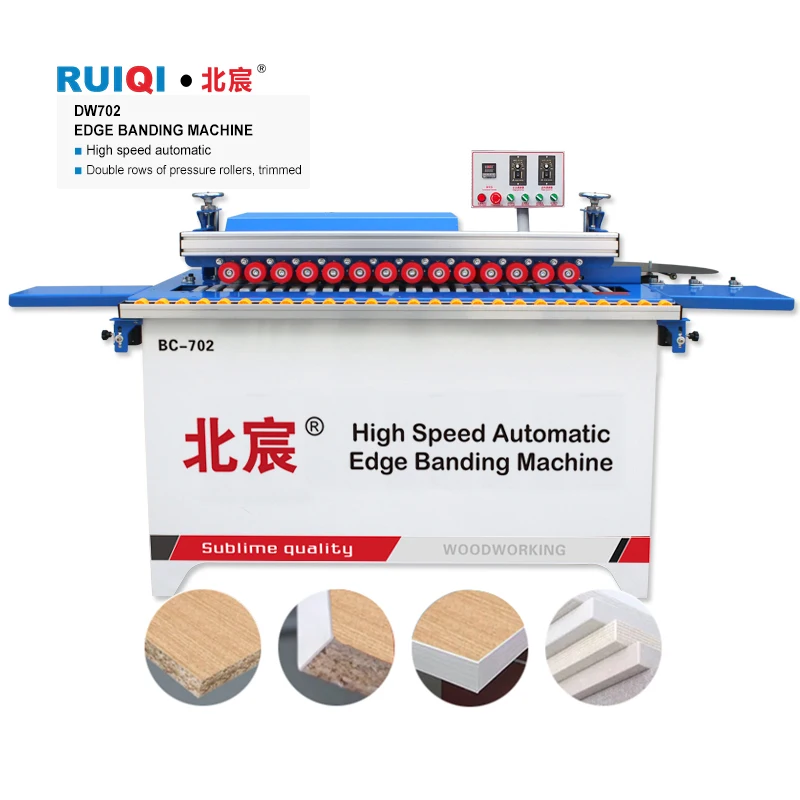
Compact Footprint, Full Function — the DW702 integrates banding, trimming, polishing and automatic head/tail cutting into a 120×55×110CM frame built for workshops where floor space and power supply constrain every equipment decision.
Technical Specifications
| Parameter |
Value |
| Model |
DW702 |
| Product Type |
Automatic Edge Banding Machine |
| Total Power |
3800W |
| Voltage Options |
220V / 380V / Custom |
| Edge Banding Thickness Range |
0.3–3mm |
| Edge Banding Height Range |
0–50mm |
| Minimum Sheet Length |
250mm |
| Minimum Sheet Width |
100mm |
| Trimming Motor Power |
800W × 2 |
| Polishing Motor Power |
180W × 2 |
| Vacuum Motor Power |
1200W |
| Edge Feed Motor |
20W |
| Transmission Motor |
140W |
| Glue Pot Capacity |
1000ml |
| Air Source Pressure |
0.4–0.8 MPa |
| Overall Dimensions |
120 × 55 × 110 cm |
| Net Weight |
105 kg |
| Key Features |
Edge banding, trimming, polishing, automatic head/tail cutting, vacuum feed |
Application Suitability
| Application |
Material or Output |
| Small-batch cabinet production |
MDF and particleboard panels with PVC edge banding |
| Custom furniture joinery |
Plywood and blockboard with veneer or melamine strips |
| Prototype and sample room use |
Mixed substrates for test pieces before main-line runs |
| Polymer door finishing |
Polymer and composite panel substrates up to 50mm edge height |
Why the Voltage Question Must Come Before the Quotation
Confirming workshop voltage and phase before ordering is the single most effective step to prevent a machine arrival that cannot run.
I once watched a small workshop owner in the Pearl River Delta wait three weeks for an electrician to rewire his shop after a brand-new edge bander arrived configured for 380V three-phase while his facility only had 220V single-phase supply. The entire production line sat idle, orders backed up, and the rewire cost nearly matched what a simple pre-order confirmation would have avoided. Mismatch between machine voltage and workshop infrastructure remains a documented reason small fabricators delay commissioning [NEED_CITE: common electrical mismatches in imported woodworking equipment]. The DW702 addresses this by offering 220V and 380V configurations plus custom voltage options, but only if the conversation happens before production begins.

A Self-Contained Station for Joinery Shops Moving Off Hand Tools
Transitioning from manual edge finishing to a machine process usually means adding several separate stations — a bander, a trimmer, a buffer — each consuming floor space and electrical capacity a small shop may not have. The DW702 collapses that sequence into one automatic edge banding machine compact workshop operators can place against a wall. At 105 kg it requires no dedicated foundation, and its 120 × 55 cm footprint leaves room for a sliding table saw or panel router on the same shop floor.
What the 0.3–3mm Banding Range Means for Daily Production
Most small custom furniture and cabinet shops work with PVC, veneer, and melamine edge banding in thicknesses that fall squarely within 0.3 to 3mm. This range covers the standard materials a joinery workshop stocks for MDF and particleboard cabinet carcasses, shelving units, and built-in furniture. The 1000ml glue pot handles short production runs without constant refilling, and the 0–50mm edge height range accommodates the panel thicknesses typical in residential cabinetry [NEED_CITE: standard edge banding material thickness ranges in cabinet manufacturing].
How Trimming and Polishing Stations Affect Edge Quality Downstream
The two 800W trimming motors remove excess banding material flush with the panel surface, which directly determines whether assembled cabinet boxes sit square. If trimming leaves even a slight overhang, panels will not meet cleanly at corners, and the defect compounds through assembly. The dual 180W polishing motors then smooth the trimmed edge, removing the micro-scorch marks that hot-melt adhesive and trimming cutters can leave on PVC and melamine surfaces. For workshops producing visible cabinet interiors or open shelving, this finishing pass is what separates a hand-made appearance from a factory-grade finish.
The Hidden Cost of Ordering Without Checking Feed Compatibility
Buying a single automatic edge banding machine compact workshop owners hope will replace hand tools can turn into a bottleneck if the minimum sheet dimensions do not match the offcuts the shop actually processes. A machine that cannot accept sheets below a certain width forces the operator to gang small pieces together before banding, adding handling steps that erase the efficiency gain. The DW702 accepts minimum sheet dimensions of 250mm length and 100mm width, which covers most offcut sizes generated during cabinet component cutting [NEED_CITE: typical offcut dimensions in small-batch cabinet fabrication]. Without verifying these limits against your actual panel sizes, the machine sits idle while operators hand-trim narrow drawer fronts and shelf brackets.
Why Procurement Rigor Matters at This Scale
The manufacturer operates a four-stage quality control process covering incoming material, in-process assembly, finished product testing, and pre-shipment verification — applied equally to single-unit orders and large production runs. The DW702 ships with a factory test record documenting performance on your specified substrate, so you see evidence of edge quality before the crate is sealed. Voltage and plug configuration are confirmed against your local supply standard before production begins, not discovered at the dock. The engineering team provides configuration recommendations rather than catalog pushes, and formal quotations arrive within 24 hours of inquiry. Custom control panel languages and operator manuals are included as standard options, not treated as expensive add-ons.
Documentation & Verification
- CE declaration of conformity specific to the DW702 model configuration
- Electrical schematic confirming your ordered voltage, phase, and plug type
- Factory test record with sample panels processed in your substrate material
- Operation and maintenance manual in your operator's working language
- Spare parts list with part numbers matching your machine serial number
Installation, Commissioning & Support
- Requires a level floor section of approximately 120 × 55 cm with no dedicated foundation work due to 105 kg net weight
- Dedicated circuit matching ordered voltage — 220V single-phase or 380V three-phase — installed before delivery
- Arrives partially assembled; trimming and polishing stations require alignment check after transit
- First-run commissioning includes glue pot temperature calibration for your specific banding material
- Vacuum feed system requires connection to compressed air supply at 0.4–0.8 MPa
- Trimming cutter replacement intervals depend on banding material hardness and daily run length
What to Include in Your Inquiry
To receive a configuration proposal matched to your workshop, share your primary panel substrate and the edge banding material type and thickness you plan to run. Provide your available voltage and phase so the electrical package is specified correctly before production. If your operators work in a language other than Chinese or English, state this upfront so the control panel and manual are prepared accordingly.
Frequently Asked Questions
Q: My workshop only has 220V single-phase — can the DW702 run on this supply?
A: Yes. The DW702 is available in 220V single-phase configuration with a total power draw of 3800W. Plug options include EU, USA, AU, and UK standards. Confirm your local voltage and frequency before ordering so the electrical package matches your supply exactly and avoids commissioning delays.
Q: Can the control panel display in my operator's language?
A: Chinese and English are the default language options. Additional languages can be configured at the time of order. Specify the required language during the inquiry stage so the control interface and operation manual are prepared before the machine ships to your workshop.
Q: What edge banding materials work with the 1000ml glue pot?
A: The DW702 handles PVC, veneer, and melamine edge banding from 0.3mm to 3mm thickness. Standard hot-melt EVA adhesive is used in the glue pot. For best adhesion results, match the glue temperature setting to your specific banding material type and workshop ambient temperature.
Q: What happens when my production volume grows beyond this machine?
A: The manufacturer offers a full range of edge banding and panel processing equipment within the same product family, so scaling up does not require switching suppliers. Upgrading to a higher-throughput model later keeps you within the same configuration logic, documentation format, and spare parts ecosystem.
Q: How is the machine packed and what support comes with delivery?
A: The DW702 ships with packing photographs and customs documentation support. Installation guidance is provided remotely, and the operation manual covers first-run setup including glue pot calibration, trimming alignment, and vacuum feed adjustment. Spare parts list is included in the shipment.