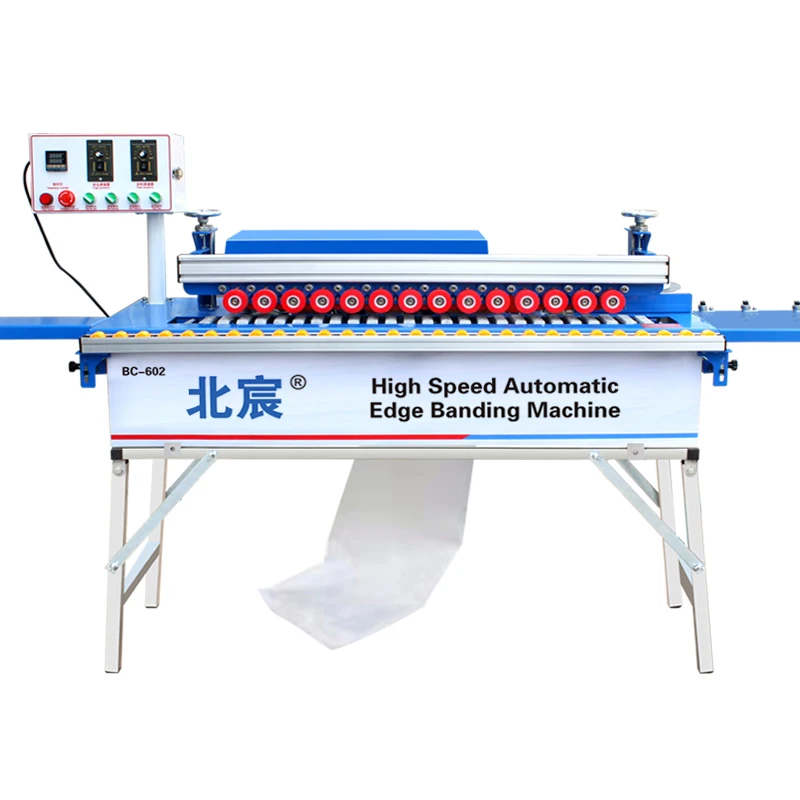
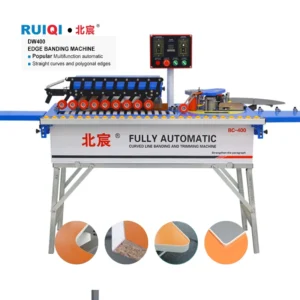
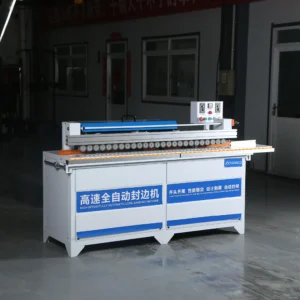
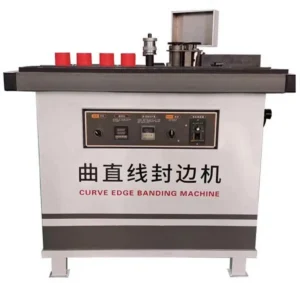
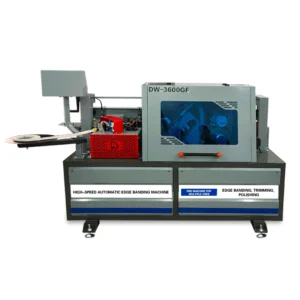
Benchtop readiness — fully assembled at 90 kg with voltage configurable from 220V to 380V, so the DW602 reaches your workshop plug-ready rather than waiting for an electrician.
Technical Specifications
| Parameter |
Value |
| Model |
DW602 |
| Product Type |
Portable Curved Edge Banding Machine |
| Total Power |
3800 W |
| Voltage Options |
220V / 380V / customization |
| Edge Banding Height Range |
0–50 mm |
| Edge Banding Thickness Range |
0.3–3 mm |
| Minimum Sheet Dimensions |
25 cm (L) × 5 cm (W) |
| Glue Pot Capacity |
1000 ml |
| Trimming Power |
650 W × 2 |
| Polishing Power |
180 W × 2 |
| Vacuum Hold-Down Power |
1200 W |
| Edge Feed Power |
20 W |
| Transmission Power |
60 W |
| Air Source Pressure |
0.5–0.8 MPa |
| Overall Dimensions (L×W×H) |
128 × 47 × 69 cm |
| Net Weight |
90 kg |
| Assembly State |
Fully assembled, benchtop format |
| Language Options |
Chinese, English; other languages customizable |
| Plug Options |
EU, USA, AU, UK |
| Key Features |
Edge banding, trimming, polishing, automatic head and tail cutting, vacuum hold-down |
Application Suitability
| Application |
Material or Output |
| Custom cabinet door profiling |
MDF and plywood panels with curved or radiused edges |
| Small-batch furniture components |
Particleboard and blockboard with PVC or veneer banding |
| Joinery workshop mechanization |
Solid wood panels transitioning from hand-trimmed edges |
| On-site carpentry finishing |
Polymer door panels and shaped substrate pieces |
| Prototype and sample production |
Short runs of melamine-faced board before committing to full-line tooling |
Why Voltage Confirmation Must Precede Every Portable Curved Edge Banding Machine for Small Workshop Order
A machine wired for the wrong frequency will overheat its trimming motors within the first production run.
I once shipped a compact edge bander to a Southeast Asian cabinet shop without confirming whether their workshop ran on 50 Hz or 60 Hz single-phase supply. The glue pot reached temperature, but the trimming spindles ran hot and the polishing wheels left burnish marks on PVC banding. Two nights of remote parameter adjustments brought it back, but the operator had already lost confidence in the equipment. That experience sits behind every voltage confirmation form we now require before production begins [NEED_CITE: voltage and frequency standards by export market]. A portable curved edge banding machine for small workshop environments cannot rely on industrial three-phase infrastructure, which makes the plug and frequency question the first conversation, not an afterthought.

Footprint That Fits Before You Commit to Floor Space
The DW602 occupies 128 × 47 × 69 cm and weighs 90 kg, meaning it sits on a standard steel workbench without requiring a dedicated foundation or anchor bolts. For a joinery startup moving from hand-held routers and manual edge trimming, this benchtop format removes the capital risk of pouring concrete pads or rearranging existing machinery. The vacuum hold-down system draws 1200 W and requires an air source between 0.5 and 0.8 MPa, so the compressor already running your nail guns or spray booth can serve double duty.
One-Pass Workflow Without a Conveyor Line
This portable curved edge banding machine for small workshop use integrates edge feeding, automatic head and tail cutting, trimming, and polishing into a single pass across the benchtop. The operator positions the panel against the vacuum platen, feeds the banding strip, and the machine handles the contour — whether straight, curved, or radiused. There is no downstream trimming station to align and no separate polishing wheel to calibrate. For a workshop producing fewer panels per day than a full automated line would justify, consolidating every edge-finishing step into one footprint eliminates the bottleneck that piecemeal equipment creates [NEED_CITE: throughput matching between edge banding stations in small workshops].
Reading the Numbers That Actually Matter on the Shop Floor
The trimming motors deliver 650 W each, which is the threshold needed to cleanly shear 3 mm PVC banding without chipping the substrate edge on MDF. Below that power level, the trimming cutters drag and leave micro-fractures that show up under lacquer. The glue pot holds 1000 ml — sized deliberately for intermittent small-batch work rather than continuous production, so the adhesive does not degrade from prolonged heating between jobs. The 0.3–3 mm banding thickness range covers melamine tape for particleboard up through solid wood veneer strips for blockboard. Panel edge heights from 0 to 50 mm accommodate everything from 16 mm cabinet shelving up to thick countertop stock. Air pressure between 0.5 and 0.8 MPa drives the vacuum hold-down and the pneumatic trimmer actuators; running below that range causes inconsistent clamping on curved profiles.
The Cost of Skipping the Substrate Conversation
Sending a machine configured for standard melamine-faced chipboard into a workshop that primarily processes curved plywood edges leads to mismatched glue temperature and feed speed. The adhesive bonds initially but fails peel tests within days because the plywood grain absorbs heat differently than a homogeneous substrate. I have seen this exact scenario require remote recalibration across multiple time zones, delaying the customer's first delivery [NEED_CITE: adhesive temperature profiles for plywood versus particleboard edge banding]. The portable curved edge banding machine for small workshop applications must be tuned to the actual material the operator loads, not the material quoted in the brochure.
Why Procurement Through This Channel Reduces Arrival Risk
Voltage and plug format are confirmed at order stage — EU, USA, AU, or UK — so the unit arrives with a cord that fits your workshop outlet rather than requiring a local adapter or rewire. Operation manuals are supplied in the agreed language before the crate ships, preventing commissioning delays when the operator cannot read the control labels. Every unit undergoes a pre-shipment test using sample panels that match your substrate specification, with photographs documenting the edge finish quality. The single-unit order model means you can validate one DW602 in production before committing to additional machines, scaling without changing supplier. Engineering configuration recommendations are formalized within 24 hours of inquiry, keeping project timelines moving [NEED_CITE: CE machinery directive requirements for woodworking equipment exports].
Documentation & Verification
- CE declaration of conformity covering portable edge banding equipment
- Factory test record using your specified panel thickness and banding material
- Electrical schematic confirming voltage, plug type, and circuit rating before dispatch
- Operation and maintenance manual delivered in the operator's agreed language
- Spare parts list identifying consumable trimmer blades and polishing pads
- Pre-shipment inspection photographs showing edge finish on your sample substrate
Installation, Commissioning & Support
- Place the 128 × 47 × 69 cm unit on a level steel bench rated for 90 kg plus panel load
- Connect to confirmed 220V or 380V supply on a dedicated circuit matching the 3800 W draw
- Supply compressed air at 0.5–0.8 MPa to the pneumatic inlet for vacuum and trimmer actuation
- Run first test panels matching your daily substrate to validate glue temperature and trimmer alignment
- Replace trimming cutters and polishing pads per the maintenance schedule in the supplied manual
- Reorder consumable banding feed rollers and glue pot seals through the documented spare parts list
What to Include When Requesting a Configuration
Provide the substrate materials you process most frequently — MDF, plywood, particleboard, or solid wood — along with typical panel thickness and whether edges are straight, curved, or both. Confirm your workshop voltage, frequency, and plug format so the machine ships wired correctly. Specify the operator's preferred language for the control panel and manual to avoid commissioning delays.
Frequently Asked Questions
Q: What voltage and plug format will the DW602 arrive with?
A: Voltage is confirmed at order stage from 220V, 380V, or a custom specification, and plug options include EU, USA, AU, and UK formats. We require written confirmation of your workshop supply before production so the unit ships with a usable cord and correct frequency rating, avoiding the rewiring delays that occur when assumptions are made.
Q: Can the operation manual and control labels be supplied in my local language?
A: Chinese and English are standard, with Spanish, French, and other languages available on request. We finalize the language selection at order confirmation so the manual and any panel labels are printed before the machine ships, ensuring the operator can follow setup and maintenance procedures from day one.
Q: What are the smallest and largest panels this machine can handle?
A: Minimum sheet dimensions are 25 cm in length and 5 cm in width, with edge banding height coverage from 0 to 50 mm and banding thickness from 0.3 to 3 mm. This range accommodates everything from small cabinet drawer fronts to thick countertop sections with solid wood veneer edging.
Q: Is a sample processing test available before I place the order?
A: Yes. Send representative panels and your preferred banding material to the factory, and we run a documented test showing edge adhesion, trimming quality, and polishing finish under your specified voltage. Photographs and test records are shared for your approval before the production order is confirmed.
Q: What spare parts are included, and how do I reorder consumables?
A: Each unit ships with a spare parts list identifying trimmer blades, polishing pads, and glue pot seals. Initial consumables are included in the crate, and reorder part numbers are documented in the manual so you can source replacements without waiting for a service visit.