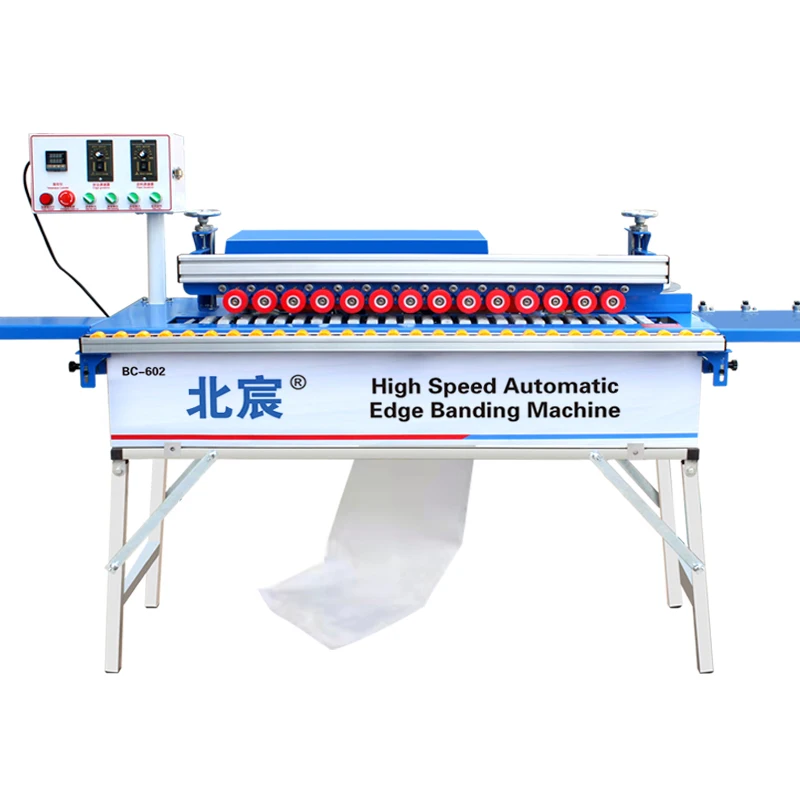
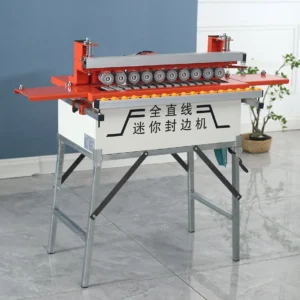
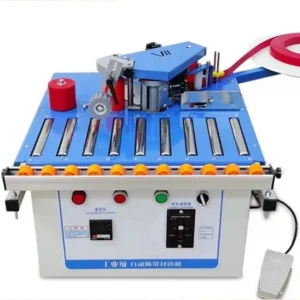
Compact Footprint, Production-Ready — the DW602 is configured for workshops that need an automatic edge banding machine in stock and operational the week it arrives, not a unit that demands a facility overhaul before it can run.
Technical Specifications
| Parameter |
Value |
| Model |
DW602 |
| Product Type |
Automatic Edge Banding Machine |
| Rated Power |
3800 W |
| Voltage & Frequency |
220V / 380V / customization (frequency to be confirmed) |
| Control System |
Operation panel available in Chinese, English, or customizable to other languages |
| Overall Dimensions (L×W×H) |
128 × 47 × 69 cm |
| Net Weight |
90 kg |
| Minimum Sheet Length |
25 cm |
| Minimum Sheet Width |
5 cm |
| Edge Banding Height Range |
0–50 mm |
| Edge Banding Thickness Range |
0.3–3 mm |
| Edge Power |
20 W |
| Transmission Power |
60 W |
| Trimming Power |
650 W × 2 |
| Polishing Power |
180 W × 2 |
| Vacuum Power |
1200 W |
| Air Source Pressure |
0.5–0.8 MPa |
| Glue Pot Capacity |
1000 ml |
| Key Features |
Edge banding, trimming, polishing, automatic head and tail cutting, vacuum hold-down |
| Assembly State |
Skid-mounted, ready to connect |
Application Suitability
| Application |
Material or Output |
| Custom cabinet door edging |
MDF and particleboard with 0.4–2 mm PVC strips |
| Small-batch furniture assembly |
Plywood panels and blockboard with veneer banding |
| Joinery workshop production |
Solid wood edge banding on shelving and carcass components |
| Polymer door finishing |
PVC and composite panel substrates requiring clean trimmed edges |
| Startup workshop scaling |
Transitioning from hand-held edge trimmers to consistent machine-fed output |
Why Voltage Confirmation Must Happen Before You Pay
A machine built for the wrong frequency will burn out its motors within the first production run, leaving you with a heavy paperweight and no recourse.
I have watched small workshop owners lose weeks of production because the automatic edge banding machine in stock they ordered arrived wired for a grid that does not exist in their region. The DW602 ships with configurable voltage options, but the 50 Hz versus 60 Hz distinction is not a detail the factory can guess from your shipping address. Confirming your local supply standard before the unit leaves the floor is the single most important step in the ordering process [NEED_CITE: voltage and frequency standards by export market]. When this step is skipped, the trimming motors overheat, the glue pot fails to reach temperature, and the vacuum hold-down loses suction — all symptoms that look like defects but are actually configuration errors.
Ready Stock Means Faster Commissioning, Not Compromise
When a joinery workshop needs to move from manual edge trimming to machine-fed consistency, waiting eight weeks for a custom build is often not an option. This automatic edge banding machine in stock configuration is built around a skid-mounted frame that arrives at your shop floor requiring only power connection, air supply hookup, and a glue load to begin running panels. The 128 cm length fits against a wall in most small workshops, and the 90 kg weight means two people can position it without a forklift.
What Entry-Level Actually Means for Your Daily Volume
The DW602 is designed for workshops producing custom pieces in low-to-medium daily volumes — think cabinet runs of twenty to forty panels per session, not continuous eight-hour production shifts feeding a large furniture plant. Pushing this class of machine beyond its intended duty cycle accelerates wear on the feed chain and trimming cutters [NEED_CITE: equipment duty cycle and component lifespan in woodworking]. Matching the machine tier to your actual throughput prevents the situation where a startup buys a compact bander, wins a large contract, and discovers the machine cannot keep pace without frequent cooldown stops.

How the Spec Sheet Translates to Panel Quality
The 0.3–3 mm edge banding thickness range covers the PVC and veneer strips that small workshops use most frequently, but it does not extend to the thicker ABS or solid wood lipping required by heavy-duty commercial furniture. The dual 650 W trimming motors handle flush trimming on standard substrate thicknesses, while the 180 W polishing wheels clean residual adhesive from the panel face. The 1000 ml glue pot is sized for intermittent production — large enough to run a full morning session without refilling, but small enough that adhesive does not degrade from prolonged heating when the machine sits idle between jobs. The 0.5–0.8 MPa air pressure requirement is compatible with standard workshop compressors, though the supply must be clean and dry to prevent moisture from contaminating the glue line [NEED_CITE: compressed air quality standards for pneumatic woodworking equipment].
What Happens When the Machine Tier Does Not Match the Work
Forcing panels thicker than the designed range through an entry-level bander damages the feed wheels and misaligns the trimming heads — a repair that takes the machine offline while replacement parts ship. Equally common is running the unit at production volumes suited to a full-line machine, which causes premature wear on the chain track and inconsistent glue application. These failures are not manufacturing defects; they are sizing errors that could have been avoided by matching the DW602 to the workload it was built to handle.
Why Procurement Through This Channel Works for Small Workshops
The configuration recommendation comes from engineers who have seen what happens when a compact machine is pushed into high-volume duty, so the proposal you receive accounts for your actual panel sizes and daily throughput rather than just the model number you initially asked about. Voltage and control panel language are confirmed in writing before production begins, eliminating the commissioning delays that arise when an operator cannot read the interface. Every unit undergoes pre-shipment testing on panel stock within the specified thickness range, and the test record ships with the documentation package so you can verify performance before the crate is opened. The upgrade path to full-function pre-milling models exists within the same product family, meaning your next machine can come from the same supplier without retraining your team on a different control architecture.
Documentation & Verification
- CE declaration of conformity specific to the DW602 edge banding configuration
- Electrical schematic confirming your ordered voltage and frequency before dispatch
- Factory test record run on panel thickness within your specified range
- Operation and maintenance manual in the language you confirm at order
- Spare parts list with part numbers matching the components in your unit
Installation, Commissioning & Support
- Floor space requirement of 128 × 47 cm with clearance for panel infeed and outfeed
- Dedicated circuit matching confirmed voltage with correct breaker rating for 3800 W total draw
- Compressed air supply at 0.5–0.8 MPa with inline moisture filter before the machine connection
- Glue pot first fill and temperature calibration performed during initial power-on sequence
- Feed chain tension and trimming head alignment checked after the first fifty panels
- Replacement trimming cutters and feed wheel segments available through standard reorder
What to Include in Your Inquiry
To match the right configuration to your workshop, provide the maximum panel thickness you will process, the edge banding materials you plan to run, your local voltage and frequency standard, and the language your operators need on the control panel. If you have existing upstream saws or downstream boring machines, note their feed heights so the DW602 integrates without manual lifting between stations.
Frequently Asked Questions
Q: What panel sizes and daily volumes is the DW602 realistically designed for?
A: The DW602 handles sheets from 25 cm minimum length and 5 cm minimum width, with edge banding heights up to 50 mm. It is built for workshops running custom cabinet and furniture panels in low-to-medium daily sessions rather than continuous high-volume production lines, keeping component wear predictable and glue quality consistent across each batch.
Q: Can I order a single unit from ready stock, and what is the dispatch lead time?
A: Single-unit orders are standard for this model, and stock units are prepared for fast dispatch once voltage, frequency, and control panel language are confirmed in writing. Lead times vary by current inventory and destination logistics, which are quoted at the time of order confirmation.
Q: Which plug types and voltage options ship with the machine?
A: The DW602 supports 220V and 380V configurations with further customization available, and the correct plug type for your destination market is fitted before dispatch. Frequency must be confirmed as 50 Hz or 60 Hz to ensure motor and heating element compatibility with your local grid.
Q: Is a curved-edge or pre-milling upgrade path available if my volume grows?
A: The DW602 handles straight and curved edge banding within its thickness range. When your production volume or panel specification requirements outgrow this tier, full-function pre-milling models within the same product family offer the next step without requiring your team to learn a different control system.
Q: What spare parts are included and how are replacements sourced?
A: Each unit ships with a spare parts list detailing consumable components such as trimming cutters and polishing wheels. Replacement parts are ordered using the part numbers in your documentation package and shipped directly, keeping downtime to a minimum for workshops without local service agents.