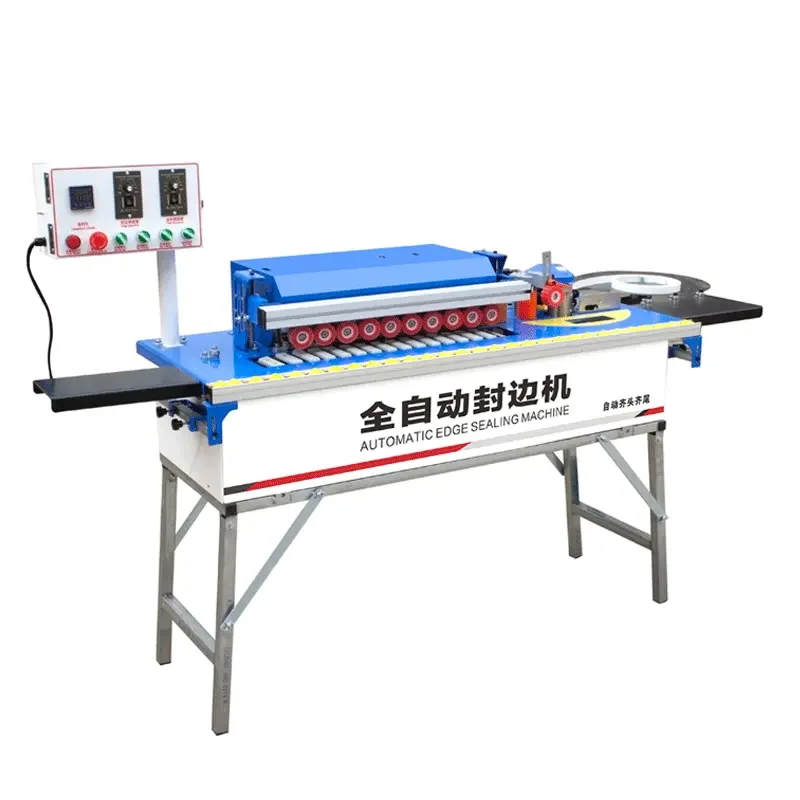
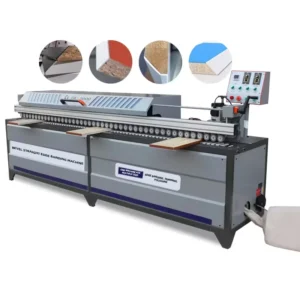
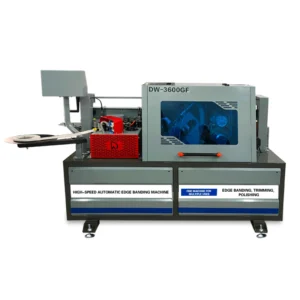
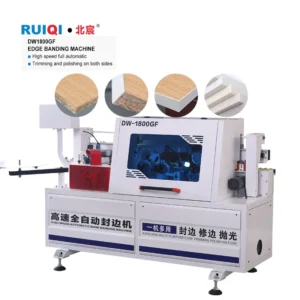
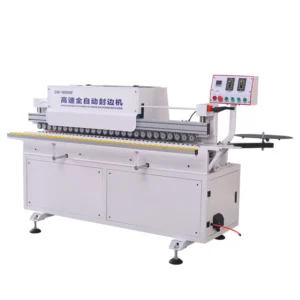
Compact automation footprint — the DW102 fits small workshops moving from hand-edge work to machine finishing without a production line commitment.
Technical Specifications
| Parameter |
Value |
| Model |
DW102 |
| Product Type |
Automatic Edge Banding Machine |
| Total Power |
3800W |
| Voltage |
220V/380V/customization |
| Standard Features |
Curved and straight edge banding, edge trimming, polishing, automatic head and tail cutting, with vacuum |
| Minimum Sheet Length |
25CM |
| Minimum Sheet Width |
5CM |
| Edge Banding Height |
0-50MM |
| Edge Banding Thickness |
0.3-3MM |
| Edge Power |
20W |
| Transmission Power |
60W |
| Trimming Power |
650W*2 |
| Polishing Power |
180W*2 |
| Vacuum Power |
1200W |
| Air Source Pressure |
0.5-0.8Mpa |
| Glue Pot Capacity |
1000ml |
| Product Size |
1284769CM |
| Product Weight |
75KG |
| Language Options |
Chinese, English, Spanish, other languages customizable |
| Plug Options |
EU, USA, AU, UK |
Application Suitability
| Application |
Material or Output |
| Custom cabinet doors |
Medium density fiberboard (MDF) |
| Wardrobe and shelving panels |
Particleboard and plywood |
| Curved furniture components |
Solid wood panels and blockboard |
| Polymer door finishing |
PVC and standard edge banding materials |
Why Voltage Verification Matters Before the Edge banding machine in stock Ships
Confirming your local frequency and phase before dispatch prevents a machine that arrives but never runs.
Many entry-level machines are quoted on catalog specs without checking whether the buyer's workshop runs 50Hz or 60Hz, single or three-phase. The DW102 supports 220V and 380V configurations, but plugging a 380V three-phase unit into a single-phase outlet means the trimming motors will not start. The edge banding machine in stock must match your site supply, not just your budget.
When a unit arrives with the wrong voltage configuration, the cost is not just rewiring — it is downtime, a missed delivery to your own customer, and an operator standing beside a silent machine.

Footprint and Single-Operator Workflow
The DW102 measures 128×47×69 cm and weighs 75 kg, meaning it occupies roughly the same floor space as a standard workbench. One operator feeds the panel at the infeed side and collects the finished piece at the outfeed — no second pair of hands required for the trimming and polishing stages.
This edge banding machine in stock is designed for the joinery workshop where every square meter counts and where a dedicated edge banding station would displace a table saw or assembly bench.
Curved and Straight on One Unit
Shaped cabinet doors and radius panels typically require a separate machine or manual trimming. The DW102 handles both curved and straight edge banding within its 0.3–3 mm thickness range and 0–50 mm height envelope, so a small furniture maker does not need two machines to cover the full order book.
The 25 cm minimum sheet length and 5 cm minimum width also cover small drawer fronts and shelf brackets that larger edge banders cannot grip.
How Specs Translate at the Bench
The 1000 ml glue pot holds enough adhesive for a full shift of cabinet work without constant refills, and the 0.5–0.8 MPa air pressure range is compatible with standard workshop compressors. The twin 650W trimming motors remove excess banding cleanly from both faces of a 18 mm MDF panel in one pass, while the dual 180W polishing wheels leave a smooth finish on PVC edges.
The 1200W vacuum holds the workpiece steady during the feed, which is necessary when running narrow panels like the 5 cm minimum width — without vacuum, thin stock drifts and the edge band shifts off center.
What Happens When Spec and Reality Drift Apart
An operator who cannot read the control panel stalls commissioning for days, waiting for a translated manual or a local technician who may not exist. A machine specified for thin PVC but fed 3 mm acrylic will show poor glue adhesion because the pot temperature and application volume were set for a different material.
These mismatches surface after the machine is bolted to the floor, not in the quotation stage.
Why Procure From This Source
The DW102 is manufactured in a facility that applies four-stage quality control — incoming material, in-process, finished product, and pre-shipment verification — with a test run on your specified panel thickness before the crate is closed. Voltage and plug type are confirmed at order, not assumed, so the machine you receive matches the socket on your workshop wall.
The engineering team provides a formal configuration proposal within 24 hours of receiving your sheet dimensions, daily volume, and material list, ensuring the DW102 is right-sized for your output rather than oversold.
Documentation & Verification
- CE declaration of conformity covering the DW102 electrical and mechanical safety requirements
- Electrical schematic with your confirmed voltage and plug type marked before dispatch
- Operation and maintenance manual in English, Spanish, or another agreed language
- Factory test record showing edge quality on your specified panel material and thickness
Installation, Commissioning & Support
- Requires a level concrete floor and a dedicated 16A circuit matching the confirmed 220V or 380V supply
- Delivered fully assembled — connect air supply at 0.5–0.8 MPa and power, then run a test panel
- Glue pot temperature and feed speed set during first commissioning based on your banding material
- Spare wear parts list provided, including trimming cutters and polishing wheels specific to the DW102
Request a Configuration Proposal
Share your primary panel material, typical sheet dimensions, and the edge banding stock you run most often, along with your workshop voltage and frequency. We confirm the DW102 configuration and respond with a formal quotation and lead time within one working day.
Frequently Asked Questions
Q: What panel materials and thicknesses can the DW102 handle in a small workshop?
A: The machine processes MDF, particleboard, plywood, blockboard, and solid wood panels. Edge banding thickness ranges from 0.3 mm to 3 mm and height from 0 to 50 mm, covering standard PVC, melamine, and veneer tapes used in cabinet and furniture work.
Q: How do I confirm the voltage and plug type match my local electrical supply?
A: Provide your workshop voltage, frequency (50 or 60 Hz), and phase (single or three-phase) at the inquiry stage. The DW102 is configured for 220V or 380V and fitted with EU, USA, AU, or UK plugs before dispatch.
Q: Can the control panel be supplied in English or another language I can read?
A: Yes. The DW102 control interface is available in Chinese, English, Spanish, and other languages on request. Specify your preference at order so the manual and on-screen labels match your operator's language.
Q: What is the upgrade path when my volume outgrows this machine?
A: The DW102 is the entry point in a product family that scales to full-function pre-milling models. When daily volume exceeds this unit's capacity, you can move to a higher-tier machine from the same range without changing supplier or retraining operators on a new control philosophy.
Q: How is the machine packed and what do I need to set it up on arrival?
A: The DW102 ships fully assembled in a crate. On arrival you need a level floor, the confirmed power supply, and an air compressor delivering 0.5–0.8 MPa. Connect air and power, load glue, and run a test piece to verify edge quality.