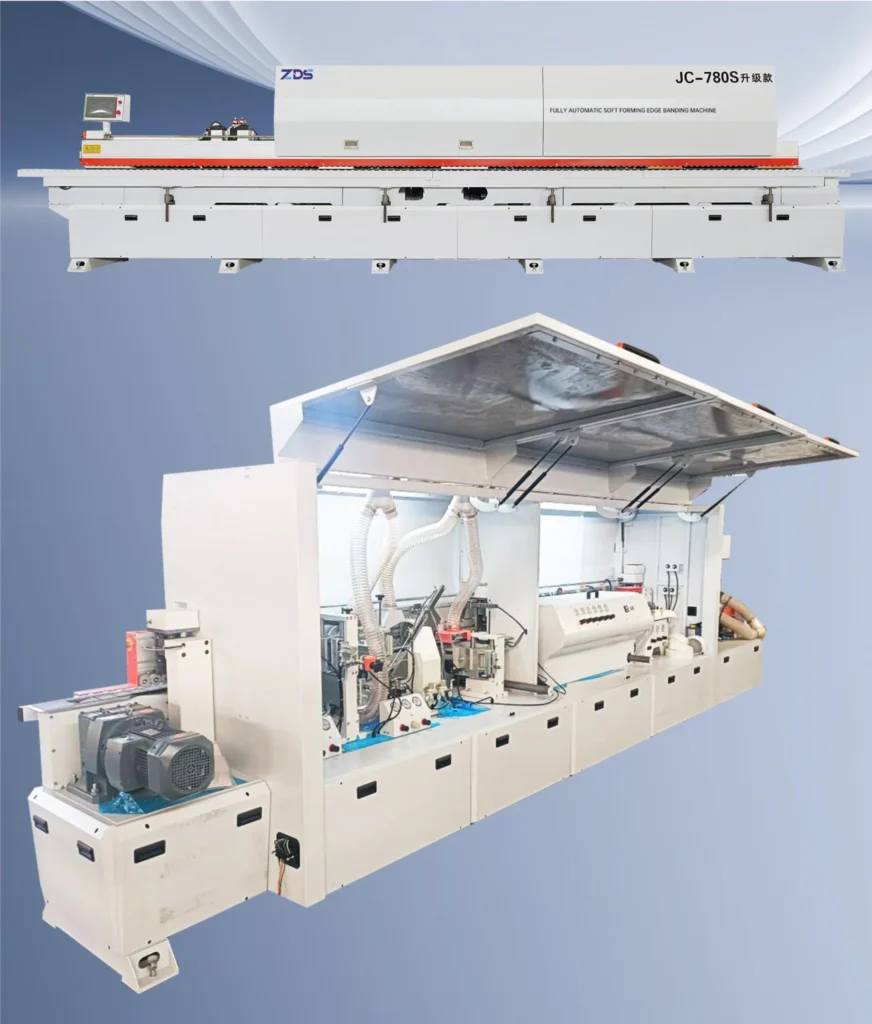
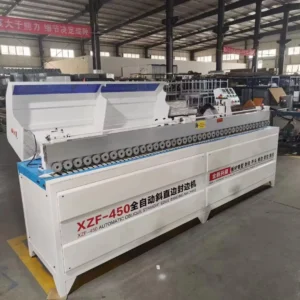
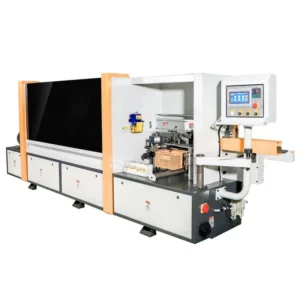
Compact footprint, ready stock — this soft forming edge banding machine ships with confirmed voltage and language configuration so it runs on day one in your workshop.
Technical Specifications
| Parameter |
Value |
| Model |
ZDSJC-780S |
| Product Type |
Soft Forming Edge Banding Machine |
| Overall Dimensions (L×W×H) |
7.26×1.07×1.85 m |
| Total Weight |
2500 kg |
| Total Power |
41 kW |
| Voltage |
380 V (configurable to other voltages on request) |
| Panel Thickness Range |
18–22 mm |
| Edge Banding Thickness |
0.5–0.8 mm |
| Edge Banding Width |
58 mm |
| Minimum Sheet Width |
150 mm |
| Minimum Sheet Length |
300 mm |
| Conveying Speed |
6–8 m/min |
| Air Supply Requirement |
≥0.6 MPa |
| Vacuum Opening Size |
Ф100×6 |
| Machining Shapes |
14 kinds (J type, C type, left/right half-pass, middle pass, concave, triangle, water drop, etc.) |
| Assembly State |
Requires assembly on site (manual and video guidance provided) |
| Warranty |
1 year |
Application Suitability
| Application |
Material or Output |
| Shaped-edge cabinet doors |
MDF and particleboard with 0.5–0.8 mm PVC strip |
| Profiled drawer fronts |
Plywood panels with veneer soft-forming edge band |
| Custom furniture shaped edges |
J-shape, C-shape, concave and triangle profiles on 18–22 mm board stock |
| Small-batch joinery production |
Short panels down to 150 mm width and 300 mm length |
Why the Voltage Question Should Come Before the Price
Confirm your workshop's power supply and frequency before any machine leaves the factory.
I once shipped a compact soft forming edge banding machine to a joinery in Portugal. The control panel arrived entirely in Chinese, and the operator spent a full day just trying to read the display before commissioning could even begin. The machine was technically fine — the configuration was wrong for the people using it. This soft forming edge banding machine compact workshop configuration starts with your local voltage, frequency, and preferred control language before production begins. Voltage mismatches and unreadable interfaces are the two most common reasons a new machine sits idle after delivery [NEED_CITE: voltage and frequency standards by export market].

14 Profile Shapes Without a Full Production Line Commitment
Most small workshops add shaped-edge capability by outsourcing or buying multiple single-purpose machines. The ZDSJC-780S handles 14 distinct profiles — J type, C type, half-pass on either side, middle pass, concave, triangle, water drop — on one machine frame. For a joinery shop moving from hand-held edge trimmers to automated soft forming, this means one operator and one floor footprint covers the shaped-edge range your customers are asking for.
Feed Speed Matched to Small-Batch, High-Mix Output
The 6–8 m/min conveying speed is not designed for high-volume continuous runs. It is matched to workshops where the next panel might be a different profile, a different board thickness, or a different edge material. At this rate, an operator can run short batches of shaped-edge components — cabinet doors in the morning, drawer fronts after lunch — without constant changeover pressure [NEED_CITE: feed speed and batch size in small workshop production].
What Panel Thickness and Edge Thickness Mean for Your Daily Output
The 18–22 mm panel range covers standard furniture board stock — most MDF, particleboard, and plywood used in cabinet and furniture work falls within this window. The 0.5–0.8 mm edge banding thickness is the working range for PVC and veneer soft-forming strips, which are flexible enough to follow J and C profiles without cracking. If your shop commonly runs boards thinner than 18 mm or edge strips thicker than 0.8 mm, a different machine class is needed. The Ф100×6 vacuum openings and ≥0.6 MPa air supply keep the strip seated against curved profiles during forming.
The Cost of Buying a Machine That Does Not Fit Your Panels
A soft forming edge banding machine compact workshop buyers choose based on price alone often fails on panel dimensions. If your shortest workpieces are under 300 mm, they cannot pass through the feed system cleanly. If your workshop air supply cannot maintain 0.6 MPa consistently, the vacuum grip on shaped profiles drops and edge quality becomes unpredictable. These are not defects — they are mismatches between the machine's working envelope and your actual production [NEED_CITE: compressed air stability and edge quality in soft forming].
Why Buyers Source This Configuration Here
In-house manufacturing with patented cutting mechanisms means tolerance claims are verifiable on your own sample panels before shipment. Voltage, language, and specification customization are handled as standard order items, not special requests. The four-stage QC process covers incoming material through pre-shipment verification, and a factory test record on your panel thickness range ships with every machine. Engineer-led configuration means someone reviews your workshop's power supply and panel format before the order is confirmed.
Documentation & Verification
- CE declaration of conformity for this soft forming machine class
- Factory test record on your 18–22 mm panel stock before dispatch
- Electrical schematic with confirmed voltage and frequency for your site
- Operation manual supplied in your agreed language with profile setup guides
- Spare parts list covering consumable cutters and guide rollers for first year
Installation, Commissioning & Support
- 7.26 m length requires clear floor path for positioning in workshops under 50 square metres
- 41 kW total power needs a dedicated 380 V circuit with confirmed breaker rating
- Machine ships in assembly-required state with video guidance for on-site setup
- Six vacuum openings require connection to your existing dust extraction system
- First commissioning includes parameter setting for your chosen edge profiles and feed speed
- One-year warranty covers components with spare parts list included at delivery
Before You Request a Quote
Send your typical panel dimensions including the shortest and narrowest pieces you plan to run. Confirm your workshop voltage and frequency, your preferred control panel language, and which of the 14 profile shapes you need most often. If you have an existing compressor, share its rated pressure and flow capacity so the air supply requirement can be verified before the order is placed.
Frequently Asked Questions
Q: Can this machine be configured for voltages other than 380 V?
A: Yes. The ZDSJC-780S is available with voltage configurations from 110 V to 440 V depending on your local supply. Voltage and frequency must be confirmed before production begins so the motor, transformer, and control components are matched to your workshop's power system. Always share your exact supply specification when requesting a quote.
Q: Which profile shapes work best with 0.5 mm versus 0.8 mm edge banding?
A: Thinner 0.5 mm PVC strips follow tight curves like water drop and triangle profiles more easily, while 0.8 mm strips provide better durability on J-shape and C-shape profiles where the edge sees more contact. The machine handles both thicknesses across all 14 shapes, but edge material selection should match the profile geometry and end-use of the panel.
Q: What is the smallest panel this machine will accept?
A: The minimum sheet width is 150 mm and the minimum sheet length is 300 mm. Panels smaller than these dimensions will not feed reliably through the conveyor and forming stations. If your production regularly includes offcuts below these limits, those pieces will need to be processed on a different machine or trimmed to size first.
Q: How much floor space and air supply does the ZDSJC-780S need?
A: The machine measures 7.26 m long by 1.07 m wide and requires operator clearance on both sides. Your compressor must deliver at least 0.6 MPa consistently to maintain vacuum grip across the six Ф100 openings. Unstable air pressure directly affects edge seating quality on curved profiles, so compressor capacity should be verified before installation.
Q: Is the control panel available in English or other languages?
A: The control panel can be supplied in English or other agreed languages. Language confirmation happens at the quotation stage, not at shipping. The operation and maintenance manual is also produced in your chosen language, covering profile setup, daily maintenance, and troubleshooting for all 14 machining shapes.