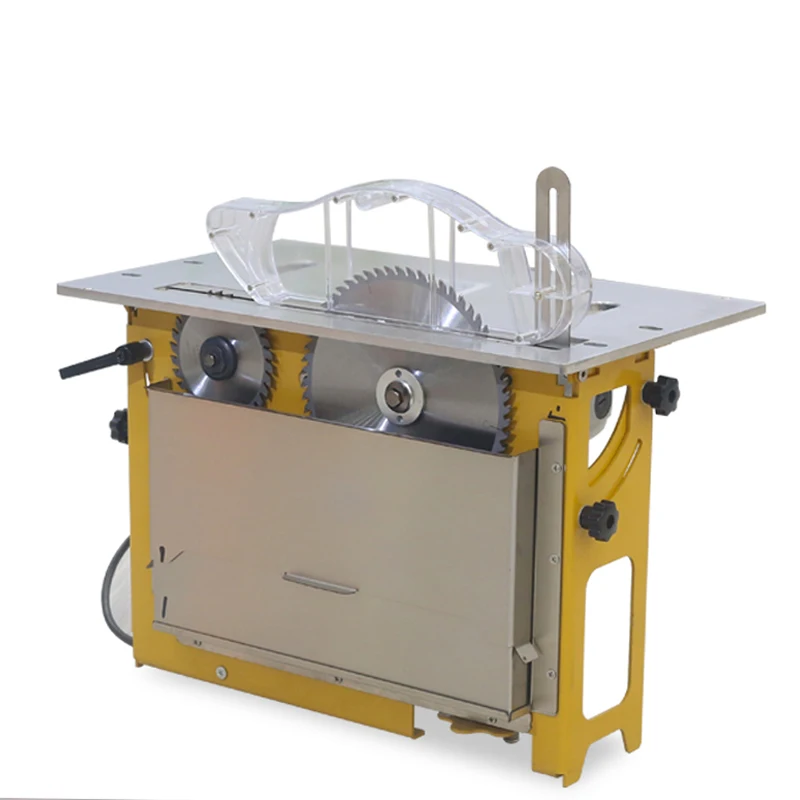
Voltage Configurable to Match Local Grids — this portable panel saw ships with confirmed voltage and plug standards so you never receive a machine that cannot run on your workshop's existing electrical supply.
Technical Specifications
| Parameter |
Value |
| Product Type |
Portable Sliding Table Panel Saw |
| Total Power |
6.2 kW |
| Main Saw Power |
3.0 kW |
| Main Saw Speed |
3800 r/min |
| Main Saw Blade Diameter |
200 mm |
| Scoring Saw Power |
2.0 kW |
| Scoring Saw Speed |
13000 r/min |
| Integrated Vacuum Power |
1.2 kW |
| Maximum Cutting Length |
2.44 m |
| Maximum Cutting Thickness |
40 mm |
| Net Weight |
22 kg |
| Machine Dimensions |
50 × 30 × 38 cm (source value — verify against manufacturer catalog) |
| Plug Options |
EU / USA / AU / UK |
| Language Options |
Chinese and English standard; other languages customizable |
| Control System |
Not stated in source |
| Voltage & Frequency |
Not stated in source — confirm with supplier |
| Feed Speed |
Not stated in source |
Application Suitability
| Application |
Material or Output |
| Small joinery workshop panel sizing |
MDF, particleboard, plywood sheets up to 2.44 m |
| Custom cabinet door and carcass cutting |
Melamine-faced chipboard and veneered panels |
| On-site carpentry and fit-out work |
Solid wood panels and laminated boards up to 40 mm thick |
| Startup workshop transitioning from hand tools |
Crosscutting and ripping standard sheet goods |
Why Voltage Should Be Confirmed Before You Click Order
A machine wired for the wrong frequency burns out its motor within hours, not months.
I have watched workshops receive woodworking equipment that sat idle for weeks because nobody asked whether the destination country runs on 50 Hz or 60 Hz. The portable panel saw in stock listing looked perfect online, arrived on time, and then tripped the breaker the moment the main motor engaged. The cost is not just the rewinding fee — it is the lost production window while the unit sits dead on the floor. [NEED_CITE: voltage and frequency standards by export market]
Small shops rarely keep a spare motor on hand, so a voltage mismatch turns a planned capacity upgrade into an unplanned downtime event. This is the reason we always ask for your local voltage and phase configuration before confirming a dispatch date, even when the unit is sitting in stock ready to ship.

A Complete Cutting Unit, Not a Bare Machine
Many entry-level saws ship without a scoring blade or dust extraction, forcing buyers to source add-ons separately and hope the components are compatible. This portable panel saw integrates a 2.0 kW scoring motor running at 13000 r/min alongside the main 3.0 kW blade, so melamine and veneered panels receive a clean score cut on the bottom face before the main blade completes the through-cut. The 1.2 kW vacuum unit connects directly to the extraction port, meaning you do not need a standalone dust collector occupying additional floor space.
Portability Without Sacrificing Cut Length
At 22 kg net weight, this saw can be repositioned within a small workshop or loaded onto a vehicle for on-site fit-out jobs. Despite the compact footprint, the sliding table accommodates full 2.44 m sheet lengths, which covers standard plywood and MDF panel sizes. The trade-off is that feed speed and panel width capacity depend on operator handling rather than powered feed rollers, so this machine suits batch sizes measured in dozens of panels per day rather than continuous production runs. [NEED_CITE: practical throughput limits for manually fed portable panel saws]
What the Specs Actually Mean on the Shop Floor
The 3800 r/min main saw speed paired with a 200 mm blade produces a peripheral cutting speed suitable for crosscutting and ripping common sheet materials without excessive tear-out. The 40 mm maximum cutting thickness handles standard 18 mm particleboard with room for double-stack cuts when needed. The scoring saw's 13000 r/min is the parameter that matters most for laminated panels — it ensures the bottom face score line is clean enough to prevent chipping on melamine and PVC-veneered substrates. If you work exclusively with raw plywood or solid wood and never use pre-finished panels, the scoring blade becomes a nice-to-have rather than essential, but once you start cutting melamine cabinet components, that second motor pays for itself on the first batch. The integrated 1.2 kW vacuum is sized for the dust volume a single operator produces, keeping the immediate cutting zone clear without the noise and power draw of a central extraction system.
What Happens When Feed Height and Throughput Do Not Match
I once helped a small cabinet maker who bought a compact saw based on price alone, only to discover the table height did not align with their existing roller stands, and the motor stalled when ripping 25 mm MDF at any reasonable feed rate. The portable panel saw in stock category attracts buyers looking for quick availability, but availability means nothing if the machine cannot handle your actual material thickness and daily panel count. A saw that works fine on 12 mm plywood will struggle and overheat on thicker density board, and the operator ends up forcing the panel, which ruins both the cut quality and the blade. [NEED_CITE: motor thermal overload risks in undersized woodworking saws]
Matching the machine to your heaviest recurring material, not your lightest occasional job, is the only way to avoid replacing it within the first year.
Why Source This Portable Saw Through Our Process
Every portable panel saw in stock is logged with its exact voltage configuration and plug type, so there is no guesswork when matching the machine to your workshop's electrical supply. The scoring blade and vacuum unit ship as integrated components, not as optional extras added to a base price after the initial quote. Pre-shipment testing includes a cut sample on the panel material you specify, documented in a factory test record you review before the crate is sealed. The operation manual is prepared in your requested language before dispatch, not translated after the machine arrives and sits waiting for the operator to decipher it. Spare parts documentation lists the exact scoring blade and main blade specifications so replacements can be sourced locally without waiting for international shipping on a single carbide insert.
Documentation & Verification
- CE declaration of conformity covering portable woodworking saw electrical safety requirements
- Factory test record showing cut samples on your specified panel material and thickness
- Electrical schematic confirming voltage, frequency, and plug type as configured for your market
- Operation and maintenance manual written in your agreed language before dispatch
- Spare parts list with exact blade diameter, bore size, and scoring blade specifications
Installation, Commissioning & Support
- Place the 22 kg unit on a level, stable workbench or dedicated stand capable of supporting feed forces
- Confirm workshop circuit supports the 6.2 kW total draw before first power-on
- Select matching plug type — EU, USA, AU, or UK — confirmed at order stage
- Verify scoring blade alignment on a test panel before beginning production cuts
- Schedule blade inspection after the first full sheet of melamine-faced board is processed
- Keep replacement scoring blades matching the documented bore and diameter on hand
Before You Request a Quote
Send the specific panel materials and thicknesses you cut most frequently, along with your workshop's voltage, phase, and frequency. If you have existing roller stands or workbenches that must align with the saw table height, include those dimensions so we can confirm compatibility. Let us know which language the operation manual and control labels should be in, and whether you need the machine dispatched from current stock or are willing to wait for a custom voltage configuration.
Frequently Asked Questions
Q: What panel materials and thicknesses can this portable saw handle cleanly?
A: The dual-motor system with scoring blade handles melamine-faced chipboard, veneered MDF, plywood, and solid wood panels up to 40 mm thick. The 13000 r/min scoring saw prevents bottom-face chipping on laminated surfaces. For best results on thicker density boards, feed rate should be controlled to match the 3.0 kW main motor capacity.
Q: How do I confirm the correct voltage and plug type for my country before ordering?
A: Provide your local voltage, phase, and frequency when you submit an inquiry. The machine is configurable from 110V to 440V, and plug options include EU, USA, AU, and UK standards. We confirm the exact electrical configuration in writing before dispatch so there are no compatibility surprises on arrival.
Q: What is the dispatch lead time for stocked units versus customized voltage configurations?
A: Units with standard voltage and plug configurations that match current stock can be dispatched rapidly after pre-shipment testing. Custom voltage or language configurations require a production window for rewinding and control panel preparation. Exact timing is confirmed once your electrical and language requirements are documented.
Q: Can the operation manual and control labels be provided in a language other than English?
A: Yes. Chinese and English are standard, but the operation manual and maintenance documentation can be prepared in Spanish, French, or other languages on request. Specify your preferred language at the inquiry stage so the documentation is ready before dispatch rather than translated after the machine arrives.
Q: How does this portable saw compare to a full-size sliding table saw in cutting accuracy and throughput?
A: This portable unit prioritizes compact footprint and transportability over automated feed speed and large-volume throughput. It handles the same panel materials and cut lengths as larger saws but relies on manual feeding, making it suited for smaller batch sizes and workshops where floor space or portability matters more than continuous production rate.