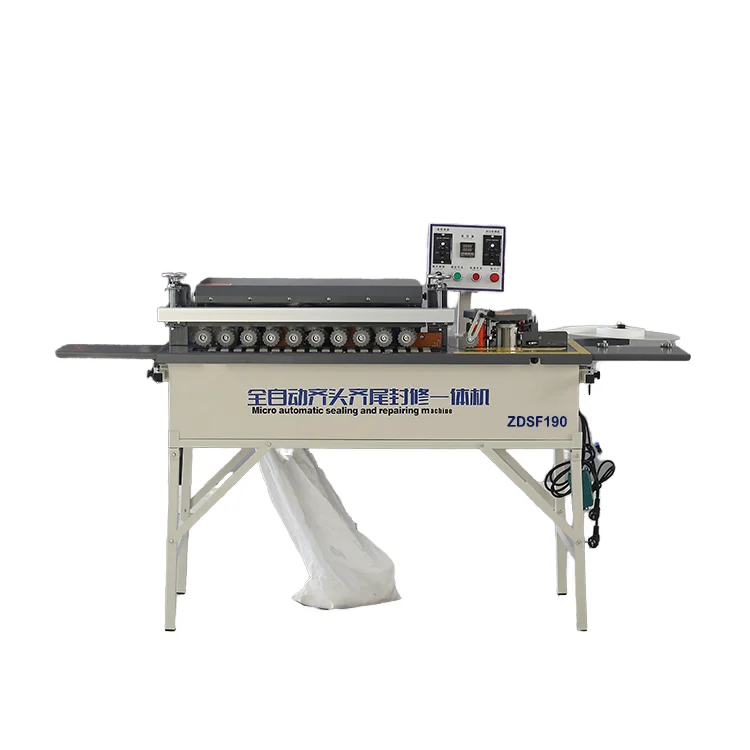
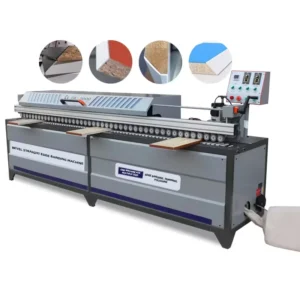
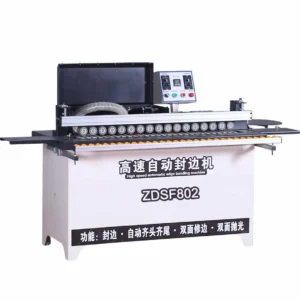
Fast Stock Readiness — ZDSF190 miniature edge bander held in ready-to-ship inventory, configured for 220V single-phase workshop environments and dispatched with voltage and manual language confirmed before crating.
Technical Specifications
| Parameter |
Value |
| Model |
ZDSF190 |
| Product Type |
Miniature Automatic Curved and Straight Edge Banding Machine |
| Function |
Automatic plate feeding, automatic belt breaking, double-sided gluing, upper and lower trimming and polishing, curved and straight edge banding |
| Edge Type |
Both curved and straight lines |
| Voltage & Frequency |
220V / 50Hz |
| Rated Power |
4 kW |
| Suction Power |
1200 W |
| Heating Power |
800 W |
| Trimming Power |
800 W × 2 |
| Polishing Power |
180 W × 2 |
| Belt Power |
25 W |
| Transmission Power |
120 W |
| Feed Speed |
0–14 m/min |
| Panel Thickness Range |
10–50 mm |
| Edge Strip Thickness Range |
0.5–2.5 mm |
| Glue Pot Capacity |
1000 ml |
| Rated Air Pressure |
0.4–0.6 MPa |
| Trimming Cutter |
4-edge arc-shaped alloy cutter head |
| Dust Extraction |
Large-diameter surrounding vacuum, dual collectors |
| Pressure Beam |
Adjustable aluminum alloy |
| Conveying System |
Double-row rubber pressure wheels, steel rod slide rails |
| Control Panel |
Multi-function button operation |
| Overall Dimensions (L×W×H) |
1900 × 560 × 1300 mm |
| Net Weight |
120 kg |
Application Suitability
| Application |
Material or Output |
| Custom cabinet door edging |
MDF and plywood panels with PVC edge banding on straight edges |
| Curved furniture component finishing |
Shaped plywood and particleboard with veneer or PVC strips |
| Small-batch joinery production |
Solid wood panels up to 50 mm thickness with 0.5–2.5 mm banding |
| Startup workshop first machine |
Mixed board types transitioning from hand-applied to machine-applied edge banding |
Why the Voltage Question Must Come Before the Order
A machine that arrives at the wrong voltage sits idle while your workshop pays for electrician visits and transformer installs.
I watched a cabinet shop lose three weeks of production because an edge bander arrived wired for 380V three-phase while the building only had 220V single-phase available. The owner had compared feed speeds and trimming stations but never confirmed what was coming out of his wall outlet. With small workshops buying their first automatic edge banding machine in stock for rapid deployment, a voltage mismatch defeats the entire purpose of a quick-dispatch purchase. The ZDSF190 is configured at 220V/50Hz single-phase as standard, specifically so a joinery shop can plug it into an existing circuit without hiring an electrical contractor first. [NEED_CITE: voltage and frequency standards by export market]

One Machine Footprint, Two Edge Profiles
Most entry-level banders force a workshop to choose between straight-line production and curved-edge capability. The ZDSF190 handles both within its 1900 mm frame length. The machine rotates 180 degrees to switch from straight panel feeding to curved contour banding, meaning a small custom furniture maker can edge-band a rectangular cabinet side in the morning and a shaped shelf profile in the afternoon without reconfiguring the shop floor. For workshops evaluating an automatic edge banding machine in stock that must earn its space every day, this dual-purpose design removes the need for a second dedicated unit.
Speed and Simplicity From Inquiry to Dispatch
Stocked inventory means the configuration conversation happens before the crate is sealed, not after the machine arrives. Voltage confirmation, control panel language selection, and a pre-shipment test run on the buyer's specified panel thickness all take place while the unit is still on the factory floor. This matters because a joinery startup typically cannot absorb a multi-week delay caused by discovering that the manual is in a language the operator cannot read or that the air pressure requirements exceed the shop compressor. Every ZDSF190 ships with these variables locked in advance, keeping the path from order to first production run as short as the logistics allow. [NEED_CITE: CE machinery directive requirements for industrial equipment]
Reading the Numbers That Actually Matter on the Shop Floor
The 10–50 mm panel thickness range covers the full spectrum of materials a small workshop encounters, from thin 10 mm MDF shelving stock up to 50 mm solid wood benchtops. Pairing that range with a 0–14 m/min variable feed speed lets the operator slow the feed for thicker, heavier panels where glue open time and trimming pressure need adjustment, then speed up for standard 18 mm particleboard cabinet components. The 4-edge arc-shaped alloy trimming cutter handles upper and lower trimming in one pass, and the dual 180 W polishing motors follow immediately to remove any residual scoring. Dust extraction through a large-diameter surrounding vacuum with dual collectors keeps the trimming zone clear, which directly affects edge finish consistency when running PVC banding that generates fine particulate during cutting. A 1000 ml glue pot is sized for intermittent small-batch work rather than continuous production line volumes, matching the duty cycle a startup or joinery shop actually runs.
What Happens When Configuration Details Get Skipped
Shops that buy on feed speed alone often discover the real cost later. A machine that lacks adjustable pressure beam settings will leave visible glue lines on thinner plywood because the clamping force is too aggressive, while warped particleboard passes through without sufficient contact. Operators who receive a control panel labeled in an unfamiliar language end up guessing at glue temperature settings, which causes banding delamination on curved profiles where adhesion is already under stress. When a single machine is purchased without considering the upstream panel saw output or downstream boring capacity, the bander becomes a bottleneck or sits underutilized. These mismatches do not show up in a specification sheet comparison but they consume real production hours once the equipment is on the floor. [NEED_CITE: common causes of edge banding adhesion failure on curved profiles]
Why Source This Unit Through Our Ready-Stock Channel
In-house manufacturing means every stocked ZDSF190 has passed through a four-stage quality check covering incoming components, in-process assembly, finished product testing, and pre-shipment verification before it enters inventory. Patented cutting mechanisms deliver the trimming precision that smaller workshops need when they cannot afford rework on expensive hardwood panels. Voltage and control language customization is handled as a standard step in the dispatch process rather than an afterthought, so the machine that arrives matches the workshop's actual electrical supply and operator skill level. An engineer reviews each order to confirm that the panel thickness range, air pressure supply, and intended edge strip material are compatible with the machine's configuration. Factory visits are welcomed for buyers who want to see the unit run their own sample panels before it ships.
Documentation & Verification
- CE declaration of conformity covering this specific miniature edge bander model
- ISO 9001 certificate confirming quality management system applicability
- Electrical schematic with 220V/50Hz wiring diagram for local electrician reference
- Factory test record run on buyer-specified panel thickness and edge strip material
- Operation and maintenance manual printed in the agreed operator language
- Spare parts list covering trimming cutters, pressure wheels, and glue pot components
Installation, Commissioning & Support
- Requires a dedicated 220V single-phase circuit rated for the 4 kW total draw plus compressor load
- Overall 1900 × 560 mm footprint fits standard workshop aisles with clearance for curved-edge rotation
- Connects to shop air supply at 0.4–0.6 MPa; verify compressor capacity before commissioning
- Dual dust collectors require two extraction hose connections to the 1200 W vacuum system
- First-run parameter setting covers glue pot temperature calibration for the specific PVC or veneer strip in use
- Trimming cutter replacement schedule based on cumulative linear meters of edge strip processed
Before You Request a Quote
To match the right unit to your workshop, share the panel materials and thickness range you process most often, the edge strip types and thicknesses you plan to run, and your local voltage and frequency supply. If your operation includes curved profiles, send a sample shape or drawing so we can confirm the contour radius falls within the machine's banding capability. Let us know the preferred language for the control panel labels and operation manual so these are set before dispatch.
Frequently Asked Questions
Q: Is this automatic edge banding machine in stock and how fast can it ship?
A: The ZDSF190 is held in ready-to-ship inventory. Before dispatch we confirm your voltage, frequency, and manual language, then run a pre-shipment test on your specified panel material. Actual transit time depends on your destination port and chosen shipping method, but the factory-side preparation does not add production lead time since the unit is already built and tested.
Q: Will 220V/50Hz work in my country or do I need voltage conversion?
A: The standard configuration is 220V single-phase at 50Hz, which matches the supply in many markets. If your local grid runs at 60Hz or a different voltage, tell us at the inquiry stage. Customization to your specific electrical standard is available and is confirmed in writing before the machine leaves the factory, avoiding the downtime of post-arrival rewiring.
Q: Can this machine handle both straight cabinet panels and curved furniture parts?
A: Yes. The ZDSF190 is designed for dual-purpose operation. Straight panels feed through in standard orientation, while the machine rotates 180 degrees for curved contour banding. This covers shaped shelf profiles, rounded cabinet doors, and custom furniture components within the 10–50 mm panel thickness and 0.5–2.5 mm strip thickness range.
Q: What edge strip materials and thicknesses are compatible?
A: The machine accepts PVC and veneer edge banding from 0.5 mm to 2.5 mm thick. The double-sided gluing system and 800 W heating element maintain consistent adhesive temperature across both material types. The 4-edge arc-shaped alloy trimming cutter handles the density difference between PVC and wood veneer without requiring a tool change between jobs.
Q: How do I move to a larger machine later without changing supplier?
A: The ZDSF190 sits at the entry point of a product family that scales through higher-capacity models with additional processing stations. When your volume outgrows this unit, the same manufacturer supplies the next tier with consistent control logic and spare parts availability, so your operator training and maintenance procedures carry over without starting from scratch.