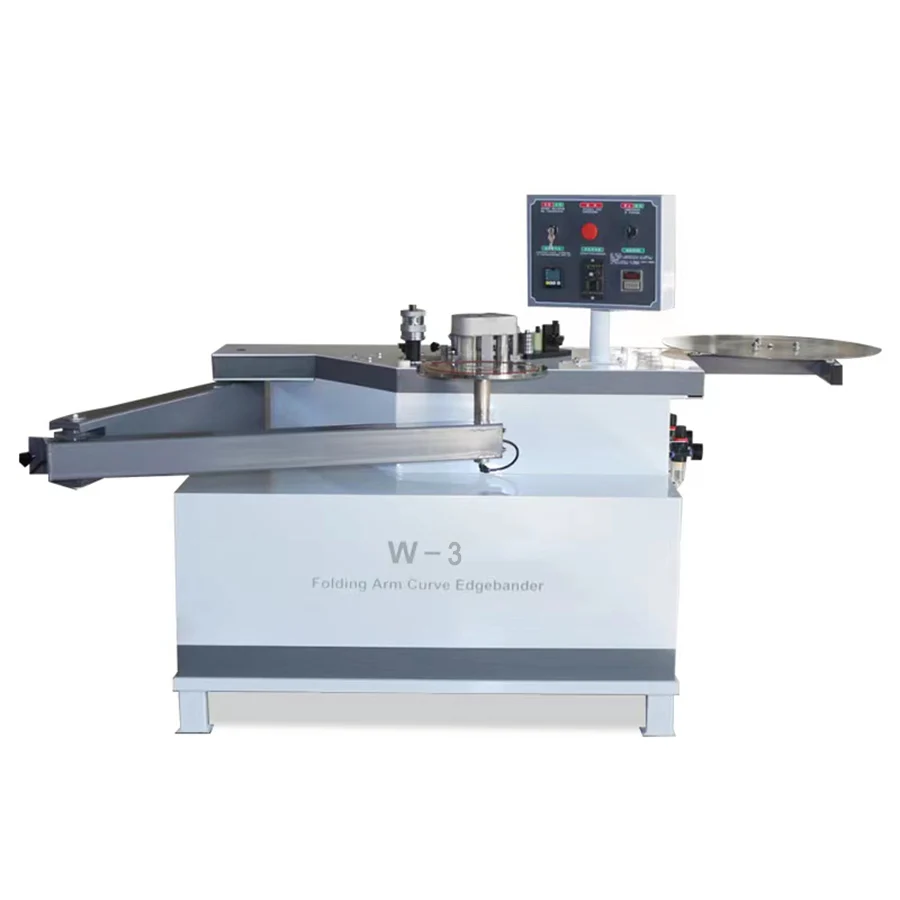
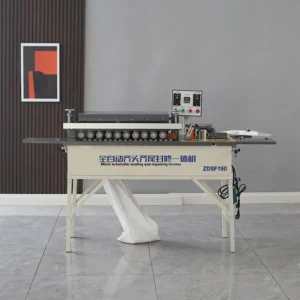
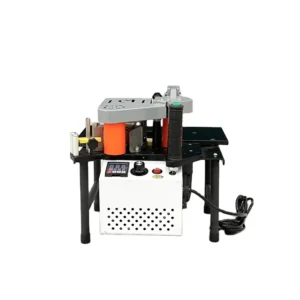
Right-Sized Starting Point — The W-series gives small workshops a compact curved edge banding machine in stock for immediate dispatch, built to handle low-volume, high-variety curved panel work without overcommitting capital.
Technical Specifications
| Parameter |
Value |
| Model |
W-1 / W-2 / W-3 |
| Product Type |
Curved Edge Banding Machine |
| Voltage & Frequency |
220V 50Hz (customizable 110V–440V) |
| Rated Power |
1.4 kW (W-1, W-2) / 3.4 kW (W-3) |
| Air Supply Requirement |
0.5–0.8 MPa |
| Edge Banding Speed |
0–180 mm/s |
| Overall Dimensions (L×W×H) |
900×620×820 mm (W-1) / 1200×800×1220 mm (W-2) / 1210×1100×970 mm (W-3) |
| Net Weight |
88 kg (W-1) / 152 kg (W-2, W-3) |
| Standard Suction Cup Size |
200×26 mm (W-1) / 300×26 mm (W-2, W-3) |
| Edge Band Thickness Range |
0.4–2 mm |
| Edge Band Width Range |
8–50 mm |
| Glue Pot |
Enlarged capacity |
| Control Features |
Intelligent temperature control, speed adjustment, timer |
| Heating System |
Bottom-up hot air device |
| Belt Breaking |
Automatic, double-cylinder controlled |
| Arm Folding Device |
Included |
| Motor Type |
Pure copper motor |
| Standards |
CE, ISO 9001 |
Application Suitability
| Application |
Material or Output |
| Custom cabinet and wardrobe curved doors |
MDF and particleboard with PVC edge banding |
| Office desk and reception counter profiles |
Plywood and MDF substrates, 0.4–2 mm band thickness |
| Small-batch decorative furniture components |
Solid wood panels and veneer edge banding on curved radii |
| Joinery workshop transition from manual finishing |
Curved panel profiles requiring consistent glue adhesion |
Why Language and Voltage Must Be Locked Before the Crate Is Nailed
A machine that arrives with the wrong control panel language or incompatible voltage is dead weight until someone flies out to fix it.
I shipped a compact curved edge bander to a small cabinet shop in Riyadh once. The machine ran perfectly in our factory test — PVC on MDF, clean adhesion, no issues. But the control panel came up in Chinese. The operator stared at it. Three days of downtime before I flew over to reflash the firmware. Since then, every compact machine I send out, I confirm language and voltage before dispatch. It is a small detail that prevents a curved edge banding machine in stock from becoming a costly delay [NEED_CITE: multilingual control panel requirements for exported machinery].

Dispatch Speed Without the Configuration Guesswork
Stock availability means little if the machine still needs weeks of customization before it can run in your workshop. The W-series models ship with voltage configurable from 110V to 440V and control panel language set to your operator's requirement before the unit leaves the factory. This removes the most common commissioning blockers that stall small workshops after delivery.
Scaling From Manual to Machine Without Overbuying
A joinery startup does not need a full-function pre-milling line on day one. The W-1 at 88 kg and 900 mm length fits where floor space is tight and power supply is limited to a standard single-phase circuit. As curved panel volume grows, stepping to the W-3 adds a larger suction cup footprint and higher rated power for sustained shifts. The curved edge banding machine in stock range lets a workshop match its first machine to actual current throughput rather than projected demand.
Reading the Spec Sheet Against Your Workshop Reality
The edge band thickness range of 0.4–2 mm and width range of 8–50 mm covers the PVC and veneer strips most small cabinet shops use on MDF and particleboard. The enlarged glue pot reduces refill stops during a shift, which matters when you are running a batch of curved wardrobe doors and cannot afford the glue to cool mid-run. The bottom-up hot air heating improves adhesion on curved profiles where gravity works against conventional top-down systems. Pure copper motors maintain consistent torque at the 0–180 mm/s feed range, and the automatic double-cylinder belt breaking device prevents strip overhang from wrapping around the feed mechanism [NEED_CITE: hot air adhesion improvement on curved edge profiles].
The Cost of Ignoring Air Supply and Suction Cup Sizing
The W-series requires 0.5–0.8 MPa air supply, which most small workshops can meet with a standard reciprocating compressor. But if your compressor cannot hold pressure at the upper band, the suction cups lose grip on curved profiles and the strip shifts mid-feed. The W-1 ships with 200×26 mm cups suited to lighter MDF panels, while the W-2 and W-3 use 300×26 mm cups for heavier plywood and thicker substrates. Specifying the wrong model for your typical panel weight means constant re-feeds and visible glue lines on finished edges [NEED_CITE: vacuum cup sizing for panel weight classes].
What Makes This Sourcing Decision Defensible
The W-series comes from a facility running four-stage quality control from incoming material through pre-shipment verification, with each unit tested on actual panel stock before crating. Voltage and language customization is standard, not an afterthought. The arm folding device and adjustable edge banding wheel with offset control are included in the base configuration. CE and ISO 9001 documentation ships with every unit, and an engineer reviews your workshop requirements before confirming the model selection.
Documentation & Verification
- CE declaration of conformity matching the W-series model configuration
- ISO 9001 certificate covering the manufacturing process
- Machine specification sheet with confirmed voltage and frequency for your site
- Electrical schematic showing circuit requirements for the selected W-series model
- Factory test record demonstrating edge banding on your specified panel material and curve radius
- Operation and maintenance manual in your agreed language with spare parts list
Installation, Commissioning & Support
- W-1 footprint of 900×620 mm fits standard workshop benches without dedicated floor anchoring
- 220V single-phase supply with dedicated circuit breaker rated for 1.4 kW or 3.4 kW depending on model
- Arm folding device requires clearance on one side — confirm workshop layout before placement
- First-run glue pot temperature calibration for your specific PVC or veneer banding material
- Suction cup pressure adjustment to match your typical MDF or plywood panel weight
- Spare glue pot elements and suction cup seals included in initial shipment for early maintenance planning
Before You Request a Quote
Tell me your typical panel material, the curve radii you run most often, and your local voltage and frequency. Confirm the control panel language your operators need. If you have an existing compressor, share its rated output pressure so we can match the W-series model to your air supply without surprises on arrival.
Frequently Asked Questions
Q: Which W-series model fits my workshop footprint and power supply?
A: The W-1 at 900×620 mm and 88 kg suits tight spaces on a standard 1.4 kW single-phase circuit. The W-2 and W-3 require more floor area and the W-3 draws 3.4 kW. Share your available space and circuit capacity, and we will confirm which curved edge banding machine in stock matches your setup.
Q: Can the voltage and control panel language be customized before shipping?
A: Yes. Voltage is configurable from 110V to 440V, and the control panel firmware is set to your operator's language before dispatch. This is confirmed during the specification stage so the machine is ready to run on arrival without firmware reflashing or transformer installation.
Q: What edge banding materials and substrate thicknesses does the machine handle?
A: The W-series handles PVC and veneer edge banding from 0.4 mm to 2 mm thick and 8 mm to 50 mm wide. Substrates include MDF, particleboard, and plywood. The bottom-up hot air device supports adhesion on curved profiles across these material combinations.
Q: How is the machine packaged and what assembly is required on arrival?
A: Each W-series unit ships crated with the arm folding device pre-installed. On arrival, you connect the air supply line, plug into your confirmed voltage circuit, and calibrate glue pot temperature for your banding material. No major mechanical assembly is required.
Q: What is the dispatch lead time for single-unit orders from stock?
A: Stocked W-series models are prepared for dispatch once voltage and language are confirmed and the pre-shipment factory test is completed. Lead time depends on customization scope and destination port — share your requirements for a specific timeline.