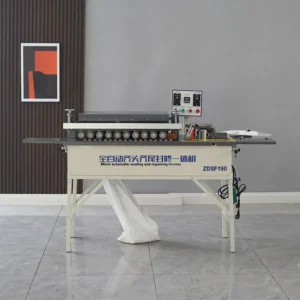
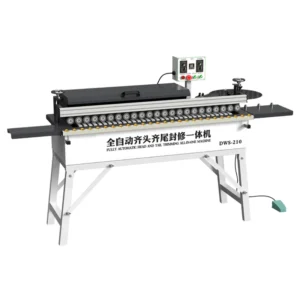
Verified Voltage Before Dispatch — the DW802 ships only after your site power, frequency, and plug type are confirmed in writing, eliminating the three-week rewiring delays that stall small workshop startups.
Technical Specifications
| Parameter |
Value |
| Model |
DW802 |
| Product Type |
Automatic Edge Banding Machine |
| Total Power |
4200 W |
| Voltage & Frequency |
220 V / 380 V / customizable (50 Hz / 60 Hz to confirm) |
| Edge Banding Height Range |
0–50 mm |
| Edge Banding Thickness Range |
0.3–3 mm |
| Minimum Sheet Length |
25 cm |
| Minimum Sheet Width |
10 cm |
| Edge Feed Power |
140 W |
| Transmission Power |
140 W |
| Trimming Power |
800 W × 2 |
| Polishing Power |
180 W × 2 |
| Vacuum Power |
1200 W |
| Air Source Pressure |
0.4–0.8 MPa |
| Glue Pot Capacity |
4000 ml |
| Overall Dimensions (L × W × H) |
130 × 60 × 95 cm |
| Net Weight |
135 kg |
| Key Features |
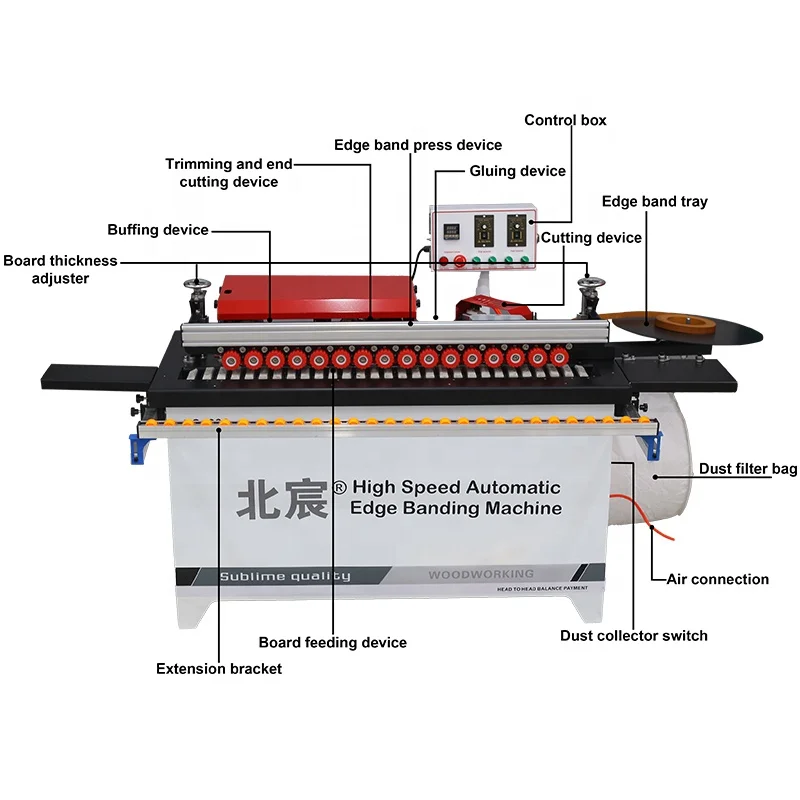
Gluing, trimming, polishing, automatic head-and-tail cutting, integrated vacuum |
| Language Options |
Chinese and English standard; Spanish or other languages customizable |
| Certification |
CE (certificate availability to confirm per unit) |
Application Suitability
| Application |
Material or Output |
| Custom cabinet door edge sealing |
MDF and particleboard with PVC or veneer banding |
| Small-batch shelving production |
Plywood and ecological board panels |
| Home decoration workshop joinery |
Solid wood board edge finishing |
| Startup furniture maker first automated step |
Mixed board substrates at moderate daily volumes |
Why the Voltage Question Should Come Before the Price on an Automatic Edge Banding Machine in Stock
A machine that cannot run on your workshop's existing supply is not a bargain — it is a three-week construction project.
Early in my career on the assembly floor in Shandong, I watched a custom cabinet shop take delivery of a compact edge bander only to discover the unit was wired for 220 V single-phase while their shop ran 380 V three-phase. The machine sat idle while an electrician reconfigured the panel, delaying production and eroding the owner's confidence in automated equipment. That single mismatch turned a straightforward commissioning into a multi-week disruption [NEED_CITE: voltage and frequency standards by export market]. Small workshops rarely have spare capacity to absorb that kind of downtime, which is why confirming the electrical environment is the first step — not an afterthought — when sourcing an automatic edge banding machine in stock.

Dispatch Speed Without Configuration Guesswork
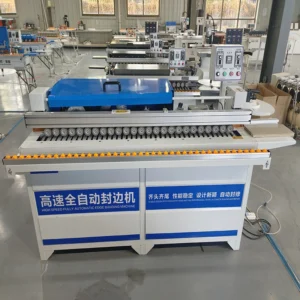
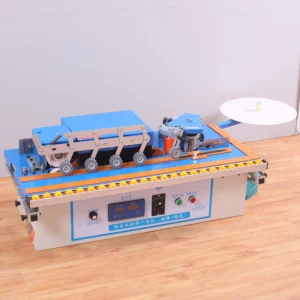
The DW802 is held in ready stock so that a single-unit order can be dispatched quickly once the buyer's electrical and language requirements are locked in. This matters for joinery shops and startups that cannot wait through extended production schedules. The unit arrives as one self-contained machine — gluing, trimming, polishing, head-and-tail cutting, and vacuum all integrated — so there is no need to source auxiliary stations separately or coordinate multiple deliveries.
Scaling From Manual to Machine-Assisted Edging
Small workshops transitioning from hand-held edge banding tools need a first machine that is forgiving on space and straightforward to operate. The 130 × 60 × 95 cm footprint and 135 kg weight mean the DW802 can be positioned in a corner of an existing shop without floor reinforcement or overhead crane access. Operators who have been applying banding by hand will find the automatic feed and integrated trimming a practical step up, reducing visible glue lines and inconsistent overhang that manual methods produce [NEED_CITE: common edge banding defects in manual versus automated application].
Reading the Numbers That Matter for Panel Quality
The 4000 ml glue pot capacity allows continuous runs through a typical batch of cabinet panels without stopping for refills, which keeps adhesive temperature stable and avoids the cold-start inconsistencies that appear when a small pot cycles on and off. The 0.3–3 mm banding thickness range covers standard PVC, melamine, and thin veneer strips used in custom furniture. Trimming at 800 W per motor provides enough torque to clean-cut banding on both MDF and denser particleboard without leaving chatter marks on the panel edge. The integrated 1200 W vacuum port captures trimming debris at the source, keeping the glue roller clean and preventing chip buildup that can score freshly banded surfaces. These specifications together define the edge quality a small workshop can expect on its output day after day.
The Hidden Cost of Skipping Pre-Dispatch Verification
When an edge bander arrives without a confirmed voltage match or an unreadable control panel, the workshop faces a choice between paying a local electrician to rewire and paying a translator to relabel every button. Neither option is cheap, and both add weeks to the timeline. I have seen small factories run extension cables through doorways to reach a mismatched outlet, creating trip hazards and voltage drop that degrades trimming motor performance [NEED_CITE: CE machinery directive requirements for industrial equipment]. A unit that was never tested on the buyer's actual panel material may also show adhesion failures only after the first batch of cabinet doors reaches the customer.
Why Small Workshops Source the DW802 Here
In-house manufacturing with verified tolerance checks means every DW802 leaving the Ningjin facility has passed a four-stage QC sequence covering incoming components, in-process assembly, finished product testing, and pre-shipment verification. Voltage, frequency, and plug type are confirmed against the buyer's electrical schematic before the crate is sealed. The control panel can be supplied in English, Spanish, or other agreed languages so the operator reads instructions directly. Engineer-led configuration recommendations are provided within one working day of inquiry, giving small workshops the same technical dialogue that larger factories receive. Single-unit orders are accepted without minimum order penalties, making the first step into automated edge banding financially accessible.
Documentation & Verification
- CE declaration of conformity issued per unit with model-specific details
- Electrical schematic and written voltage confirmation matched to your site supply
- Factory test record running your specified panel thickness and banding material
- Operation and maintenance manual supplied in the agreed language before dispatch
- Spare parts list with part numbers for glue roller, trimming blades, and polishing wheels
- Packing photographs showing crate condition and machine securing before collection
Installation, Commissioning & Support
- The 135 kg weight allows two-person placement on a standard concrete floor without anchors
- Dedicated circuit required matching confirmed voltage — 220 V single-phase or 380 V three-phase as ordered
- Machine ships fully assembled; connect air supply at 0.4–0.8 MPa and power on
- First-run glue temperature and feed alignment verified against your sample panel before crating
- Trimming blade replacement and glue pot cleaning covered in the supplied manual
- Spare polishing wheels and trimming cutters included for initial consumable coverage
Preparing Your Inquiry for a Fast Response
To receive a configuration proposal for the DW802 within one working day, share your workshop's available voltage and frequency, the panel materials and thicknesses you process most often, and your preferred control panel language. If your shop already runs other woodworking machines, noting their feed direction and dust extraction setup helps us recommend placement and auxiliary connections.
Frequently Asked Questions
Q: Is the DW802 in stock, and what is the dispatch lead time for a single-unit order?
A: The DW802 is kept in ready stock for fast dispatch. Single-unit orders are accepted without minimum quantity requirements. Once your voltage, frequency, plug type, and control panel language are confirmed in writing, the unit is prepared, tested, and crated for shipment. Lead time from confirmation to dispatch is typically short, though exact timing depends on the customization scope requested.
Q: How do you confirm my local voltage, frequency, and plug type before shipping?
A: We ask you to photograph your workshop's main electrical panel and any existing machinery nameplates. Our engineers review the supply details, match the DW802 motor and control wiring to your site, and send you a written voltage confirmation document along with an electrical schematic. The machine is then built or reconfigured to that specification before dispatch.
Q: Can the control panel be supplied in English only, or in another language such as Spanish?
A: The standard control panel is supplied in Chinese and English. Spanish and other languages are available on request and confirmed before production. Button labels, display text, and the operation manual are all aligned to the agreed language so your operator can commission and run the machine without translation guesswork.
Q: What panel materials and edge banding thicknesses does the DW802 handle out of the box?
A: The DW802 processes MDF, particleboard, plywood, ecological board, and solid wood panels. It accepts edge banding from 0.3 mm to 3 mm thick, covering standard PVC, melamine, and thin veneer strips. The 4000 ml glue pot and integrated trimming and polishing stations deliver consistent edge quality across these materials without requiring separate auxiliary equipment.
Q: What installation guidance and after-sales support do you provide once the machine arrives?
A: The DW802 ships fully assembled with an operation and maintenance manual in your agreed language, a spare parts list, and installation guidance documentation. Our engineering team provides remote support during first startup and parameter setting. Ongoing technical assistance is available for troubleshooting, consumable replacement advice, and operational questions as your workshop ramps up production volume.