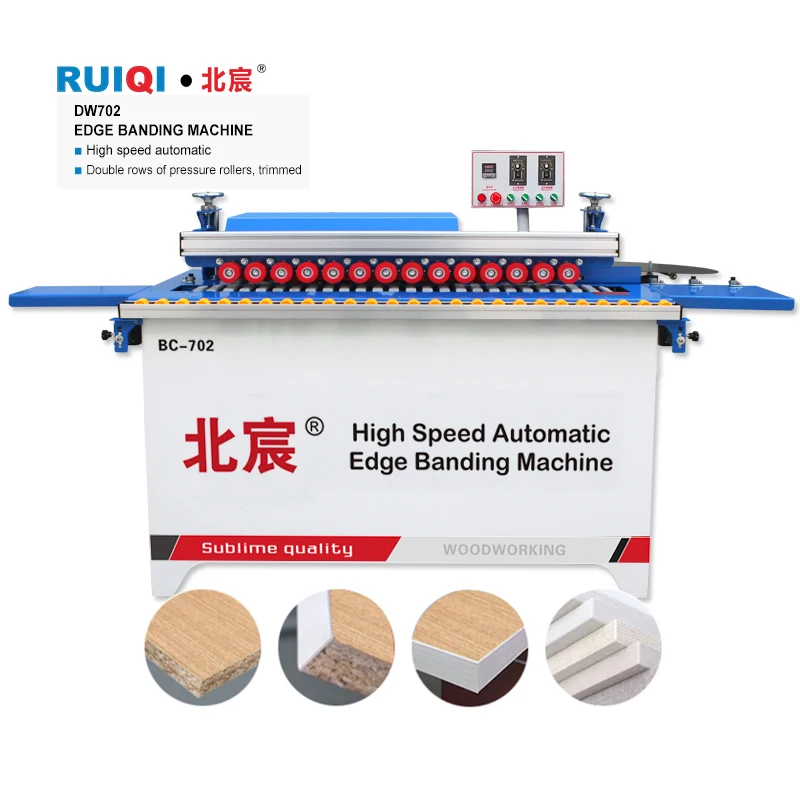
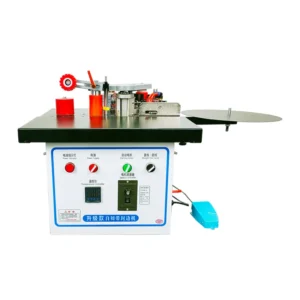
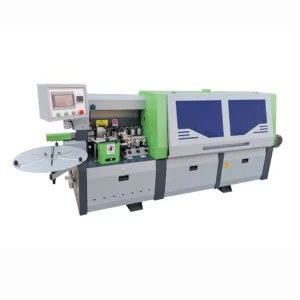
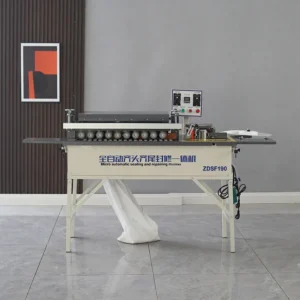
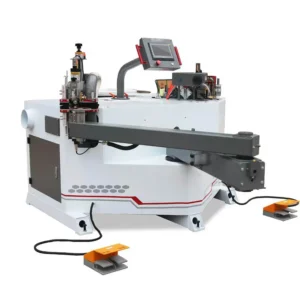
Ready-stock dispatch — Voltage confirmation and plug configuration locked in before this compact automatic edge banding machine leaves the factory floor.
Technical Specifications
| Parameter |
Value |
| Model |
DW702 |
| Product Type |
Automatic Edge Banding Machine |
| Total Power |
3800W |
| Voltage |
220V / 380V / customization (confirm 50Hz/60Hz) |
| Feed Speed |
(basis to be confirmed) |
| Edge Banding Height Range |
0-50mm |
| Edge Banding Thickness Range |
0.3-3mm |
| Minimum Sheet Length |
250mm |
| Minimum Sheet Width |
100mm |
| Panel Thickness Range |
(basis to be confirmed) |
| Glue Pot Capacity |
1000ml |
| Glue Pot Temperature Range |
(basis to be confirmed) |
| Trimming Motor Power |
800W × 2 |
| Polishing Motor Power |
180W × 2 |
| Edge Motor Power |
20W |
| Transmission Motor Power |
140W |
| Vacuum Power |
1200W |
| Air Source Pressure |
0.4-0.8MPa |
| Overall Dimensions (L×W×H) |
1200 × 550 × 1100 mm |
| Net Weight |
105kg |
| Key Features |
Edge banding, automatic head & tail cutting, trimming, polishing, integrated vacuum |
| Language Options |
Chinese / English (other languages customizable) |
| Plug Options |
EU / USA / AU / UK |
| Standards |
CE, ISO 9001 |
Application Suitability
| Application |
Material or Output |
| Custom cabinet door edge finishing |
MDF and particleboard panels with PVC or veneer banding |
| Small-batch shelving and carcass production |
Plywood and blockboard up to 50mm banding height |
| Decorative panel and polymer door fabrication |
Wood-based panels requiring clean trim and polish in limited floor space |
| Joinery workshop transition from manual banding |
Small-to-medium offcuts down to 250mm length and 100mm width |
Why the Voltage Question Must Come Before Dispatch
A machine that cannot start on arrival is not a delay — it is a stalled workshop.
Early in my dispatch scheduling work, I watched a small Southeast Asian carpentry shop wait nearly a month for a step-down transformer because the edge bander shipped on 380V three-phase while their workshop ran 220V single-phase. The machine sat crated against a wall, the owner losing every day of production he had planned around its arrival. That shop was not unique. [NEED_CITE: voltage and frequency standards by export market] When an automatic edge banding machine entry-level compact configuration arrives without confirmed voltage matching, the buyer absorbs transformer cost, electrician time, and the idle wages of operators who were supposed to be running panels that week.

Single-Unit Ordering Without the Usual Lead-Time Penalty
Small workshops rarely have the volume to justify container-load machinery purchases, and most suppliers will not prioritize a single-unit order through a standard production queue. This automatic edge banding machine entry-level compact model is held in stocked configuration for fast dispatch, meaning a joinery startup or a cabinet maker replacing a failed unit can place one order and receive a machine configured for their local power supply. The emphasis here is on eliminating the multi-week production gap between order placement and first panel run.
Compact Footprint With a Complete Function Set
The DW702 packs edge banding, automatic head and tail cutting, dual trimming motors, dual polishing motors, and an integrated vacuum system into a 1200 × 550 mm footprint. For a workshop operating out of a converted garage or a shared industrial unit, this matters. There is no need to allocate floor space to a separate trimming station or a standalone dust extraction unit. The 105kg net weight also means the machine can be repositioned within the workshop by two people using a pallet jack, which is relevant when a small operation is still organizing its material flow layout.
Reading the Specs That Matter for Small-Panel Work
The 250mm minimum sheet length and 100mm minimum sheet width are worth close attention because they define the lower boundary of what this machine will process reliably. In custom cabinet work, offcuts from larger panel sizing frequently fall into this range, and a machine that cannot grip and feed a short workpiece will force the operator to hand-finish those edges. The 1000ml glue pot is sized for the intermittent batch rhythm typical of small workshops rather than continuous high-volume production, reducing the risk of glue degradation from prolonged heating. [NEED_CITE: adhesive open time and pot temperature management in edge banding] The 0.3-3mm banding thickness range covers the PVC and veneer materials most commonly used in MDF and particleboard furniture, while the 0-50mm height range accommodates standard carcass and door panel thicknesses. Dual 800W trimming motors provide the cutting torque needed for clean end-trimming without tear-out on melamine-faced substrates.
The Cost of Skipping Voltage and Frequency Confirmation
When a workshop accepts delivery of a machine without verifying that voltage and frequency match local supply, the consequences extend beyond a blown fuse. Motors wound for 380V running on 220V will overheat and degrade insulation within hours, often before the warranty period begins. Frequency mismatch between 50Hz and 60Hz alters motor RPM, which shifts feed speed and trimming timing, producing inconsistent edge quality that the operator may attribute to material or operator error rather than electrical supply. [NEED_CITE: CE machinery directive requirements for industrial equipment] These failures appear intermittently at first, making them difficult to diagnose, and by the time the root cause is identified, motor rewinding or replacement has already added weeks of downtime.
Why Procurement Through This Channel Works for Small Orders
Stocked inventory means the machine ships from available configuration rather than entering a build queue, which shortens the gap between purchase decision and first production day. Voltage and plug type are confirmed during the order process rather than assumed, with a written confirmation sheet generated before dispatch. Operation and maintenance manuals are produced in the buyer's agreed language so that commissioning does not stall on unreadable control instructions. Pre-shipment testing generates a factory test record with photographs, giving a single-unit buyer the same verification documentation that a full-line purchaser receives. The product range allows a workshop to start with this entry-level model and add matching equipment from the same supplier as volume grows, avoiding the integration headaches that come from mixing machine brands across different stations.
Documentation & Verification
- Voltage confirmation sheet matching your local supply before the machine is crated
- Factory test record run on panel dimensions within your specified working range
- CE declaration of conformity and ISO 9001 certificate included in the shipping packet
- Electrical schematic showing the confirmed wiring configuration and circuit protection ratings
- Operation and maintenance manual in your chosen language with spare parts illustrations
- Packing photographs documenting machine condition and crate sealing prior to dispatch
Installation, Commissioning & Support
- Requires a level floor capable of supporting 105kg plus operator and material load
- Dedicated circuit matching confirmed voltage with appropriate breaker rating for 3800W total draw
- Air supply connection at 0.4-0.8MPa from a compressor with adequate reserve capacity
- First-run calibration of trimming depth and polishing pressure using your actual banding material
- Operator walkthrough covering glue pot temperature setting, feed adjustment, and emergency stop procedure
- Consumable spare parts list with reorder references for trimmer blades and polishing wheels
Before You Request a Quote
To move quickly from inquiry to dispatch confirmation, we need your workshop's local voltage and frequency, the plug type required at your facility, and the primary panel material and thickness you will be processing. If you are replacing an existing machine, note its current feed speed and daily panel count so we can confirm this model fits your throughput. Tell us which language your operators read, and whether you need a test run on your own sample material before the machine ships.
Frequently Asked Questions
Q: What voltage and plug will be configured for my country before the machine dispatches?
A: Voltage is confirmed during the ordering process — you specify your local supply, and the machine is wired accordingly with the matching plug type from EU, USA, AU, or UK options. A written voltage confirmation sheet ships with the documentation packet so your electrician can verify the circuit before first connection.
Q: Can I order a single DW702 now and add more machines from the same product family later?
A: Yes. Single-unit orders are standard for this stocked model, and the broader product range includes higher-throughput machines using consistent control logic and spare part families. This means your operators transfer their skills directly, and your maintenance inventory does not fragment across unrelated suppliers.
Q: Is the control panel available in a language my operators can actually read?
A: Chinese and English are standard, with additional languages available as a customization option confirmed before dispatch. The operation manual is also produced in your agreed language, which prevents the common problem where commissioning stalls because the shop floor team cannot interpret the on-screen prompts.
Q: What spare parts ship with the machine, and how quickly can consumables be reordered?
A: A spare parts list with references is included in the shipping documentation, covering wear items like trimmer blades and polishing wheels. Consumable reorder lead times depend on your location and chosen shipping method, which we confirm at the time of your initial order so you can plan inventory accordingly.