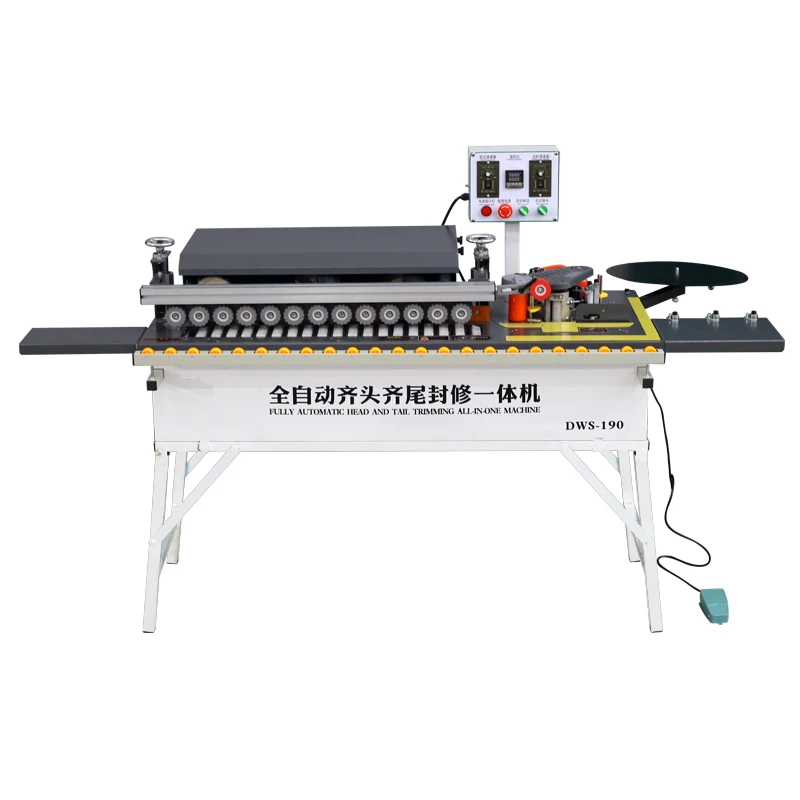
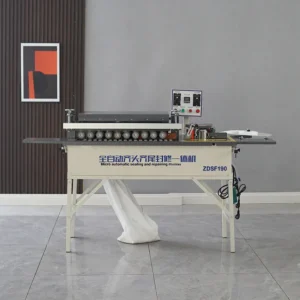
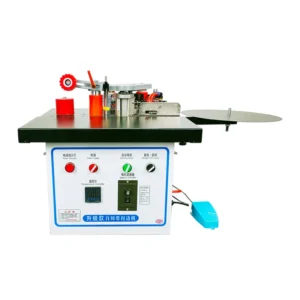
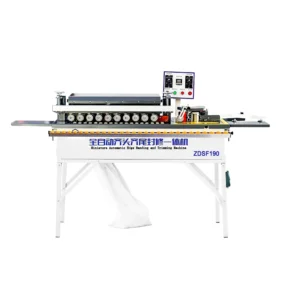
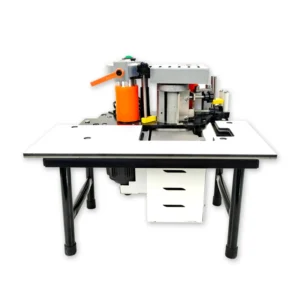
Compact Footprint Configuration — the DW190 fits a 130×52×66 cm main body into workshops where floor space determines what equipment can even be considered.
Technical Specifications
| Parameter |
Value |
| Model |
DW190 |
| Product Type |
Automatic Edge Banding Machine |
| Main Body Size |
130×52×66 cm |
| Extension Dimension |
190×83×120 cm |
| Equipment Weight |
100 kg |
| Glue Capacity |
2000 ml |
| Rated Power |
4000 W |
| Voltage |
220 V (frequency to be confirmed: 50 or 60 Hz) |
| Language Options |
Chinese, English (other languages configurable) |
| Plug Options |
EU, USA, AU, UK |
| Certification |
CE |
Application Suitability
| Application |
Material or Output |
| Small-batch cabinet door banding |
MDF and particleboard panels |
| Custom furniture straight-edge finishing |
Plywood and wood-based substrates |
| Joinery workshop edge trimming replacement |
PVC and veneer edge banding materials |
| Startup production runs |
Small-volume panel processing |
Why Voltage Confirmation Beats Every Other Spec on the Sheet
Ordering an automatic edge banding machine in stock without verifying local frequency is the fastest way to receive a unit you cannot power on.
Small workshops rarely have the leverage to absorb a two-week return cycle when a 220V machine arrives configured for 50 Hz but the local grid runs 60 Hz. The motor runs hotter, the glue pot overshoots temperature, and the feed mechanism drifts from its intended speed. I have watched a joinery shop in the Yangtze Delta region sit idle for ten days because nobody asked the frequency question before dispatch. [NEED_CITE: voltage and frequency standards by export market]

Floor Space Is the First Constraint a Small Shop Faces
When a workshop measures under fifty square meters, every machine competes for the same limited footprint. The DW190 addresses this with a main body that occupies roughly 0.68 square meters, leaving room for material staging and operator movement. An automatic edge banding machine in stock at this size class means the equipment can be repositioned as the shop layout evolves, rather than bolted into a permanent cell from day one.
Single-Phase Power Opens Doors That Three-Phase Cannot
Many small joinery shops and startup furniture makers operate in commercial units where three-phase supply was never installed and the cost to bring it in is prohibitive. The 220V single-phase requirement on the DW190 removes that infrastructure barrier entirely. You plug into a standard circuit and begin banding, which is exactly the kind of low-friction start a growing workshop needs. [NEED_CITE: CE machinery directive requirements for electrical configuration]
Reading the Glue Pot and Weight Specs in Context
A 2000 ml glue capacity is sized for intermittent batch work rather than continuous production line duty — the operator refills between runs, which suits a shop doing ten to fifty panels per session. The 100 kg weight means two people can reposition the machine when the shop layout changes, something that matters when a workshop is still figuring out its optimal material flow. The 4000 W rated power draws within the capacity of most standard commercial circuits without requiring a dedicated high-amperage breaker.
What Happens When the Machine Class Does Not Match the Workload
The most common failure pattern I have seen in small workshops is not mechanical breakdown — it is a machine asked to do production-line volumes on an entry-level frame. Bearings wear prematurely, the feed chain stretches beyond tolerance, and glue application becomes inconsistent across the run. The DW190 is specified for workshop-scale output, and pushing it into high-volume territory invites the exact downtime that stalls a small business. [NEED_CITE: mechanical fatigue in underspecified woodworking machinery]
What You Actually Receive Before the Crate Leaves the Factory
Every DW190 ships with a pre-shipment test record run on actual panel stock, so you see the edge quality before the machine reaches your dock. Voltage configuration is confirmed in writing against your local grid specification, not assumed from a country code. The operation manual arrives in your chosen language, and a spare parts list is included so you know which consumables to reorder and at what intervals — this last point matters enormously, because I have seen a workshop lose two full weeks of production waiting on a single heating element that was not in the original spare kit.
Documentation & Verification
- CE declaration of conformity covering the DW190 unit class
- Voltage and frequency confirmation document matched to your local grid
- Factory test record showing edge banding results on your specified panel material
- Operation and maintenance manual delivered in your agreed language
- Spare parts list with reorder intervals for consumable components
- Pre-shipment packing photographs for condition verification
Installation, Commissioning & Support
- 220V single-phase circuit with adequate amperage for the 4000 W rated draw
- Level floor surface supporting 100 kg across the 130×52 cm footprint
- Plug type configured to your regional standard before dispatch
- English or custom-language control panel verified at pre-shipment test
- Spare heating elements and feed chain links recommended at initial order
What to Include When You Request a Quotation
Send your typical panel material and thickness range, the edge banding material you intend to run, and your confirmed local voltage and frequency. If your workshop has space constraints, share the available floor area so the extension dimensions of 190×83×120 cm can be validated against your layout.
Frequently Asked Questions
Q: What panel thickness and edge banding materials does the DW190 handle?
A: The DW190 is designed for wood-based panels including MDF, particleboard, and plywood, running PVC and veneer edge banding in straight-edge applications. Specific thickness range depends on the configuration selected at order — confirm your typical panel stock so the machine can be set and tested before dispatch.
Q: Can I order a single unit, and what is the dispatch lead time?
A: Single-unit orders are the standard configuration for this platform. The DW190 is stocked for fast dispatch, and lead time depends on voltage confirmation and plug customization requirements. Typical orders ship within days once specifications are verified and the pre-shipment test is completed.
Q: Which plug type and voltage will be configured for my country?
A: Plug options include EU, USA, AU, and UK standards. The 220V system is configured to match your local frequency, either 50 Hz or 60 Hz, which must be confirmed before the machine is prepared for shipment. This prevents the motor and heating system from operating outside their intended parameters.
Q: Is the control panel available in English or other languages out of the box?
A: Chinese and English are standard language options on the control interface. Additional languages can be configured based on supplier capability — specify your operator's preferred language at the inquiry stage so it is ready at commissioning.
Q: What upgrade path exists if my production volume grows beyond this model?
A: The DW190 serves as an entry point for workshops moving from manual edge trimming to machine-assisted banding. When volume outgrows this class, the product family extends to higher-throughput models with additional trimming stations and automated feed systems, allowing a transition without changing supplier.