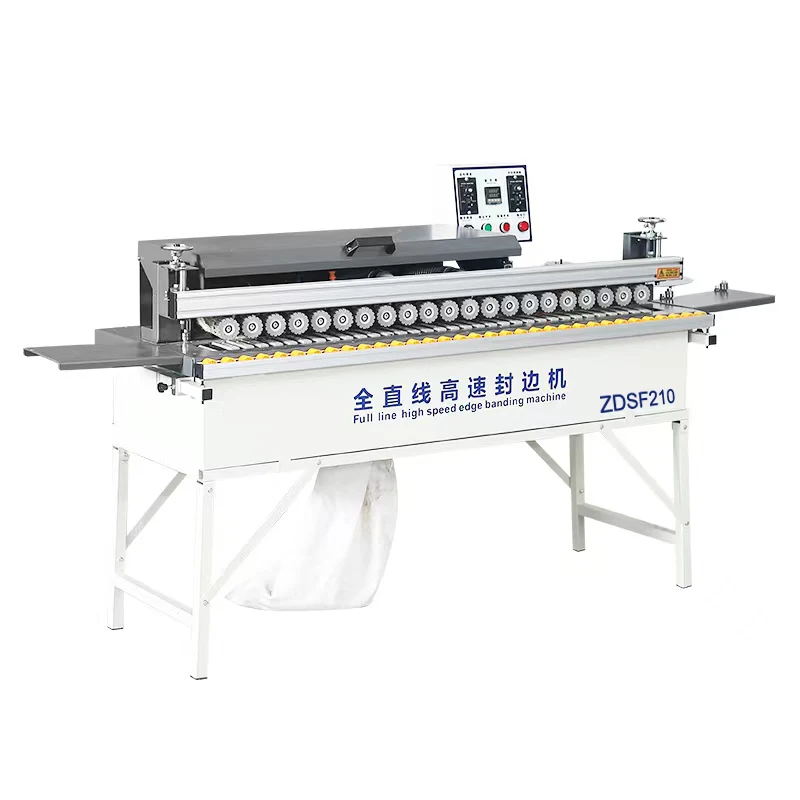
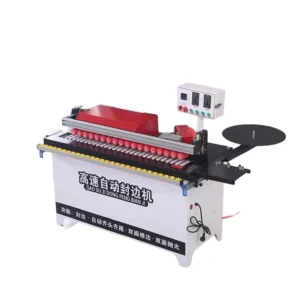
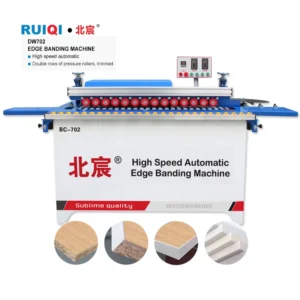
Compact Power Footprint — the ZDSF210 packs a full edge finishing line into a 155 kg portable frame so a small workshop can move from manual edging to automatic output without reworking the shop floor.
Technical Specifications
| Parameter |
Value |
| Model |
ZDSF210 |
| Product Type |
Portable Automatic Edge Banding Machine |
| Edge Banding Speed |
6 m/min |
| Belt Feed Motor |
25 W |
| Board Feed Motor |
120 W |
| Trimming Motor |
800 W × 2 |
| Heating Motor |
800 W |
| Vacuum Fan |
1200 W |
| Glue Capacity |
1000 ml |
| Guide Rail Type |
Steel rod guide rail |
| Pressing System |
Elastic device with secondary pressing |
| Trimming Function |
Up/down, left/right profile trimming |
| Dust Collection |
Airtight dust collection and cleaning |
| Polishing |
Cross polishing |
| Glue Line Cleaning |
Flexible scraping and glue line cleaning |
| Overall Dimensions (L×W×H) |
1500 × 570 × 630 mm |
| Net Weight |
155 kg |
| Motor Base |
Frame type motor base |
| Voltage & Frequency |
Configurable from 110 V to 440 V (basis to be confirmed at order) |
| Control Panel Language |
Multilingual options available (basis to be confirmed at order) |
| Panel Thickness Range |
To be confirmed based on material |
| Edge Banding Material Compatibility |
PVC, veneer, melamine (range to be confirmed) |
| Warranty |
1 year on machine and core components |
Application Suitability
| Application |
Material or Output |
| Small-batch MDF furniture edge sealing |
MDF panels with PVC or melamine edge banding |
| Custom cabinet door and drawer finishing |
Plywood and particleboard with veneer or PVC strips |
| Joinery startup replacing hand-held edging |
Straight-edge panels up to the machine's confirmed thickness range |
| Portable on-site edge banding for fit-out contractors |
Lightweight panels in workshops with limited floor space |
Why the Voltage Question Must Come Before the Purchase Decision
A portable edge banding machine in stock means nothing if the motors cannot run on your local supply.
One of the most common failures I see with entry-level equipment ordered online is a voltage mismatch discovered only after the crate is opened. A small workshop in Colombia once received a 380 V/50 Hz unit while running a 220 V/60 Hz shop supply — the motors overheated on the first test run, and the heating element could not hold stable glue temperature. That Portable Automatic Edge Banding Machine sat idle for weeks while replacement motors were shipped [NEED_CITE: voltage and frequency standards by export market]. The ZDSF210 is configurable across a wide voltage range, but that configuration must be locked in before production starts, not after the machine arrives.

The Smallest Step Up From Hand-Held Edging
For a joinery workshop still relying on manual edge banding tools, the jump to a full automatic line can feel like too much investment too soon. The ZDSF210 sits in the narrow gap between a hand-held roller and a multi-station production line. It handles gluing, profile trimming, scraping, and cross polishing in one pass, which means a single operator can complete an entire edge finishing cycle without walking the panel to separate stations. For a startup producing custom cabinets or small-batch MDF furniture, this portable edge banding machine in stock configuration is often the first piece of automated equipment on the floor.
A Portable Footprint That Actually Fits a Garage Workshop
At 1500 × 570 × 630 mm and 155 kg, the ZDSF210 can be repositioned by two people using a pallet jack when shop layout changes — something a fixed-line edge bander simply cannot offer. This matters for small operations where the same floor space serves cutting, assembly, and finishing at different times of the day. The steel rod guide rail and frame-type motor base keep vibration low even on a standard concrete floor without a dedicated machine foundation [NEED_CITE: small workshop floor loading requirements for light machinery].
Reading the Specs That Actually Matter for Edge Quality
The 800 W × 2 trimming motors handle both up/down and left/right profile trimming, which directly determines whether the finished edge sits flush or proud of the panel surface. On MDF and particleboard, a weak trimming motor tends to chatter against the substrate, leaving visible ridges that show through laminate finishes. The secondary elastic pressing device pushes the edge band firmly against the panel during the glue curing phase — this reduces the hollow spots and air pockets that cause peeling after a few months of use. The 1000 ml glue pot is sized for intermittent small-batch runs rather than continuous production, so operators working full shifts should plan for refill intervals. The integrated airtight dust collection keeps MDF fines from settling on the glue roller, which is a frequent cause of uneven adhesive transfer in shops without separate extraction systems.
The Cost of Skipping Configuration Confirmation
I have seen small workshops buy a compact edge bander based on price alone, then discover the control panel is labeled only in a language their operator cannot read. Commissioning stalls, remote video support stretches across time zones, and the first production batch is delayed by days. With a machine this size, the assumption that "it just plugs in and runs" is especially dangerous because buyers often skip the pre-order technical conversation they would normally have for a larger line [NEED_CITE: common commissioning delays in exported woodworking equipment]. Confirming control language, compatible edge banding material width, and panel thickness range before ordering avoids most of these delays.
What Buying From Ruiqi Actually Means for a Small Workshop
Every ZDSF210 leaves the Ningjin facility after a four-stage quality check covering incoming materials, in-process assembly, finished unit testing, and pre-shipment verification — with a video inspection record provided so you can see your machine running before it ships. Voltage customization from 110 V to 440 V is handled as a standard configuration step, not a special request, which matters when your local supply does not match Chinese industrial standards. The patented cutting mechanisms and precision-ground components in the trimming stations hold tolerances that are verifiable on the test panels included in your shipment documentation. Engineer-led configuration recommendations are provided within 24 hours of inquiry, so the machine you receive is matched to your actual panel material and production volume rather than being a generic stock push.
Documentation & Verification
- CE declaration of conformity matched to the ZDSF210 configuration you ordered
- Factory test record showing edge banding results on your specified panel thickness and material
- Electrical schematic confirming your voltage and frequency before the unit leaves the factory
- Operation and maintenance manual in your operator's chosen language
- Spare parts list with part numbers for trimming blades, scraping tools, and glue pot components
Installation, Commissioning & Support
- Requires a level concrete floor with minimum 2 square meters of clear space around the 1500 × 570 mm footprint for panel handling
- Dedicated electrical circuit matching confirmed voltage and frequency, sized for the combined motor and heating load
- Arrives partially assembled; guide rail and pressing device alignment must be verified on site before first run
- Initial glue temperature and feed speed calibration performed against your specific edge banding material sample
- Operator training covers panel loading sequence, trimming adjustment, and daily glue pot cleaning procedure
- Consumable spare parts include trimming blades, flexible scraping inserts, and glue roller sleeves
What to Include in Your Inquiry
Send your panel material type, thickness range, and the edge banding material you plan to use so the configuration can be matched before quotation. Confirm your workshop voltage, frequency, and the language your operator reads on a control screen. If you have existing upstream cutting or downstream boring equipment, share the feed height and throughput so the ZDSF210 integrates without bottlenecks.
Frequently Asked Questions
Q: What panel thickness and edge banding material can the ZDSF210 handle?
A: The exact range depends on configuration at the time of order. The machine is built to process PVC, veneer, and melamine edge banding on MDF, plywood, and particleboard. Share your panel thickness and banding material specifications during inquiry so the pressing device and trimming setup are matched to your production.
Q: What voltage do I need to confirm before ordering?
A: The ZDSF210 can be configured from 110 V to 440 V, but the correct setting must be locked before assembly. Provide your local supply voltage and frequency so the motors, heating element, and vacuum fan are wound correctly. A mismatch discovered after delivery means motor replacement and significant downtime.
Q: How much floor space and power does my workshop need?
A: Plan for roughly 2 square meters of clear space around the 1500 × 570 mm machine body for panel handling and operator movement. A dedicated circuit rated for the combined load of the trimming motors, heating element, and vacuum fan is required — a shared circuit with other equipment risks tripping during startup.
Q: Is assembly required on arrival, and is setup guidance provided?
A: The ZDSF210 ships partially assembled. Guide rail alignment and pressing device calibration must be verified on site. An operation manual in your chosen language and a pre-shipment test video are provided, and remote video guidance is available during first startup.
Q: What spare parts come with the machine, and how do I reorder?
A: A spare parts list is included in your documentation package, covering trimming blades, scraping inserts, and glue pot wear items. Consumables can be reordered through the same channel as your original purchase, with part numbers clearly marked on the list for accurate fulfillment.