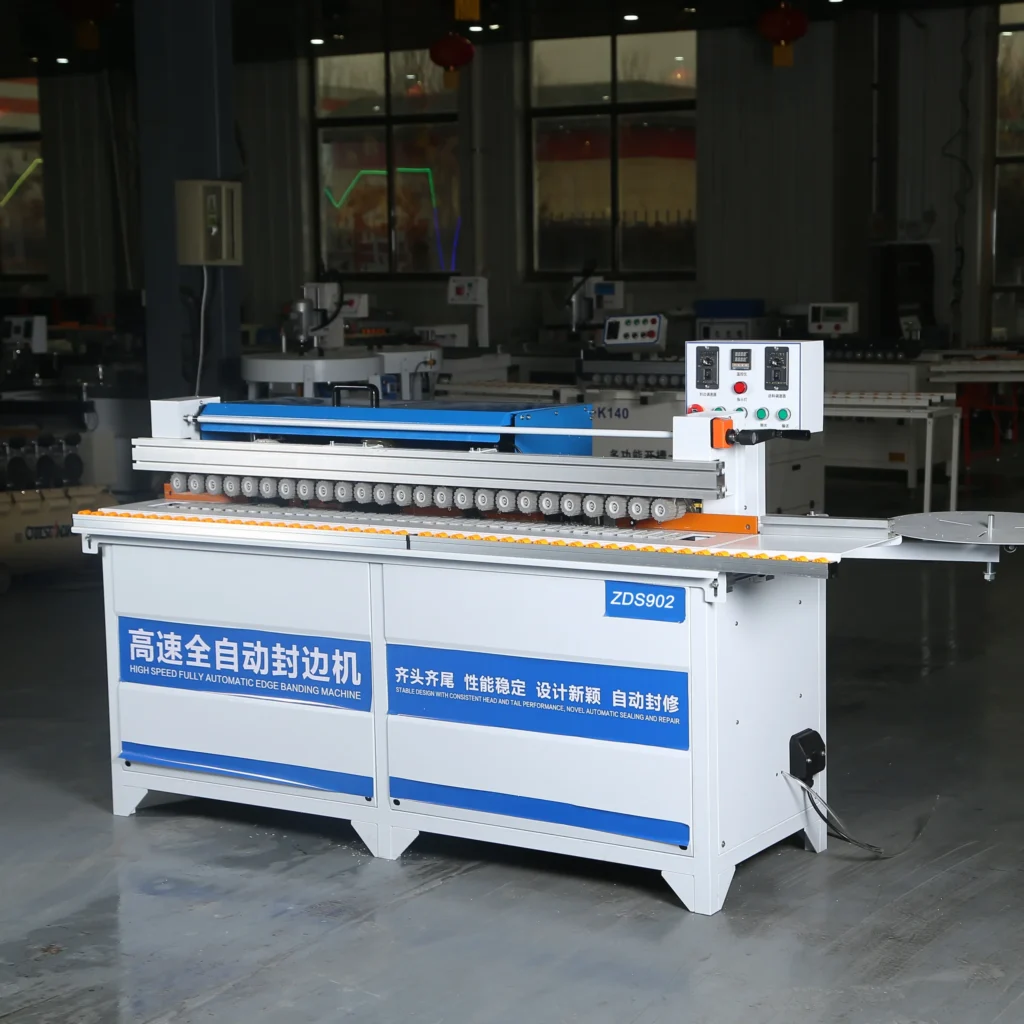
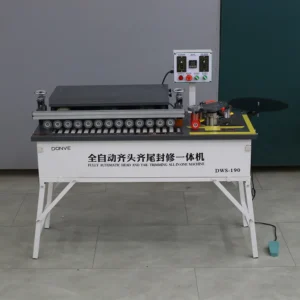
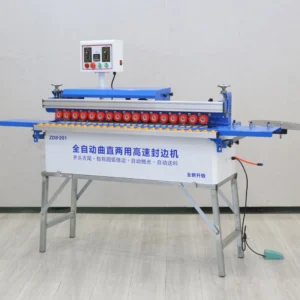
Stocked and Ready — A 220V compact edge bander dispatched as a single complete unit, eliminating the piecemeal compatibility issues that stall first-time automation in small joinery workshops.
Technical Specifications
| Parameter |
Value |
| Product Type |
Automatic Edge Banding Machine |
| Voltage |
220V |
| Total Power |
4200W |
| Overall Dimensions (L×W×H) |
207 × 60 × 122 cm |
| Net Weight |
245 kg |
| Edge Banding Type |
Linear |
| Edge Band Height Range |
0–35 mm |
| Edge Band Thickness Range |
0.6–2.0 mm |
| Glue Pot Capacity |
4000 ml |
| Pressure System |
Integrated beam, double rows of pressure wheels |
| Conveyor Belt Material |
Silicone |
| Edge Strip Cutting Device |
Pneumatically controlled |
| Polishing & Trimming |
Dual up-and-down motors |
| Assembly State |
Requires assembly (KD packing for some components) |
Application Suitability
| Application |
Material or Output |
| Small custom cabinet fabrication |
MDF and particleboard with PVC edge banding |
| Joinery workshop upgrading from hand tools |
Plywood panels with veneer edge strips |
| Low-volume furniture repair and refurbishment |
Melamine edge banding on composite boards |
| Prototype and sample production runs |
Solid wood panels requiring precise corner rounding |
Why the Voltage Question Must Come Before the Price Tag
Matching your local power supply to the machine's electrical specification prevents commissioning failure on day one.
Many workshops discover voltage incompatibility only after the machine arrives, when the automatic edge banding machine in stock fast delivery cannot start without a costly transformer or fails under load. I have seen a first-time buyer wire a 220V unit into a 380V three-phase circuit, damaging the control board before any panel was fed through. This compact unit ships configured for 220V single-phase operation, but every export market has different frequency standards and plug configurations [NEED_CITE: voltage and frequency standards by export market]. Confirming these details during the quotation stage ensures the machine you unplug is the machine you run.

Ready Stock Means Fast Workshop Deployment
Ordering the first automatic edge banding machine for a small workshop often involves long lead times that delay production commitments. This model is maintained in ready stock, allowing single-unit orders to dispatch within typical commercial freight timelines rather than waiting for a production slot. For a joinery startup that has just signed its first cabinet contract, having a machine on the water within days rather than weeks can determine whether the first delivery deadline is met.
Compact Footprint for Constrained Workshop Floors
Small workshops rarely have the luxury of a dedicated edge banding bay with material staging on both sides. At roughly two meters in length, this machine fits against a wall or between existing bench stations without requiring a complete floor plan rearrangement. The handle-adjustable pressure beam and integrated trimming functions mean there is no need for separate auxiliary stations that would consume additional floor space.
Reading the Specifications for Real Workshop Conditions
The 4000 ml glue pot capacity translates to longer uninterrupted production runs before a refill is needed — a practical advantage when a small team is running batch after batch of cabinet components and cannot afford to stop mid-job to top up adhesive. The pneumatic edge strip cutting device removes the need for manual snipping, which is where most quality variation enters the process when operators are transitioning from hand-held tools.
The 0.6–2.0 mm edge band thickness range covers the most common PVC and veneer materials used in custom furniture. However, feed speed and panel thickness range are not stated in the current specification sheet [NEED_CITE: typical feed speeds for entry-level linear edge banders]. These values directly determine whether the machine can handle your typical daily workload or whether you will outgrow it within months. Always request the factory test record using your actual panel stock and edge banding material before finalizing the order.
The Hidden Cost of Skipping a Material Trial Run
I have seen a workshop test a machine with PVC edge banding, sign off on the finish, and then switch to melamine strips in daily production — only to find the corner rounding unit chipping the melamine surface and halting the line. Different banding materials respond differently to trimming motor speed and cutter geometry, and a setup that works perfectly on one substrate may fail entirely on another. Skipping a trial run with your actual material inventory is the fastest way to turn a machine purchase into a commissioning problem [NEED_CITE: edge banding material behavior differences between PVC and melamine during trimming].
Why Procure This Machine Through Our Stock Channel
Our inventory model prioritizes the smallest viable configuration for workshops scaling from manual finishing, so you receive a complete, self-contained unit rather than a base machine that requires additional purchases. Each unit undergoes pre-shipment verification with your specified voltage configuration confirmed before dispatch. Custom voltage options from 110V to 440V are available upon request, though standard 220V stock ships fastest. The engineer-led configuration recommendation means your quotation includes a suitability assessment, not just a price list. Factory test records and packing photographs are provided before the crate is sealed.
Documentation & Verification
- CE declaration of conformity specific to this edge banding model class
- Factory test record run on your specified panel thickness and edge band material
- Electrical schematic confirming 220V wiring and component ratings
- Operation manual translated into your operator's working language
- Pre-shipment verification photographs showing machine run with your material
Installation, Commissioning & Support
- Requires a dedicated 220V circuit rated above the 4200W total power draw
- Assembly needed on arrival — KD-packed components include glue pot and conveyor sections
- Pressure beam handle adjustment covers your board height range up to 35 mm edge band
- Silicone conveyor belt tension must be calibrated during first commissioning run
- Dual polishing motors require alignment check after transit before first production use
- Pneumatic cutting device needs compressed air supply connection at your workshop
What to Include in Your Inquiry
To provide an accurate dispatch timeline and configuration confirmation, share your primary edge banding material (PVC, veneer, or melamine), typical panel dimensions and daily volume, and your workshop's exact voltage and frequency specification. If you are replacing an existing manual process, describe the edge quality issues you currently face so the configuration can address them directly.
Frequently Asked Questions
Q: What voltage options are available, and how do I confirm the machine matches my local power supply?
A: The stocked configuration is 220V single-phase, but custom voltage from 110V to 440V can be arranged at the quotation stage. Share your local supply voltage and frequency (50Hz or 60Hz) during inquiry so the electrical schematic and motor ratings are matched before dispatch. This prevents transformer costs and commissioning delays on arrival.
Q: Can I order a single unit, and what is the typical dispatch lead time from stock?
A: Single-unit orders are standard on this platform. Stocked machines are prepared for dispatch within typical commercial timelines once voltage and documentation details are confirmed. Exact lead time depends on destination port and shipping method selected, which will be quoted alongside your order confirmation.
Q: What panel thickness and edge band materials does this machine handle?
A: The machine handles edge band heights from 0 to 35 mm and thicknesses from 0.6 to 2.0 mm, covering PVC, veneer, and melamine materials on MDF, particleboard, and plywood. Panel thickness range is confirmed during the quotation stage — always request a factory test with your actual stock before finalizing.
Q: Is assembly required on arrival, and what installation support is provided?
A: Some components arrive KD-packed and require assembly. Installation guidance covers conveyor alignment, pressure beam calibration, and pneumatic system connection. The operation manual in your language provides step-by-step commissioning instructions, and remote technical support is available during your first production runs.