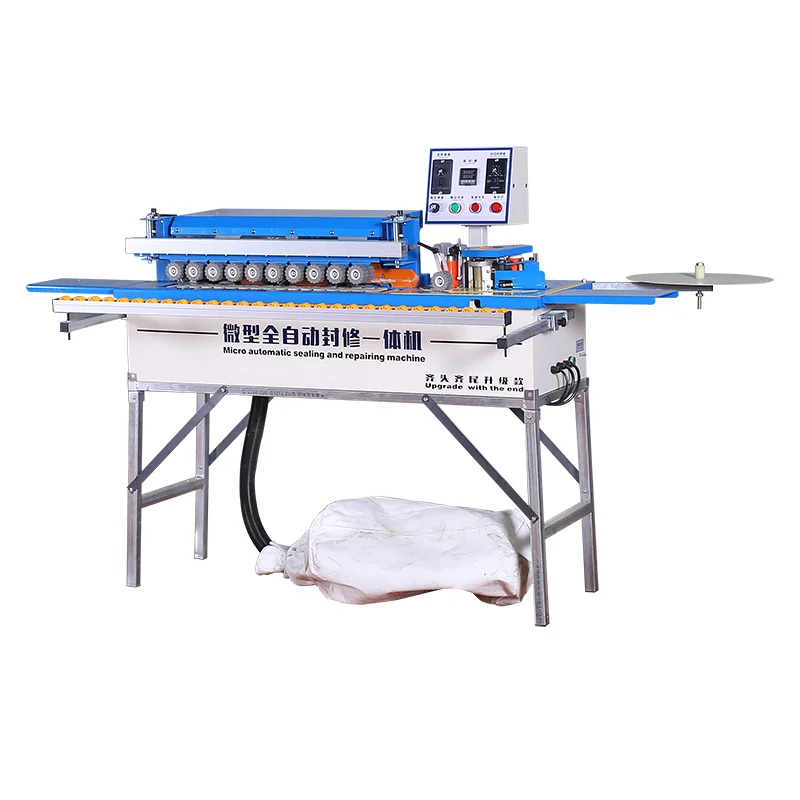
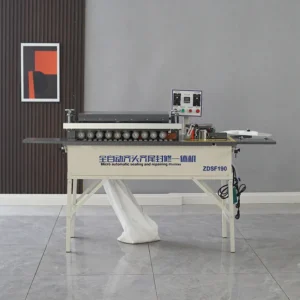
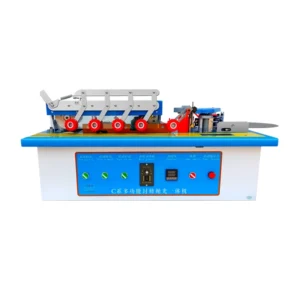
Ready from stock — compact 4 kW edge bander configured for small workshops, dispatched without waiting for a custom build cycle.
Technical Specifications
| Parameter |
Value |
| Product Type |
Automatic Edge Banding Machine |
| Voltage |
220V (frequency to be confirmed for target market) |
| Rated Power |
4000W (4 kW) |
| Overall Dimensions (L×W×H) |
1200 × 540 × 720 mm |
| Feed Speed |
0–6 m/min |
| Board Thickness Range |
10–60 mm |
| Edge Banding Thickness Range |
0.5–3 mm (PVC) |
| Glue Pot Capacity |
1000 ml |
| Glue Application |
Double-sided gluing |
| Gluing Device |
Rotatable 180° for curved edge banding |
| Trimming Stations |
Up and down edge trimming (2 × 800W motors) |
| Polishing Stations |
Up and down cross polishing (2 × 180W motors) |
| Board Feeding |
Automatic, double-row rubber pressure wheels |
| Dust Extraction |
Integrated at trimming station |
| Control System |
Independent function switches on control panel |
| Warranty |
1 year |
Application Suitability
| Application |
Material or Output |
| Small furniture and cabinet workshop |
MDF, plywood, and particleboard panels with PVC edge banding |
| Custom joinery shop |
Straight and curved edge profiles on panel-based components |
| Startup woodworking operation |
Transition from manual to mechanized edge banding on PVC-banded boards |
| Kitchen cabinet and wardrobe production |
PVC-banded MDF and particleboard panels up to 60 mm thick |
Why the Voltage Question Should Come Before Everything Else
Confirm your local supply frequency and plug type before the machine leaves the factory, not after it arrives.
I have watched small workshop owners in Southeast Asia unbox a brand-new Automatic Edge Banding Machine in stock, plug it in, and see the control panel light up in a language none of their operators can read. The machine sat idle while they waited for someone to fly out and switch the interface. That downtime is avoidable if voltage, frequency, and language are locked down during the order stage rather than treated as afterthoughts [NEED_CITE: voltage and frequency standards by export market].

Footprint That Fits a Startup Floor Plan
At 1200 × 540 mm, this Automatic Edge Banding Machine in stock occupies roughly the same floor space as a standard workbench. For a joinery shop moving from hand-applied edge banding to their first mechanized unit, that compact footprint means the machine drops into an existing layout without rearranging the entire production flow. The 720 mm height keeps the working surface at a comfortable level for operators feeding panels manually from a nearby table.
Dual-Purpose Gluing Without a Second Machine
The 180° rotatable gluing device lets a single machine handle both straight panel edges and curved profiles. Small workshops often cannot justify buying separate straight and curved edge banders, so this dual-purpose setup covers kitchen cabinet doors with radiused corners alongside standard wardrobe side panels. The 1000 ml glue pot with double-sided application holds enough adhesive for sustained short runs without constant refilling.
What the Spec Sheet Numbers Mean on the Shop Floor
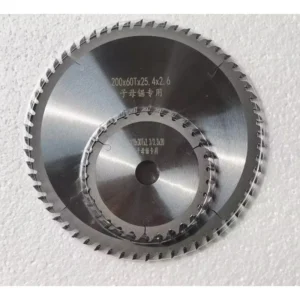
The 10–60 mm board thickness range covers everything from thin shelving stock to thick countertop panels, so a custom cabinet maker processing mixed orders does not need to swap machines between jobs. Feed speed adjustment from 0 to 6 m/min lets operators slow down for curved sections and speed up on long straight runs. The dual 800W trimming motors remove excess PVC banding cleanly on both top and bottom edges, while the 180W polishing motors smooth the trimmed surface to a finished state. Integrated dust extraction at the trimming station pulls PVC shavings away before they settle on the glue pot or the next panel in the queue — a detail that matters when the machine sits three meters from a spray booth [NEED_CITE: dust extraction requirements in woodworking environments].
What Happens When You Skip Configuration Checks
Buying a machine rated for 220V without confirming whether your local supply runs at 50 Hz or 60 Hz can result in motor overheating within the first week. I have seen edge banders of this class fail in humid workshops simply because the glue pot thermostat was calibrated for a different climate zone, leaving adhesive too thin to bond properly on MDF. When a single-machine shop loses its only edge bander to a preventable electrical mismatch, production stops entirely until a technician arrives — and in some regions, that wait stretches into weeks [NEED_CITE: impact of voltage mismatch on industrial motor lifespan].
Why Source This Model Through This Channel
In-house manufacturing with patented cutting mechanisms means the trimming stations on this unit are built to a verified tolerance, not assembled from generic sub-assemblies. Voltage and language customization is treated as standard order procedure rather than a special request, so a buyer in the Philippines or Vietnam can specify 220V/60Hz and a Tagalog or Vietnamese control panel before production begins. The four-stage quality check — incoming material, in-process, finished product, and pre-shipment verification — catches electrical and mechanical faults before the crate leaves the factory floor. An engineer reviews your workshop requirements and returns a formal configuration recommendation within one working day. Factory visits are welcomed for buyers who want to see the machine run their own panel stock before committing.
Documentation & Verification
- CE declaration of conformity matching the shipped unit serial number
- Electrical schematic confirming your specified voltage and frequency
- Factory test record showing edge banding output on your panel thickness range
- Operation and maintenance manual in your operator's preferred language
- Spare parts list with part numbers for trimming blades and polishing wheels
Installation, Commissioning & Support
- Requires a dedicated 220V circuit rated for at least 4 kW continuous draw
- Compact 1200 × 540 mm footprint fits through standard workshop doorways for placement
- Some components ship KD packed — assembly guided by manual or video
- First commissioning includes glue pot temperature calibration for your local climate
- Double-row rubber pressure wheels require periodic tension adjustment for consistent feed
- Trimming and polishing motors ship with spare blades and wheels in the parts kit
Before You Request a Quote
Send your typical panel material (MDF, plywood, or particleboard), the thickness range you process most often, and whether your work includes curved edge profiles. Confirm your local voltage, frequency, and plug type so the electrical system is built to match. Let us know if your operators need a control panel in a specific language, and whether you have existing dust extraction infrastructure the machine needs to connect to.
Frequently Asked Questions
Q: Is this machine suitable for my current daily panel volume, and what is the realistic upgrade path?
A: This model is designed for small workshops and startup operations transitioning from manual edge banding. The 0–6 m/min feed speed handles moderate daily volumes comfortably. When your order book grows, you can add higher-throughput machines from the same product family without changing supplier, keeping operator training and spare parts inventory consistent across your floor.
Q: Can the voltage and plug type be confirmed for my country before shipment?
A: Yes. Voltage, frequency, and plug configuration are confirmed during the order stage before production begins. The electrical schematic is prepared to match your local supply standard, and the pre-shipment test is conducted at the confirmed voltage to verify motor performance and glue pot temperature stability under your specific electrical conditions.
Q: How do I set up and commission the machine — is there a manual or video in my language?
A: The operation and maintenance manual is provided in your agreed language, and video guidance covers assembly of KD-packed components and first startup. Glue pot temperature calibration and feed speed adjustment are documented step by step so your team can commission the machine without waiting for an on-site technician visit.
Q: What are the key wearing parts, and are spare parts shipped with the machine?
A: Trimming blades, polishing wheels, and rubber pressure wheel surfaces are the primary wearing components. A spare parts kit is included in the shipment covering these items, and the spare parts list provides part numbers for reordering directly when your consumable stock runs low.
Q: What is the typical dispatch lead time from stock for this model?
A: Stocked units are prepared for dispatch after pre-shipment testing and voltage confirmation, which typically takes several working days. Custom voltage or language configurations may extend the lead time slightly to accommodate electrical and control panel adjustments before crating.