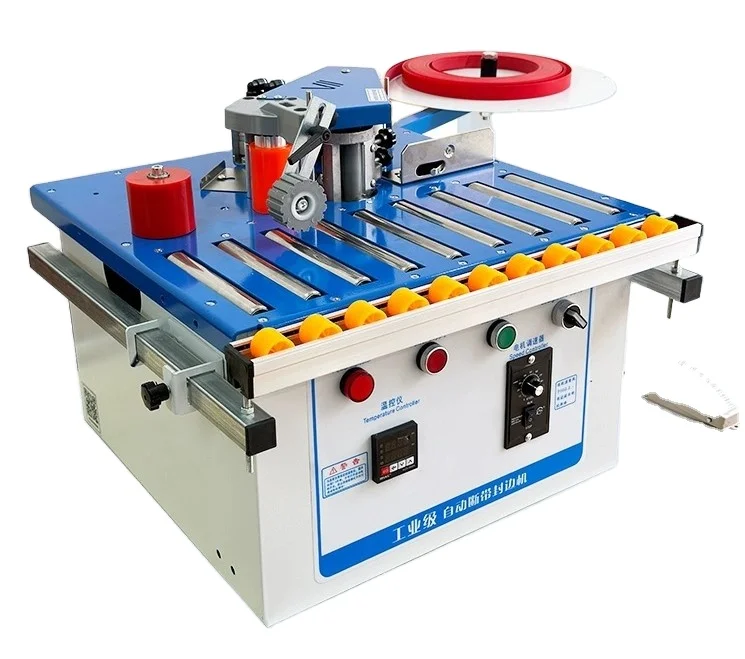
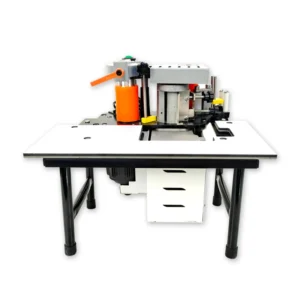
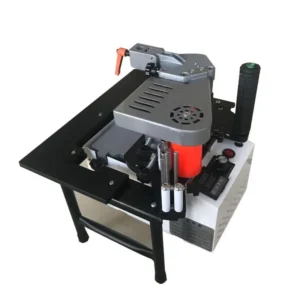
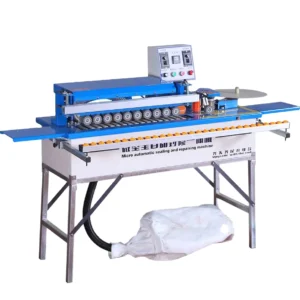
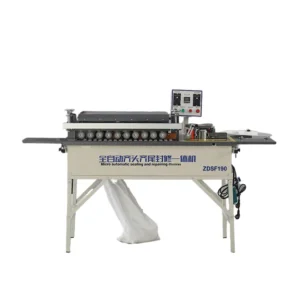
Ready from shelf — the ZDSF50 mini portable edge banding machine is stocked in standard 220V configuration for fast dispatch, letting small workshops order today and run edges this week without waiting on build slots.
Technical Specifications
| Parameter |
Value |
| Model |
ZDSF50 Mini Portable Edge Banding Machine |
| Product Type |
Mini Portable Edge Banding Machine |
| Rated Voltage |
220V |
| Rated Power |
1.2 kW |
| Edge Banding Speed |
0–6 m/min |
| Strip Thickness Range |
0.5–1.5 mm |
| Panel Thickness Range |
10–60 mm |
| Glue Pot Capacity |
1000 ml |
| Heating Time |
5–10 min |
| Rated Air Pressure |
0.4–0.6 MPa |
| Glue Heating |
4 heating tubes |
| Belt Breaking |
Pneumatic with foot switch (curved) and travel switch (straight) |
| Pressure Rollers |
Adjustable rubber rollers per board thickness |
| Edge Strip Transport |
Adjustable bayonet per strip height |
| Function |
Double side gluing for straight, curved and shaped edges |
| Overall Dimensions |
54 × 54 × 56 cm |
| Machine Weight |
26 kg |
| Assembly State |
Portable, bench-top format |
Application Suitability
| Application |
Material or Output |
| Bespoke cabinet edge finishing |
MDF and plywood panels with PVC edge strips 0.5–1.5 mm |
| Custom furniture short-run production |
Particleboard shelves and carcass sides with straight and curved profiles |
| On-site fit-out and installation work |
Solid wood panels and veneer banding at job locations |
| Workshop prototyping and sample making |
Mixed panel substrates transitioning from manual to machine-assisted banding |
Why Voltage Confirmation Matters Before You Click "Buy"
A portable edge banding machine that arrives with the wrong voltage is a 26 kg paperweight until an electrician rewires it or a transformer shows up.
I once saw a small joinery shop take delivery of a bench-top bander only to find the motor was wound for 380V three-phase while their workshop ran single-phase 220V. The machine sat unplugged for over a week while they sourced a step-up transformer and reorganized their panel board. That delay cost them a kitchen fit-out deadline. When you are ordering a Portable Edge Banding Machine in stock fast delivery, the whole point is speed — and a voltage mismatch erases that advantage before the crate is even open. The ZDSF50 ships as a confirmed 220V single-phase unit, and the specification sheet is verified against your local supply before the machine leaves the floor [NEED_CITE: voltage and frequency standards by export market].

Dispatch Without the Usual Build-Slot Wait
Small workshops rarely plan edge banding purchases months ahead. A job comes in, the hand-held trimming method starts showing its limits, and the owner needs a machine on the bench next week — not after a twelve-week production queue. The ZDSF50 is held in finished stock at 220V, meaning the order cycle compresses to packing, crating and freight booking rather than component sourcing and assembly. You receive a tested unit, not a machine still waiting on its glue pot heater tubes to arrive from a sub-supplier.
Straight Edges, Curves and the Pneumatic Difference
Hand-held edge banding on a curved cabinet door is a two-person job: one feeding the strip, one trimming with a router and praying the bearing does not gouge the veneer. The ZDSF50 handles curved and shaped profiles with a pneumatically controlled belt-breaking system triggered by a foot switch, leaving both hands free to guide the panel. On straight runs, a travel switch takes over and breaks the strip automatically at the end of the pass. That split-control approach means the operator is not constantly reaching for a manual cut-off lever while the workpiece is still moving through the pressure rollers [NEED_CITE: ergonomic injury patterns in small woodworking shops].
What the Spec Sheet Numbers Actually Mean on the Bench
The 10–60 mm panel thickness range covers everything from thin shelving stock up to thick workbench tops, and the adjustable rubber pressure rollers track that range without requiring a tooling swap between jobs. For a small shop running kitchen cabinets one day and a solid-wood dining table the next, that flexibility matters. The 1000 ml glue pot with four heating tubes reaches working temperature in roughly five to ten minutes, so the first piece of the morning is not delayed by a long thermal soak. Glue is applied to both the panel edge and the strip back simultaneously through coated rollers, which gives a firmer bond than single-surface application — especially noticeable when banding plywood end grain where absorption rates vary across the substrate. The 0–6 m/min feed speed is deliberately modest; at this scale the operator is guiding the panel by hand, and a slower feed keeps the strip tracking true on curved sections without the strip skating ahead of the glue line.
When a Cheap Bander Becomes an Expensive Mistake
Buying the smallest machine available and then feeding it production volumes it was never rated for is a pattern I have watched repeat across small furniture startups. The glue pot runs dry mid-batch, the heating elements cannot recover temperature fast enough, and the operator starts feeding panels before the glue has properly melted — resulting in strips that peel off during assembly. The ZDSF50 is built for low-volume and on-site work, not for running two hundred cabinet doors in a shift. Treat it as a finishing tool for bespoke and short-run jobs, and it holds up; push it into serial production and the bond quality will drift [NEED_CITE: adhesive open-time failure modes in edge banding].
Why Source This Machine Through This Channel
Stock availability is the core promise here: the ZDSF50 is not built to order, so your lead time is measured in dispatch days rather than production weeks. Voltage is confirmed against your supply before the unit is crated, removing the most common cause of dead-on-arrival complaints in exported woodworking machinery. Every machine ships with a pre-shipment test record showing actual edge banding results, not just a bench run without material. The operation manual is provided in your agreed language so the operator can read glue temperature settings and safety procedures without guessing at translated labels. And because the entire ZDSF product family — from this portable unit up to full-function automatic banders — comes from one manufacturer, a workshop that outgrows the ZDSF50 can scale to a larger model without learning a new control interface or changing service contacts.
Documentation & Verification
- CE declaration of conformity available for the ZDSF50 prior to order confirmation
- Pre-shipment test record using your specified panel thickness and strip material
- Voltage confirmation sheet matching your local single-phase supply before crating
- Operation and maintenance manual supplied in the buyer's agreed language
- Electrical schematic included for local electrician reference during installation
- Packing photographs sent before the crate is sealed for freight
Installation, Commissioning & Support
- Place the 26 kg unit on a stable bench with at least 54 cm clearance on all sides for panel handling
- Connect to a dedicated 220V single-phase circuit rated for the 1.2 kW draw plus startup surge
- Supply a compressed air line regulated to 0.4–0.6 MPa for the pneumatic belt-breaking system
- Load hot-melt glue granules into the 1000 ml pot and allow the full 5–10 minute heat-up before first feed
- Adjust the transport bayonet and pressure rollers to match your strip height and panel thickness before running stock
- Keep spare heating tubes and rubber roller sleeves on hand as routine wear items
What We Need to Move Your Order Forward
To get a ZDSF50 dispatched quickly, share the panel materials you will be banding most often and the thickness range you typically work with. Confirm your workshop voltage and frequency so we can match the documentation to your local supply. Let us know if you need the operation manual in a specific language or if your operators will be running veneer strips alongside standard PVC, since glue temperature settings differ between the two. If you have existing upstream cutting or boring equipment, tell us the feed heights so we can confirm the ZDSF50 fits your current workflow without bench modifications.
Frequently Asked Questions
Q: Is the ZDSF50 currently in stock and how fast can it ship?
A: The ZDSF50 is held in finished stock at 220V standard configuration. Once your voltage is confirmed and payment clears, the unit moves to pre-shipment testing, packing and freight booking. Dispatch timing depends on your destination and chosen shipping method, but there is no production build queue to wait through.
Q: Can the voltage be changed if my workshop does not run 220V?
A: The ZDSF50 is stocked in 220V single-phase for fast dispatch. If your local supply differs, let us know the exact voltage and frequency before ordering. Custom voltage configurations are possible but move the order from the ready-stock lane into a build cycle, which changes the delivery timeline accordingly.
Q: What comes in the crate and what do I need to supply myself?
A: The package includes the ZDSF50 machine, operation manual in your agreed language, a spare parts list and standard accessories. You will need to supply hot-melt glue granules suitable for your edge strip material, a compressed air source regulated to 0.4–0.6 MPa, and a stable 220V power circuit. Edge banding strips are not included.
Q: How do I switch between straight edges and curved profiles on this machine?
A: For straight edges, the panel passes through the pressure rollers and a travel switch triggers the belt break automatically at the end of the run. For curved and shaped edges, you use the foot switch to control the pneumatic belt break manually, keeping both hands on the workpiece for better guidance around radii and contours.
Q: What is covered under the warranty and how are replacement parts handled?
A: The ZDSF50 carries a one-year warranty covering manufacturing defects. If a component fails within that period, replacement parts are shipped to your location. The electrical schematic and spare parts list included with the machine help your local technician identify and install the correct parts without extended downtime.