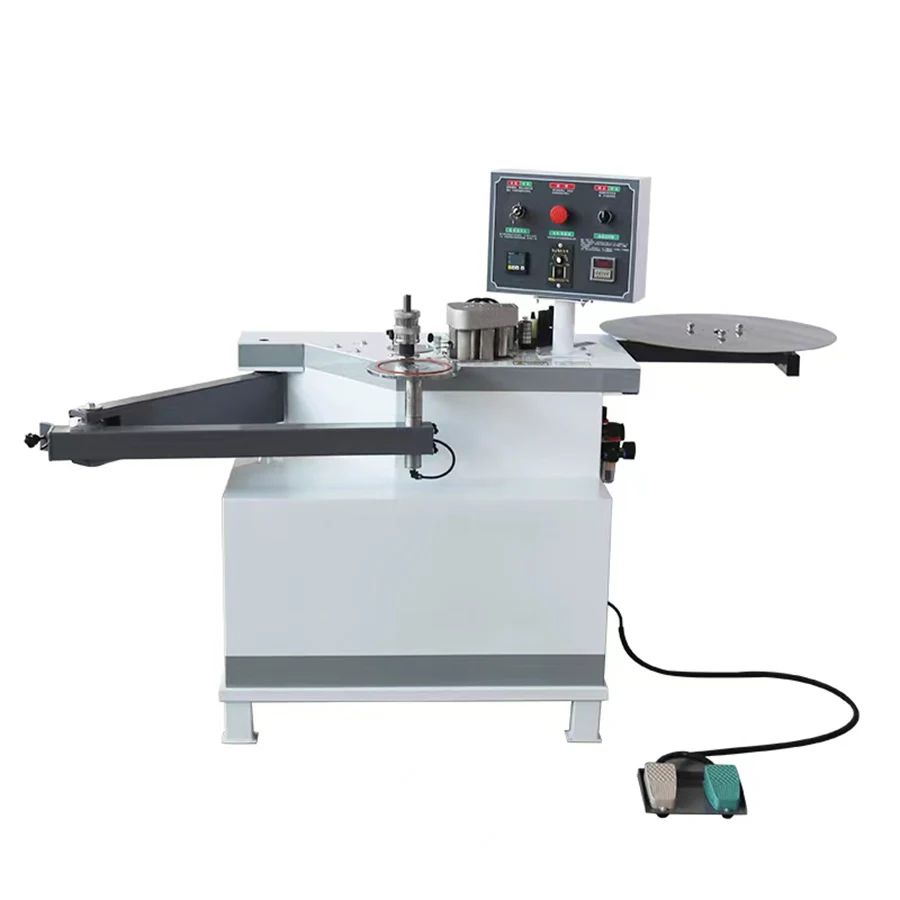
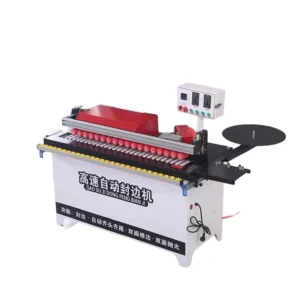
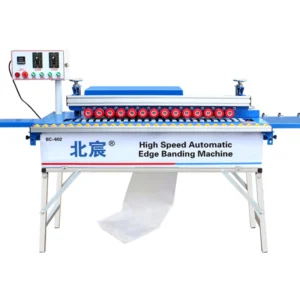
Ready for dispatch — pre-shipment tested on your specified board thickness and edge material before the crate leaves Shandong.
Technical Specifications
| Parameter |
Value |
| Product Type |
Manual Edge Banding Machine |
| Model Options |
W-1 / W-2 / W-3 |
| Voltage & Frequency |
220V 50Hz |
| Total Power |
1.4 kW (W-1, W-2) / 3.4 kW (W-3) |
| Air Source Pressure |
0.5–0.8 MPa |
| Edge Banding Speed |
0–180 mm/s |
| Edge Band Thickness Range |
0.4–2 mm |
| Edge Band Width Range |
8–50 mm |
| Overall Dimensions |
900×620×820 mm (W-1) / 1200×800×1220 mm (W-2) / 1210×1100×970 mm (W-3) |
| Net Weight |
88 kg (W-1) / 152 kg (W-2, W-3) |
| Standard Suction Cup Size |
200×26 mm (W-1) / 300×26 mm (W-2, W-3) |
| Glue Pot |
Enlarged capacity for reduced refill stops |
| Hot Air Device |
Bottom-up hot air heating |
| Belt Breaking |
Automatic, double-cylinder controlled |
| Control Panel |
Intelligent temperature control, speed adjustment, timer |
Application Suitability
| Application |
Material or Output |
| Custom cabinet and wardrobe panel edging |
Plywood and MDF with 0.4–2 mm PVC banding |
| Curved furniture components |
Melamine board with veneer or PVC edge band |
| Small-batch office furniture production |
Particleboard and plywood with straight and shaped edges |
| Door and window frame banding |
Solid wood and MDF substrates with veneer strips |
| Decorative panel finishing |
MDF and melamine panels requiring alternating curved and straight edge work |
Why the Right Machine Size Matters More Than the Price Tag
Buying a machine built for light-duty work and pushing it into daily production is the fastest way to burn through guides, belts, and patience.
I have watched workshops take a compact manual edge bander and run it eight hours a day on thick PVC stock. The machine was never designed for that volume. Within a few months the guide rails show wear that should take years to appear, and glue adhesion becomes inconsistent because the pot cannot maintain stable temperature under continuous cycling [NEED_CITE: typical wear patterns on manual edge banders under production-level duty cycles]. This manual edge banding machine in stock is built for a specific job: small batches, mixed curved and straight profiles, and workshops that are just stepping away from hand-applied edge work. Matching the machine to the actual workload is what keeps it running reliably.

What This Machine Actually Does Well
A folding-arm manual edge banding machine handles the one thing that automatic machines struggle with: switching between curved and straight edges on the same panel without retooling. The operator guides the board by hand, adjusting feed pressure on the fly. For a joinery shop making a run of cabinet doors with shaped tops and straight sides, that flexibility is the entire point. The manual edge banding machine in stock here covers edge band from 0.4 mm up to 2 mm, which spans most PVC and veneer strips used in custom furniture work.
Where It Fits in a Growing Workshop
This machine is the first step off the hand-gluing bench. It gives a small shop consistent glue temperature, controlled feed speed, and repeatable edge placement without the footprint or power draw of a full automatic line. When order volume climbs to the point where one operator cannot keep up, the path forward is a semi-automatic or automatic edge bander on a dedicated straight-line conveyor [NEED_CITE: typical production scaling stages for small furniture workshops]. This unit stays useful even after that upgrade, handling the curved and shaped pieces that the automatic line cannot process.
Reading the Spec Sheet Against Your Actual Work
The edge band thickness range of 0.4–2 mm tells you what the glue roller and pressure zone can handle. Running veneer at the thin end requires lower glue temperature and lighter pressure to avoid squeeze-out. PVC at 2 mm needs the opposite: a hotter pot and firmer contact. The intelligent temperature control on this panel allows you to dial in settings for each material rather than relying on a fixed thermostat. The 0–180 mm/s feed speed range is manually controlled, which means the operator sets the pace by feel. The enlarged glue pot reduces refill interruptions during a batch, which matters when you are running twenty or thirty panels in a session and cannot afford to stop and let the pot cool down. The double-cylinder automatic belt breaking gives a clean end cut on the banding strip, removing the ragged overhang that leads to chipping during trimming.
The Cost of Ignoring Duty Cycle
When a workshop buys a compact manual unit and runs it as if it were a production machine, the problems show up in sequence. First the glue pot struggles to hold temperature between back-to-back panels. Then the suction cup loses grip on heavier boards. Finally the guide mechanism develops play that makes curved edges inconsistent [NEED_CITE: edge banding adhesion failure causes in small workshop environments]. The fix is not a repair — it is recognizing that the machine was asked to do a job outside its design envelope. That is why we confirm actual daily panel count and edge material before recommending any model.
What You Get When You Order Here
Voltage and frequency are confirmed against your local power supply before dispatch, so the machine arrives ready to plug in. Every unit ships with a pre-shipment test record run on the board thickness you specified. The operation and maintenance manual is provided in the language your operator reads, not just in Chinese or English. A spare parts list is packed inside the crate so you can cross-reference wear items from day one. Factory visits are welcome if you want to see the assembly bench and test the machine on your own material before committing.
Documentation & Verification
- CE declaration of conformity covering this manual edge bander class
- Factory test record run on your specified board thickness and edge band material
- Electrical schematic with voltage and frequency confirmation for your facility
- Operation and maintenance manual in your agreed language
- Spare parts list packed with the machine for immediate reference
- Packing photographs taken before crate closure
Installation, Commissioning & Support
- Requires a 220V single-phase circuit with dedicated breaker matching the 1.4 kW or 3.4 kW draw
- Air supply line delivering 0.5–0.8 MPa to the machine inlet
- Bench or floor placement on level surface using the 900×620 mm or larger footprint
- First-run glue temperature calibration on your actual PVC or veneer stock
- Operator walk-through of folding-arm technique for curved and straight transitions
- Wear-item checklist covering suction cups, glue roller, and belt-breaking cylinders
Before You Send an Inquiry
We need to know the board materials you work with most often, the edge band type and thickness you run, and whether your panels are mostly straight, mostly curved, or a mix. Tell us your local voltage and frequency so we can confirm compatibility before quoting. If you already have upstream cutting or downstream boring equipment, share the make and feed height so we can check whether the panel transfer height aligns.
Frequently Asked Questions
Q: Is this manual edge banding machine in stock and how fast can it ship?
A: Stocked models are ready for dispatch after a pre-shipment test on your specified material. Lead time depends on whether voltage customization or language-specific documentation is needed. Standard 220V 50Hz units typically ship faster than configured variants.
Q: What voltage options are available for my country?
A: The standard configuration is 220V 50Hz. If your facility runs on a different voltage or frequency, confirm this before ordering so the motor and heating elements are matched to your supply. Sending a machine at the wrong voltage is a problem that cannot be fixed with an adapter.
Q: Can this machine handle both curved and straight edges on the same panel?
A: Yes. The folding-arm design allows the operator to guide the panel along a curved profile and then transition to a straight edge without changing tooling or stopping the machine. That flexibility is the main reason workshops choose this manual format over fixed-path automatic units.
Q: What is the minimum workshop space and power requirement?
A: The smallest model, the W-1, occupies roughly 900×620 mm of bench space and draws 1.4 kW from a standard single-phase outlet. You also need an air compressor delivering 0.5–0.8 MPa. Most small joinery shops already have both of these in place.
Q: How do I upgrade from this manual unit to a semi-automatic or automatic edge bander?
A: When your daily panel volume outpaces what one operator can feed by hand, the next step is a semi-automatic or automatic machine with powered feed and trimming stations. This manual unit remains useful for curved and shaped pieces that automatic lines cannot handle, so it stays on the floor rather than being replaced.