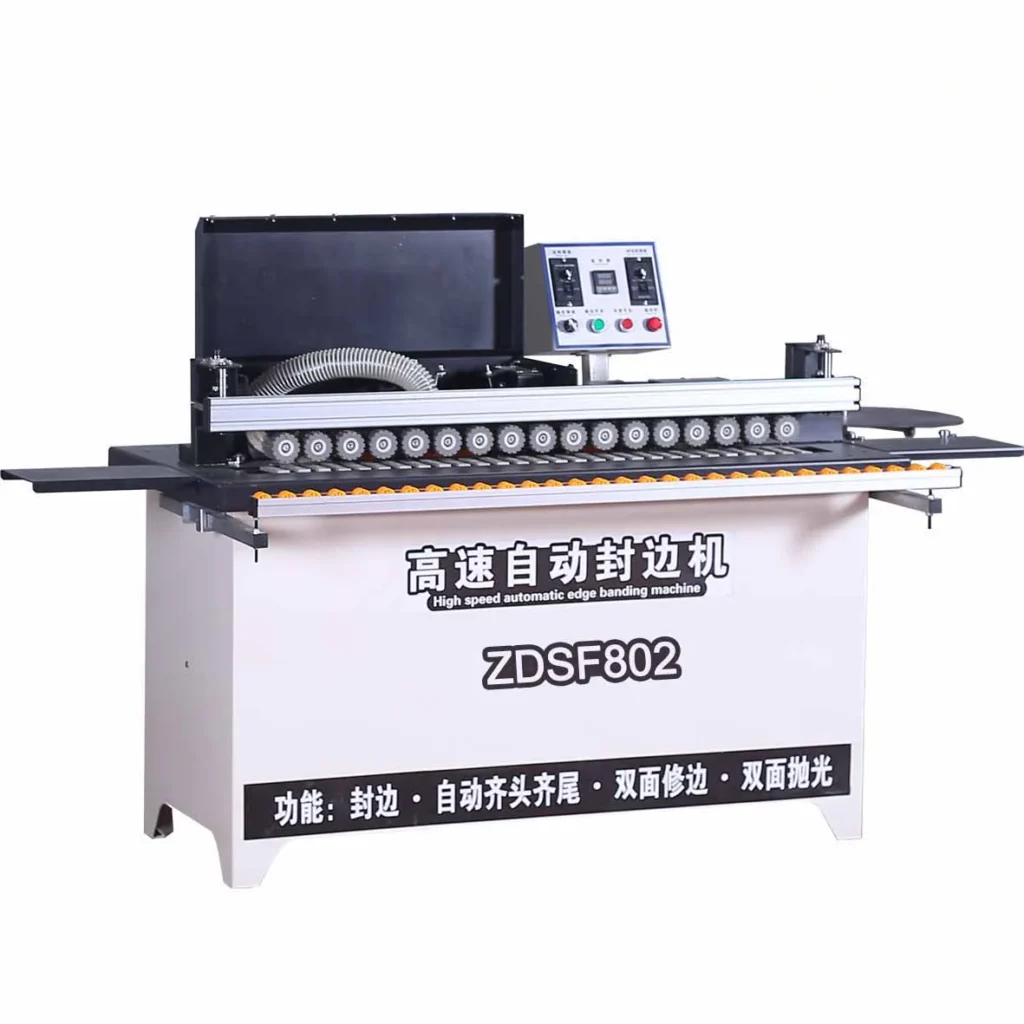
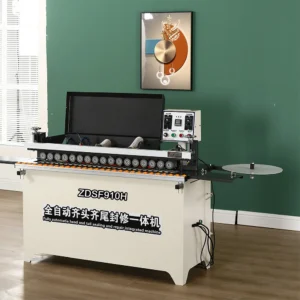
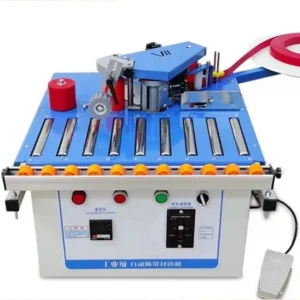
Ready-stock dispatch — Zds802 units are built, tested, and held in inventory for immediate loading rather than assembled against a backlog.
Technical Specifications
| Parameter |
Value |
| Model |
Zds802 |
| Product Type |
Automatic Edge Banding Machine |
| Rated Power |
4 kW |
| Voltage & Frequency |
220 V (frequency to confirm 50 Hz or 60 Hz) |
| Feed Speed |
0–10 m/min |
| Panel Thickness Range |
10–50 mm |
| Strip Thickness Range |
0.5–2.5 mm |
| Edge Type |
Straight line |
| Trimming Power |
800 W × 2 |
| Polishing Power |
180 W × 2 |
| Suction Power |
1200 W |
| Glue Pot Capacity |
4000 ml |
| Glue Pot Heating Power |
1000 W (heat-up time 5–10 min) |
| Rated Air Pressure |
0.4–0.6 MPa |
| Overall Dimensions (L×W×H) |
130 × 65 × 75 cm |
| Machine Weight |
150 kg |
| Control System |
Digital display, independent switch |
| Trimming Stations |
Upper and lower trimming, automatic end trimming |
| Polishing Stations |
Upper and lower polishing |
| Gluing Method |
Double-sided gluing |
| Conveyor Belt |
Silicone material |
| Dust Extraction |
Integrated dust collector |
| Warranty |
1 year |
Application Suitability
| Application |
Material or Output |
| Custom cabinet door edging |
MDF and particleboard panels 10–50 mm thick |
| Small-batch wardrobe panel finishing |
Plywood with PVC or melamine edge banding 0.5–2.5 mm |
| Joinery workshop starter production |
Solid wood panels for shelving and carcass components |
| Retrofit from manual banding |
Straight-line furniture components in compact workshop layouts |
Why Voltage Confirmation Must Happen Before the Crate Is Nailed Shut
A 220 V machine wired for the wrong frequency will overheat the glue pot element and stall the feed motor within the first production shift.
I once helped a small cabinet shop in Shandong commission a compact edge bander that arrived configured for 50 Hz while the local grid ran at 60 Hz. The glue pot could not hold temperature, the feed motor ran fast but with less torque, and panels came off the line with half-bonded edge strips. Two days of production were lost while the motor and heating element were swapped. This happens more often than buyers expect, especially with ready-stock units that leave the warehouse without a final electrical audit against the destination market [NEED_CITE: voltage and frequency standards by export market]. Confirming the exact voltage, phase, and frequency before dispatch avoids a problem that no amount of on-site troubleshooting can fix.

How Stock Availability Changes the Commissioning Timeline
When a joinery workshop decides to move from hand-held edge banding to a first Automatic Edge Banding Machine in stock, the gap between order and first usable panel matters. The Zds802 is held as a complete, tested unit — not as a kit requiring assembly from sub-inventories. Once the crate arrives, the operator connects the 220 V supply, attaches the air line at 0.4–0.6 MPa, and runs the first test panel within hours. This removes the multi-week build slot that made-to-order machines demand, which is important for workshops that have already committed delivery dates to their own customers.
Dispatch Readiness vs. Rushed Dispatch
Holding machines in stock is only useful if each unit has been verified before it enters the warehouse. Every Zds802 passes a four-stage quality check covering incoming components, in-process assembly, finished-product run-off, and pre-shipment verification. The glue pot is brought to operating temperature, the double-sided gluing heads are tested against actual PVC strip, and the upper-and-lower trimming cutters are run through a panel cycle to confirm edge finish. A test record accompanies the crate so the buyer can see what the machine produced before it was bolted down [NEED_CITE: factory pre-shipment test protocols for woodworking machinery].
What the 10–50 mm Panel Range and 0–10 m/min Feed Mean in Practice
The 10–50 mm panel thickness range covers the majority of carcass and door stock that a small custom furniture shop processes — thin 10 mm backs, standard 18 mm shelving, and 40–50 mm thick workbench tops. The variable feed speed from 0 to 10 m/min lets the operator slow down for dense MDF that needs a longer glue open time, then speed up for lighter particleboard where the adhesive grabs quickly. In my experience, the shops that get the cleanest edge finish are the ones that treat feed speed as a material-specific setting rather than leaving the dial at maximum. The 4000 ml glue pot supports extended runs without stopping to refill, which keeps the thermal mass stable and avoids the cold-start glue lumps that appear when the pot runs low.
When the Wrong Glue Temperature Meets High-Adhesive Board
A few months ago, a custom cabinet customer sent sample panels for a trial run on a machine in this class. The samples were standard particleboard and the edge strips bonded cleanly. But when the machine arrived at his factory, his actual stock was a high-glue-content MDF that required a noticeably higher glue pot temperature and a slower feed rate to achieve full adhesion. The parameters had to be rebuilt from scratch, and his line sat idle while we worked through the settings. The lesson I now share with every buyer: tell me the exact board brand and grade before the machine ships, so the test record reflects the material that will actually run on your shop floor [NEED_CITE: substrate adhesive content and edge bonding performance].
What You Gain by Ordering Through the Ready-Stock Channel
Stock-held Zds802 units ship with the conveyor belt, pressure beam, and double-row pressure rollers already aligned, saving the initial calibration step that a flat-pack build requires. The integrated 1200 W dust collector is matched to the trimming and polishing stations, so there is no separate extraction unit to source or duct to connect. Pneumatically controlled strip breaking is pre-set at the factory, giving a precise end cut without manual adjustment on first use. The silicone conveyor belt surface protects finished panels from scratching during transport through the machine, which matters when the output goes straight to an assembly bench without intermediate sanding. Every stocked unit ships with an operation manual in the agreed language, an electrical schematic confirming voltage, and a spare parts list that identifies every wearing component by part number.
Documentation & Verification
- CE declaration of conformity covering the Zds802 electrical and mechanical safety scope
- Factory test record run on the buyer's specified panel thickness and edge strip material
- Electrical schematic confirming 220 V wiring and component ratings before dispatch
- Operation and maintenance manual written in the buyer's chosen language
- Spare parts list with part numbers for trimmer blades, polishing wheels, and conveyor sections
Installation, Commissioning & Support
- Requires a level floor capable of supporting 150 kg across the 130 × 65 cm footprint
- Dedicated 220 V circuit rated above the 4 kW total draw to prevent voltage sag during glue pot heating
- Machine arrives fully assembled; connect power and 0.4–0.6 MPa air supply before first run
- Digital display and independent switch allow operator to set glue temperature and feed speed without PLC training
- First-batch commissioning includes test panels in MDF or particleboard to verify trim and polish finish
- Silicone conveyor belt inspected and replaced under warranty if surface defects appear within the first year
What to Include With Your Inquiry
Send the exact panel material, brand, and thickness range you plan to process so the pre-shipment test can match your real production conditions. Confirm your local voltage and frequency, and specify the plug type required at your site. If you have existing upstream saws or downstream boring machines, share their feed heights so the Zds802 conveyor alignment can be verified before dispatch.
Frequently Asked Questions
Q: Is the Zds802 in stock and how fast can it be dispatched?
A: The Zds802 is held as a fully assembled and tested unit in ready-stock inventory. Once voltage, plug configuration, and documentation language are confirmed, the crate can be prepared for loading without a build-to-order lead time. Dispatch timing then depends on shipping route and destination port scheduling.
Q: What voltage and plug configuration will I receive?
A: The machine is configured for 220 V operation. Before dispatch, we confirm whether your site runs 50 Hz or 60 Hz and fit the matching plug type. An electrical schematic is included in the crate so your electrician can verify the supply circuit matches the machine's rated draw before first power-on.
Q: What panel materials and thicknesses can this machine handle?
A: The Zds802 processes MDF, plywood, particleboard, and solid wood panels from 10 to 50 mm thick, with PVC or veneer edge strips from 0.5 to 2.5 mm. If your board has unusual adhesive content or density, share a sample so we can verify glue temperature and feed speed settings before shipping.
Q: Does it come with a dust collector or do I need a separate extraction system?
A: A 1200 W integrated dust collector is built into the Zds802 and ducted to the trimming and polishing stations. No separate extraction unit is required for normal operation. For very high-volume continuous running, some workshops add a central extraction system, but the integrated unit handles typical small-workshop duty.
Q: What spare parts are included and how do I order replacements?
A: Each Zds802 ships with a spare parts list identifying wearing components — trimmer blades, polishing wheels, conveyor belt sections, and glue pot heating elements — by part number. Replacements can be ordered directly using these numbers. The one-year warranty covers defective parts under normal operating conditions.