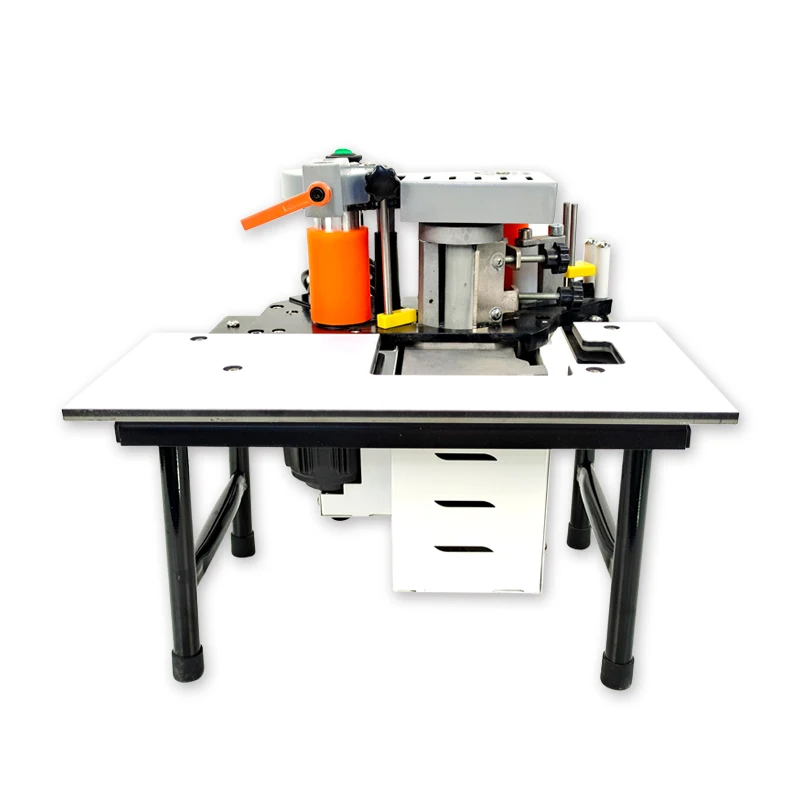
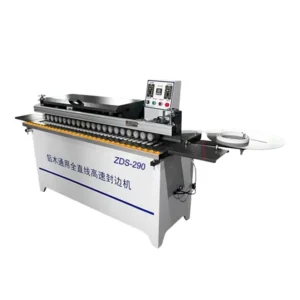
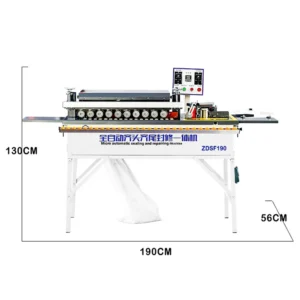
Ready-to-Ship Portable Edge Bander — ST-30 units are configured per order with confirmed voltage, plug type, and operator language before dispatch, eliminating the dead-on-arrival failures common with unverified stock machines.
Technical Specifications
| Parameter |
Value |
| Product Type |
Handheld Edge Banding Machine |
| Model |
ST-30 |
| Total Power |
1000W |
| Voltage & Frequency |
220V / 380V / Customizable to local grid |
| Edge Banding Type |
Straight and curve edge banding |
| Suitable Edge Banding Tape |
ABS, PVC, Melamine, Veneer |
| Minimum Sheet Length |
25 cm |
| Minimum Sheet Width |
3 cm |
| Edge Banding Height Range |
0–50 mm |
| Edge Banding Thickness Range |
0.3–3 mm |
| Edge Power |
20W |
| Air Source Pressure |
0.5–0.8 MPa |
| Glue Pot Capacity |
1000 ml |
| Machine Dimensions (L×W×H) |
38 × 35 × 35 cm |
| Machine Weight |
12 kg |
| Control Panel Language |
Chinese, English; customizable to Spanish or other languages |
| Plug Options |
EU, USA, AU, UK |
| Certification |
CE, ISO 9001 (basis to be confirmed for this specific model) |
Application Suitability
| Application |
Material or Output |
| Custom cabinet edge finishing |
MDF and particleboard panels with PVC or ABS tape |
| Small-batch furniture production |
Plywood panels with melamine or veneer edge banding |
| On-site interior decoration installs |
Solid wood and composite panels requiring curved-edge banding |
| Joinery workshop transition from manual taping |
Mixed board stock in low-volume, high-mix environments |
| Repair and rework of damaged panel edges |
Pre-existing furniture components needing re-banding on site |
Why Voltage Confirmation Must Happen Before the Order Is Placed
A Handheld Edge Banding Machine in stock is only useful if it actually runs when it arrives. Every export market has different single-phase and three-phase standards, and a unit wired for 380V three-phase is completely inoperable on a 220V single-phase workshop supply without an external transformer — a delay that can cost weeks on a job site.
Confirming voltage, frequency, and plug type in writing before dispatch is the single most important step in ordering portable woodworking equipment across borders.
I once watched a contractor lose three weeks on a Middle East interior fit-out because the edge bander that arrived was wired for the wrong supply. The transformer had to be sourced locally, shipped in, and tested — while carpenters sat idle and the client's handover deadline slipped. That machine was technically fine; it was just useless in that specific room with that specific breaker panel. [NEED_CITE: voltage and frequency standards by export market]

Built for the Workshop That Is Still Figuring Out Its Volume
The ST-30 occupies a specific place: it is the first machine a joinery startup or small carpentry team buys when hand-applied edge tape starts producing inconsistent glue lines and visible seams. At 12 kg with a 38 × 35 × 35 cm footprint, it sits on a bench or gets carried to a job site without a forklift. A Handheld Edge Banding Machine in stock at this tier is not a substitute for a full automatic line — it is the honest entry point for shops that need machine-assisted gluing on both straight and curved profiles without committing to a five-station floor unit.
Curved Edges Without a Second Machine
Most entry-level edge banders handle only straight runs, forcing small shops to buy a separate curve banding unit or revert to hand application for any contoured panel. The ST-30 covers both geometries in one body, handling edge tape from 0.3 mm to 3 mm thickness across a 0–50 mm height range. This matters for custom furniture makers producing radius-corner cabinets, rounded shelving, or contoured desk fronts — work that represents a growing share of interior decoration contracts. [NEED_CITE: CE machinery directive requirements for portable woodworking equipment]
Reading the Specs That Actually Matter on Site
The 1000 ml glue pot capacity determines how long the operator can run before stopping to refill — on small batches of custom panels, this is typically enough for a full working session without interruption. The 0.5–0.8 MPa air pressure requirement means the unit needs a small compressor on site; this is standard for pneumatic-assisted edge banding but must be factored into the workshop's air supply planning. The 0.3–3 mm tape thickness range covers the full spectrum of PVC, ABS, melamine, and veneer tapes used in furniture production, so the operator is not locked into one material supplier. The minimum sheet dimensions — 25 cm length and 3 cm width — define the smallest offcut or narrow stile the machine can grip, which is relevant for drawer component and face-frame work.
The Cost of Ignoring the Small Details at Purchase
A machine that arrives with a control panel in a language the operator cannot read stalls commissioning entirely — the team spends days guessing at temperature settings and feed adjustments instead of producing panels. Units ordered without specifying plug type require an electrician to cut and rewire the cord before first use, voiding the warranty in some jurisdictions. And when a portable bander is pushed into production volumes it was never sized for, the glue pot cannot keep up, the feed mechanism wears prematurely, and edge quality degrades without obvious warning until panels fail at the assembly bench. [NEED_CITE: common causes of edge banding failure in small workshop environments]
What You Are Actually Buying at This Tier
Every ST-30 unit ships with voltage and plug configuration confirmed against the buyer's local supply before production begins, not assumed from the destination country. The control panel language is specified at order — Chinese, English, or a custom option like Spanish — so the operator reads the interface on day one. Pre-shipment testing includes running the buyer's specified edge tape on a sample panel, with photographs included in the delivery package. Single-unit orders are accepted without minimum quantity requirements, which matters when a workshop is trialing the machine before scaling. The four-stage quality check covers incoming components through to pre-shipment verification, catching tolerance issues before the crate is sealed.
Documentation & Verification
- Electrical schematic confirming your specified voltage, frequency, and plug type before dispatch
- Factory test record using your edge tape material and panel thickness before crating
- Operation and maintenance manual delivered in the language specified at order confirmation
- CE declaration of conformity and ISO 9001 certificate included in shipping documentation
- Spare parts list with part numbers matching the unit shipped, not a generic catalog
Installation, Commissioning & Support
- Requires a dedicated circuit matching confirmed voltage; the 1000W total draw fits standard 220V workshop outlets
- Air compressor delivering 0.5–0.8 MPa must be on site before first use of the ST-30
- Glue pot initial heat-up takes several minutes; first test run should use scrap stock to verify temperature
- Operator manual covers glue temperature adjustment for PVC, ABS, melamine, and veneer tape differences
- Curved-edge banding requires slower manual feed; practice on offcuts before working finished panels
Before You Request a Quote
To configure the right Handheld Edge Banding Machine in stock for your workshop, tell us your local supply voltage and frequency, the plug standard in your country, and the language your operator reads. Share the edge tape materials you work with most often — PVC, ABS, melamine, or veneer — and the typical panel thickness range you need to band. If you are evaluating this unit as a trial before a larger equipment purchase, we can arrange a single-unit dispatch with your specific configuration.
Frequently Asked Questions
Q: What panel sizes and edge shapes can this handheld unit actually handle?
A: The ST-30 bands both straight and curved edges on panels as small as 25 cm long and 3 cm wide, with edge tape thickness from 0.3 mm to 3 mm and a banding height up to 50 mm. This covers most custom cabinet components, drawer fronts, and contoured shelving produced in a small joinery workshop.
Q: How do I confirm voltage and plug type for my country before ordering?
A: You provide your local supply voltage, frequency, and plug standard at inquiry — we confirm the configuration in writing before production begins. The machine ships wired and plugged exactly for your workshop, with a matching electrical schematic in the documentation package.
Q: What edge banding materials work with this machine?
A: The ST-30 handles ABS, PVC, melamine, and veneer edge banding tape. Glue temperature adjustment is required when switching between material types, and the operator manual covers the recommended settings for each tape to ensure consistent adhesion on MDF, particleboard, plywood, and solid wood.
Q: What is the dispatch lead time for a single-unit order?
A: Stock-configured units with standard voltage and English-language panels dispatch faster than custom-configured orders. Single-unit orders are accepted without minimum quantity barriers, and dispatch timing is confirmed at quotation based on your specific voltage, plug, and language requirements.
Q: Can I order one unit as a sample before committing to a larger purchase?
A: Yes. The ST-30 is available as a single-unit trial order with your full configuration specified — voltage, plug type, and control panel language. The pre-shipment test record and panel photographs let you verify output quality before the machine leaves the factory.