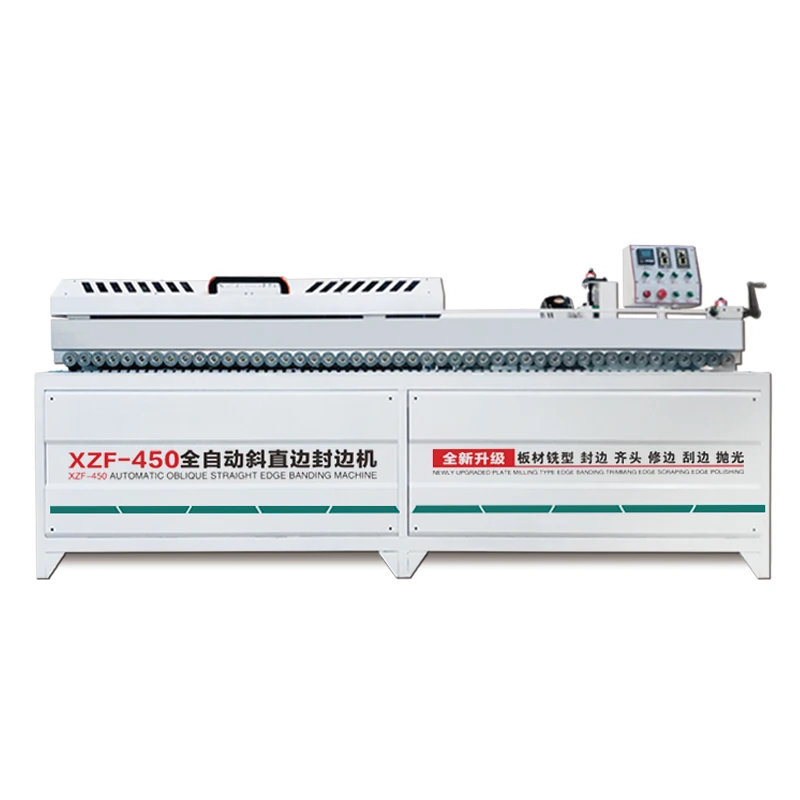
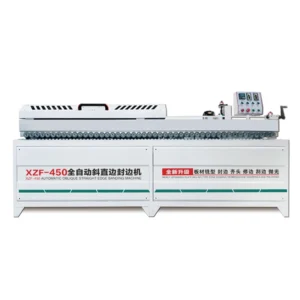
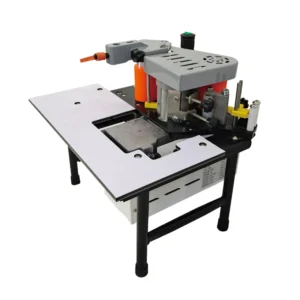
Ready from Stock — The XZF450 bevel and straight edge banding machine ships from existing inventory with voltage and plug confirmed before dispatch, eliminating multi-week waits for small workshops ready to mechanize.
Technical Specifications
| Parameter |
Value |
| Model |
XZF-450 |
| Product Type |
Bevel and Straight Edge Banding Machine |
| Total Power |
9.5 kW |
| Voltage Options |
380V / 415V |
| Pre-milling Motor |
4 kW |
| Edge Banding Motor / Speed |
0.16 kW / 0–12 m/min |
| Transmission Motor / Speed |
180 W / 0–12 m/min |
| Trimming Motor |
2.2 kW × 2 |
| Polishing Motor |
0.4 kW × 2 |
| Vacuum Power |
550 W |
| Feed Speed |
0–12 m/min |
| Minimum Sheet Length |
300 mm |
| Minimum Sheet Width |
150 mm |
| Edge Banding Height |
0–50 mm |
| Edge Banding Thickness |
0.3–3 mm |
| Glue Pot Capacity |
4000 ml |
| Air Source Pressure |
0.5–0.7 MPa |
| Machine Dimensions (L×W×H) |
3000 × 650 × 1350 mm |
| Machine Weight |
430 kg |
| Standard Functions |
Pre-milling, 30°/45°/60° bevel banding, trimming, scraping, polishing, vacuum extraction |
| Control Panel Language |
English standard (configurable) |
| Plug Options |
EU, USA, AU, UK |
Application Suitability
| Application |
Material or Output |
| Cabinet door edge finishing |
MDF and melamine-faced particleboard |
| Small-batch custom furniture |
Plywood and blockboard panels up to 50 mm |
| Joinery workshop mechanization |
Solid wood and polymer door components |
| Startup production line |
PVC and veneer edge banding on composite substrates |
Why the Voltage Question Must Come Before You Order an Edge Banding Machine in Stock
A machine that cannot plug into your workshop grid is a 430 kg paperweight until an electrician rewires the entire facility.
I once watched a Middle Eastern customer wait three weeks to run a brand-new edge bander because the factory shipped it configured for a voltage standard that did not match their local supply. The control panel locked out, the glue pot would not heat to operating temperature, and the feed motor tripped the breaker on every start attempt. This Edge Banding Machine in Stock is configured after your voltage and frequency are confirmed, not before [NEED_CITE: voltage and frequency standards by export market]. Choosing a unit based on price alone, then discovering the electrical mismatch at the loading dock, is a pattern that repeats across every export market where grid standards differ from the manufacturer's domestic supply.

Compact Footprint Designed for Workshop Floors, Not Factory Halls
Small joinery shops and startup cabinet makers rarely have the floor space of a panel processing plant. The XZF450 packs seven working stations — pre-milling, bevel and straight banding, trimming, scraping, polishing, and high-power vacuum extraction — into a three-meter footprint. This Edge Banding Machine in Stock is built for workshops that need a complete edge finishing station in one unit, without chaining together separate machines that consume twice the floor area and require individual power circuits.
From Hand Trimming to Automated Finishing in a Single Step
Many small workshops still rely on manual edge application and hand scraping, which produces inconsistent glue lines and visible trimming marks across different substrates. The XZF450 eliminates that variability by running panels through a fixed sequence at a controlled feed speed. The operator loads the sheet, sets the angle — 30, 45, or 60 degrees — and the machine handles pre-milling, glue application, trimming, and polishing in one pass [NEED_CITE: edge quality requirements in furniture assembly standards].
How Feed Speed, Glue Temperature, and Panel Thickness Interact
The variable feed speed of 0–12 m/min directly governs how long each panel section spends under the glue roller and trimming cutters. Slower speeds allow the 4 kW pre-milling station to remove more material from uneven panel edges, which is necessary when working with particleboard that tends to chip. The 4000 ml glue pot must reach a stable temperature matched to the edge banding material — PVC strips require different heat settings than thin wood veneer. Running the wrong combination produces visible glue lines or delamination during trimming. The 0.3–3 mm thickness range covers most common banding materials, but the operator should verify that the glue temperature setting corresponds to the specific strip being used [NEED_CITE: adhesive temperature curves for PVC and veneer edge banding]. Edge banding height up to 50 mm accommodates standard cabinet panels as well as thicker solid wood components.
What Happens When the Wrong Configuration Arrives at Your Dock
Purchasing a single edge bander without confirming the air source pressure requirement often surfaces only when the trimming and scraping stations fail to actuate properly. The XZF450 requires 0.5–0.7 MPa compressed air — workshops with undersized compressors experience intermittent pneumatic failures that mimic electrical faults and waste days of troubleshooting. Equally problematic is receiving a control panel in a language the operator cannot read; commissioning stalls while the buyer searches for a translator familiar with industrial terminology [NEED_CITE: operator interface language requirements in machinery safety directives].
Why Buyers Choose This Supplier for Entry-Level Machines
In-house manufacturing means the XZF450 is assembled, tested, and stored under one roof — no third-party trading company sits between you and the production floor. Every unit undergoes a four-stage quality check that includes pre-shipment verification on actual panel material when requested. Voltage, plug type, and control panel language are confirmed before the machine leaves the facility, not assumed from a default configuration. The patented cutting mechanism in the trimming stations holds tolerance that affects downstream assembly fit, and engineers provide configuration guidance matched to the buyer's substrate and production volume rather than pushing the highest-spec model available.
Documentation & Verification
- CE declaration of conformity covering machinery safety requirements
- Factory test record run on buyer's specified panel thickness and edge material
- Electrical schematic confirming voltage, frequency, and plug type before dispatch
- Operation and maintenance manual in agreed language with illustrated component diagrams
- Packing photographs showing crate condition and accessory placement prior to collection
Installation, Commissioning & Support
- Requires a level concrete floor capable of supporting 430 kg concentrated load
- Dedicated 380V/415V circuit with appropriate breaker rating for 9.5 kW total draw
- Arrives as a single assembled unit requiring only air hose and power connection
- First-run parameter setup includes glue pot temperature calibration to your edge banding material
- Spare parts list covers trimming blades, polishing wheels, and glue pot heating elements
What to Include with Your Inquiry
To receive a configuration proposal matched to your workshop, provide the panel materials you process most often — MDF, particleboard, plywood, or solid wood — along with typical panel dimensions and edge banding thickness. Confirm your local voltage, frequency, and preferred plug type so the machine ships ready to connect. If your operators require a specific control panel language beyond English, state the preference with the inquiry so it is set before dispatch.
Frequently Asked Questions
Q: What voltage and plug type ships with the machine, and can it be changed before dispatch?
A: The XZF450 ships configured to 380V or 415V with EU, USA, AU, or UK plug options. Voltage and plug type are confirmed during the order stage and set before the machine leaves the factory. No field modification is needed upon arrival, provided your workshop supply matches the confirmed specification.
Q: Can the control panel display English or another language?
A: English is the standard control panel language on every unit. Additional languages including Spanish are available and set before dispatch. Specify your preferred language during the ordering process so the interface is configured and tested before the machine is packed.
Q: How quickly does a stocked unit dispatch after order confirmation?
A: Units held in ready stock ship after pre-shipment testing and packing are completed, typically within days of order confirmation and payment receipt. Custom voltage or language configurations add a short preparation period. Exact timing is confirmed at the quotation stage based on current inventory status.
Q: What spare parts should I order alongside the machine?
A: The recommended initial spare set includes trimming cutter inserts, polishing wheels, and a spare glue pot heating element. A complete spare parts list with part numbers is included in the documentation package so future reorders can be placed directly without identifying components manually.