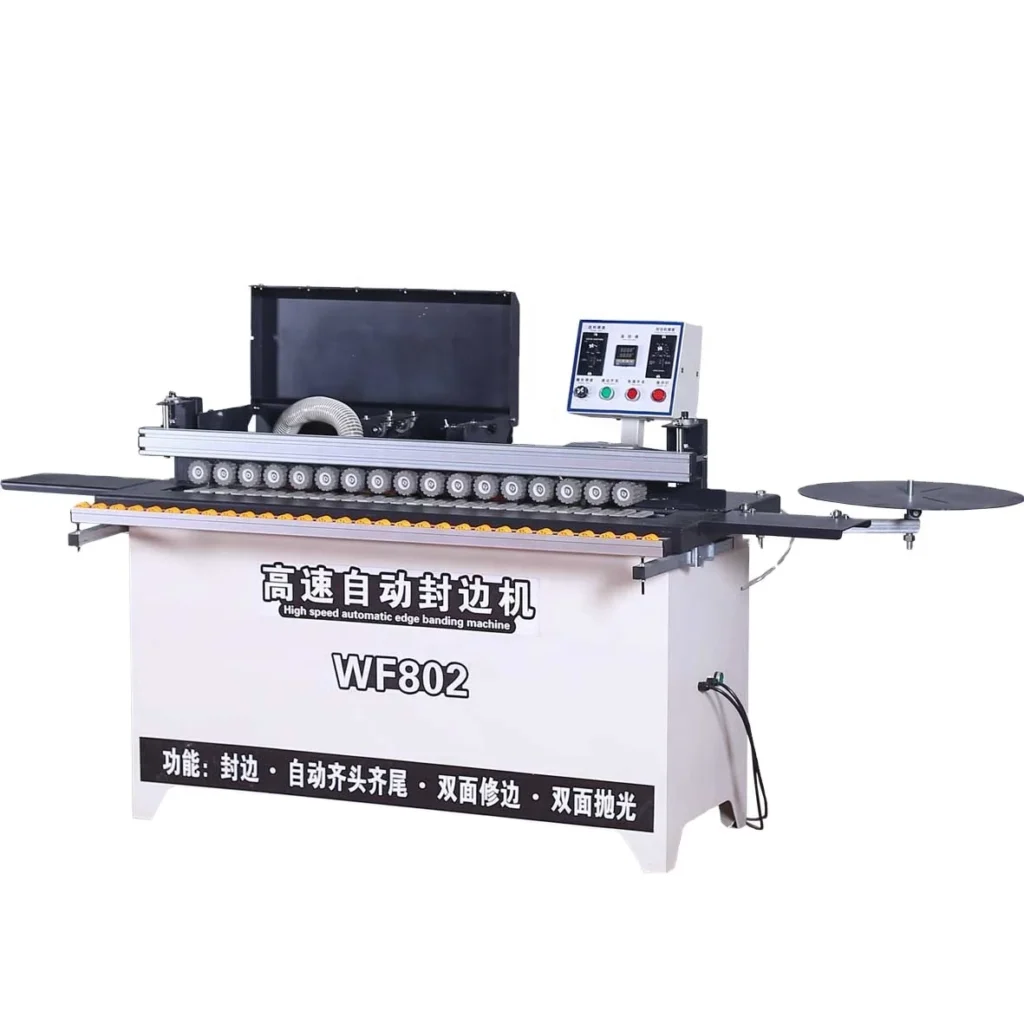
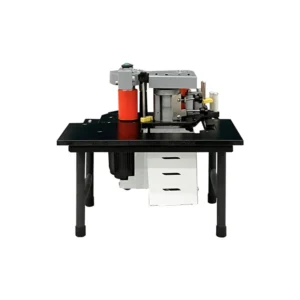
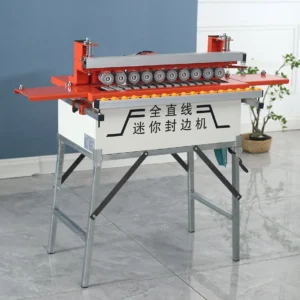
Voltage-ready compact banding — a 220V, 150 kg straight-line edge bander kept in stock for workshops that need automated trimming and polishing without reworking their shop floor wiring.
Technical Specifications
| Parameter |
Value |
| Model |
802 |
| Product Type |
Automatic Linear Edge Banding Machine |
| Edge Type |
Straight line |
| Rated Voltage |
220V (configurable from 110V to 440V per order) |
| Rated Power |
4 kW |
| Trimming Power |
800 W × 2 |
| Polishing Power |
180 W × 2 |
| Suction Power |
1200 W |
| Heating Power |
1000 W (warm-up 5–10 min) |
| Rated Air Pressure |
0.4–0.6 MPa |
| Feed Speed |
0–10 m/min |
| Conveyor Belt Speed |
0–10 m/min |
| Strip Thickness Range |
0.5–2.5 mm |
| Sheet Thickness Range |
10–50 mm |
| Glue Pot Capacity |
4000 ml |
| Overall Dimensions (L×W×H) |
130 × 65 × 75 cm |
| Machine Weight |
150 kg |
| Control Interface |
Digital display with independent switches |
| Conveyor Belt Material |
Silicone |
| Pressure Beam |
One-piece, double rows of pressure wheels |
| Belt Breaking Method |
Pneumatically controlled |
| Extendable Support |
Fluent strips for large plate stability |
| Key Features |
Automatic plate feeding, end cutting, upper and lower polishing, head and tail trimming, integrated dust collector |
Application Suitability
| Application |
Material or Output |
| Custom cabinet door edge sealing |
MDF and particleboard with PVC or veneer banding |
| Small-batch wardrobe panel finishing |
Plywood sheets 10–50 mm thick |
| Joinery workshop first automated bander |
Solid wood panels with straight-line edges |
| Low-volume furniture production |
Melamine-faced boards in batch runs |
Why the Voltage Question Should Come Before the Price on an automatic edge banding machine for small workshop
Confirm your local supply voltage and frequency before any commercial discussion — a mismatched machine simply will not run.
I once watched a container get unloaded in Southeast Asia with a 380V edge bander destined for a 220V workshop. The variable frequency drive burned out within minutes of power-on, and the operator sat idle for three weeks waiting for replacement parts. That kind of delay does not show up in a quotation spreadsheet. [NEED_CITE: voltage and frequency standards by export market]
When sourcing an automatic edge banding machine for small workshop environments, the power supply is the first constraint that determines whether the machine can even be switched on. Small joinery shops often operate on single-phase 220V circuits with limited breaker capacity, and a machine pulling 4 kW at the wrong frequency will trip protection or damage electronics before the first panel is fed.

Stock Availability and Dispatch Lead Time
This Model 802 automatic edge banding machine for small workshop use is positioned as a ready-stock configuration. The 220V baseline matches the standard single-phase supply found in most small joinery shops and startup cabinet makers, so the machine can be dispatched without waiting for a custom motor or transformer swap. For workshops planning a fast upgrade from manual banding, having a known configuration in the warehouse shortens the gap between order decision and first sealed panel.
Compact Footprint for Tight Workshop Floors
At 130 × 65 × 75 cm and 150 kg, this unit fits through standard doorways and can be positioned by two people with a pallet jack. The extendable fluent strips deploy only when oversized panels need support, then fold away so the machine does not permanently consume floor space that a small shop needs for material staging. [NEED_CITE: CE machinery directive requirements for industrial equipment]
Reading the Specs That Matter on the Shop Floor
The 10–50 mm sheet thickness range and 0.5–2.5 mm strip thickness range define what this machine can physically process. Panels thinner than 10 mm tend to flex under the pressure beam, while strips over 2.5 mm require more trimming force than the 800 W × 2 trimming motors are rated to deliver continuously. The 0–10 m/min feed speed is practical for batch work where an operator loads and inspects each panel; at this throughput the silicone conveyor belt and double-row pressure wheels keep panels scratch-free without needing the higher belt speeds of a production-line machine. The 4000 ml glue pot capacity is large enough to sustain a continuous run of cabinet panels without mid-batch refills, which matters when you are the only person operating the machine and cannot pause to top up hot-melt adhesive every twenty minutes. The 1000 W heating element with a documented 5–10 minute warm-up window means the operator should power on the glue pot before laying out the first batch of panels.
What Happens When the Wrong Configuration Ships
A small workshop that receives a machine with a control panel in an unreadable language faces a stalled commissioning — the operator cannot set glue temperature or adjust feed speed without guesswork, and incorrect settings lead to visible glue lines or delaminated edges. Entry-level machines pushed beyond their designed production volume develop premature wear on trimming cutters and conveyor belts, which then get blamed on build quality rather than misapplication. [NEED_CITE: common commissioning faults from language and configuration mismatches]
Why Procurement Through This Channel Works
Stock configurations like the 802 are held with confirmed voltage and language settings, so the machine that arrives matches the quotation. Each unit ships with a factory test record run on your specified substrate and edge material, not a generic demo panel. The one-piece pressure beam and pneumatic belt breaking are verified functional before crating, and packing photographs document the machine condition at the point of dispatch. Engineer-led configuration review catches incompatibilities — like a 440V requirement in a 220V region — before production starts rather than after the container is loaded.
Documentation & Verification
- CE declaration of conformity applicable to this voltage class
- Factory test record on your actual panel thickness and edge material
- Electrical schematic confirming 220V wiring and breaker requirements
- Operation and maintenance manual in your specified language
- Spare parts list with trimming cutter and conveyor belt consumables
- Pre-shipment packing photographs documenting machine condition
Installation, Commissioning & Support
- Requires a dedicated 220V circuit rated for at least 4 kW continuous draw
- Compressed air supply at 0.4–0.6 MPa for pneumatic belt breaking
- Arrives assembled; position on a level floor with clearance on the feed side for the extendable fluent strips
- Allow 5–10 minutes for the 1000 W glue pot to reach operating temperature before first panel
- Silicone conveyor belt inspection and pressure wheel alignment during first-day commissioning
- Trimming cutter replacement intervals depend on strip material hardness and daily run volume
Preparing Your Inquiry
To match the right stock unit to your workshop, share your local voltage and frequency, the primary panel materials and thicknesses you run, and the edge banding strip type and thickness range you currently use. If your operator needs the control interface in a specific language, state that upfront so the correct unit is allocated from available stock.
Frequently Asked Questions
Q: What panel materials and edge banding thicknesses does the Model 802 handle?
A: The machine processes MDF, particleboard, plywood, and solid wood panels from 10 to 50 mm thick. Compatible edge banding strips range from 0.5 to 2.5 mm in thickness, covering standard PVC, melamine, and thin veneer materials commonly used in cabinet and furniture workshops.
Q: Is 220V the only voltage option available for this machine?
A: The 220V configuration is the stocked baseline for fast dispatch. Voltage can be configured from 110V to 440V on a per-order basis to match your local supply. Always confirm your exact voltage and frequency before the unit is allocated or modified.
Q: What is realistic daily throughput, and when should I consider a higher-tier model?
A: At 0–10 m/min feed speed with manual panel loading, this machine suits low-to-medium batch volumes typical of a small custom furniture shop. When your daily panel count grows to the point where continuous feed and automatic return become necessary, stepping up to a full-function pre-milling model on the production-line site is the logical path.
Q: Does the machine ship fully assembled, and what installation support is provided?
A: The unit ships assembled at 130 × 65 × 75 cm and 150 kg, requiring only a level floor, a dedicated 220V circuit, and a compressed air supply. Installation guidance covers pressure wheel alignment, glue pot warm-up, and first-panel test runs to verify edge quality on your substrate.
Q: How do I order spare consumables like glue and replacement trimming cutters?
A: The spare parts list shipped with the machine includes part numbers for trimming cutters, polishing wheels, and the silicone conveyor belt segment. Consumables can be reordered through the same procurement channel using those references, and stocking a set of cutters locally avoids downtime during high-volume weeks.