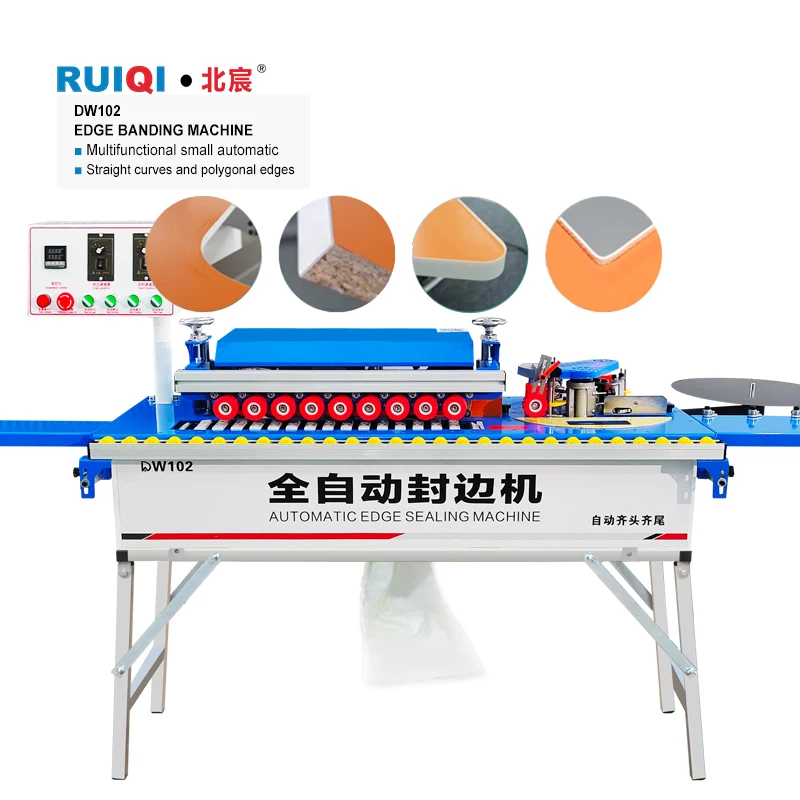
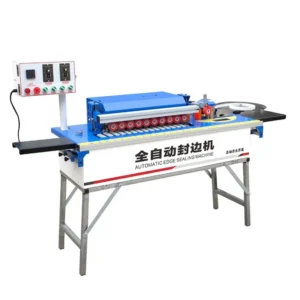
Verified Compact Footprint — A benchtop automatic edge bander built around a 1280×470mm frame that integrates gluing, trimming, and polishing without requiring separate stations or external vacuum generators.
Technical Specifications
| Parameter |
Value |
| Model |
DW102 |
| Product Type |
Automatic Edge Banding Machine |
| Total Power |
3800 W |
| Voltage Options |
220 V / 380 V / Customization |
| Edge Banding Thickness Range |
0.3 – 3 mm |
| Edge Banding Height Range |
0 – 50 mm |
| Minimum Sheet Length |
250 mm |
| Minimum Sheet Width |
50 mm |
| Glue Pot Capacity |
1000 ml |
| Trimming Motor Power |
650 W × 2 |
| Polishing Motor Power |
180 W × 2 |
| Vacuum Motor Power |
1200 W |
| Transmission Motor Power |
60 W |
| Edge Motor Power |
20 W |
| Required Air Pressure |
0.5 – 0.8 MPa |
| Overall Dimensions (L×W×H) |
1280 × 470 × 690 mm |
| Net Weight |
75 kg |
| Key Features |
Curved and straight edge banding, automatic head and tail cutting, edge trimming, polishing, integrated vacuum hold-down |
| Language Options |
Chinese, English; other languages available on request |
| Plug Options |
EU, USA, AU, UK |
| Certification |
ISO Approval |
Application Suitability
| Application |
Material or Output |
| Custom cabinet door edge finishing |
MDF and plywood panels with PVC or veneer banding |
| Small-batch furniture panel processing |
Particleboard with melamine edge strips |
| Joinery workshop curved edge work |
Solid wood and blockboard with curved profiles |
| Polymer door edge sealing |
Polymer composite panels with matching edge material |
Why Voltage Must Be Settled Before the Edge Banding Machine for Small Workshop Ships
A machine wired for 380 V three-phase is useless in a workshop running single-phase 220 V — and the fix is rarely a simple transformer swap.
One of the most common reasons compact edge banders sit idle after delivery is a voltage and frequency mismatch that was never checked at the quotation stage. The DW102 can be configured for 220 V or 380 V with multiple plug standards, but the correct combination must be locked in before production begins. Swapping motors or rewiring control panels after arrival costs more than confirming the spec upfront [NEED_CITE: voltage and frequency standards by export market]. When an edge banding machine for small workshop environments arrives with the wrong plug or incorrect phase configuration, commissioning stalls until a local electrician resolves the issue — if one is available at all.

From Hand Iron to Machine Finish Without Rebuilding the Floor Plan
Moving from a manual edge iron to an automatic edge bander usually means finding room for a machine, a dust extractor, and a separate trimming station. The DW102 consolidates gluing, automatic head-and-tail cutting, trimming, and polishing into a single 1280 mm long unit. A joinery shop can place it against a wall and start producing finished panels the same day it is unpacked. The integrated 1200 W vacuum hold-down replaces the need for a standalone vacuum pump, keeping the edge banding machine for small workshop setups genuinely self-contained.
What Compact Really Means on a Working Benchtop
The 470 mm width and 75 kg net weight mean two people can position this machine on a sturdy workbench without a forklift or floor anchors. Despite the footprint, the 0.3–3 mm edge banding thickness range covers PVC, melamine, and veneer strips — the materials a small cabinet shop encounters daily. The 1000 ml glue pot is sized for short production runs rather than continuous shifts, which aligns with how a startup furniture shop actually works: batch processing rather than non-stop feeding [NEED_CITE: glue pot sizing for short-run furniture production]. This prevents glue from degrading in an oversized reservoir during idle periods.
Reading the Numbers That Actually Affect Edge Quality
The 650 W × 2 trimming motors provide enough torque to cleanly shear PVC and veneer without tearing the strip edge — a direct result of matching motor power to the cutting mechanism geometry rather than overspecifying. The 0.3–3 mm banding thickness range is wide enough to handle most cabinet and furniture edge profiles, while the 50 mm maximum edge height accommodates standard 18 mm and 25 mm board thicknesses with room for thicker stock. The 0.5–0.8 MPa air pressure requirement is standard for workshop compressors already running CNC routers or pneumatic clamps, so no additional air supply investment is needed. The 3800 W total power draw stays within the capacity of a typical single-phase workshop circuit, avoiding the need for a dedicated high-amperage line.
What Happens When the Feed Height Does Not Match Your Panels
A frequent failure point in small workshop equipment is discovering that the machine's feed mechanism was never matched to the actual board thickness being processed. Panels that are too thick for the feed rollers produce inconsistent glue lines and uneven trimming pressure. Panels that are too thin can shift during the banding pass, resulting in visible edge gaps. The DW102 specifies a 0–50 mm banding height and a 250 mm minimum sheet length, which defines its working envelope clearly — but buyers still need to verify their most common panel stock falls within that range before committing to a configuration [NEED_CITE: panel thickness compatibility with feed mechanisms].
Why This Supplier for a First Machine Purchase
The DW102 arrives fully assembled, eliminating the alignment errors that occur when a small shop attempts field assembly of separate gluing and trimming stations. Voltage and plug type are confirmed during the quotation process rather than assumed, so the machine connects directly to the existing workshop supply. The control panel language is selected at order stage — English is standard, with other languages available — so operators can read settings without guesswork. A pre-shipment test record documents actual edge finish quality on the buyer's own panel material before the machine leaves the factory. Factory visits are welcomed, giving buyers the chance to see the four-stage QC process applied to the specific unit they will receive.
Documentation & Verification
- CE declaration of conformity for the DW102 automatic edge bander
- Factory test record showing edge finish on your specified panel material and thickness
- Electrical schematic confirming configured voltage, phase, and plug type
- Operation and maintenance manual in the agreed control panel language
- Spare parts list matching the shipped configuration for reorder accuracy
Installation, Commissioning & Support
- Place on a level, vibration-resistant bench capable of supporting 75 kg plus panel load
- Connect to a circuit rated for the confirmed voltage and 3800 W total draw
- Supply compressed air at 0.5–0.8 MPa via standard quick-connect fitting
- Verify glue pot temperature settings against your specific edge banding material
- Run initial test panels to calibrate trimming depth and polishing pressure
- Schedule periodic glue pot cleaning to prevent residue buildup in the 1000 ml reservoir
What to Share Before Requesting a Quotation
To match the right configuration to your workshop, provide the panel materials you process most often along with their typical thickness range. Specify your local voltage and frequency so the correct motor and transformer setup is quoted. Confirm the preferred control panel language for your operators. If you want to see how the machine handles your specific stock, send a sample panel and edge banding strip for a pre-shipment test run.
Frequently Asked Questions
Q: What panel sizes and thicknesses can this compact edge bander handle?
A: The DW102 accepts panels with a minimum length of 250 mm and minimum width of 50 mm, with a banding height range of 0–50 mm. This covers standard furniture board thicknesses. Edge banding thickness from 0.3 mm to 3 mm handles PVC, melamine, and veneer strips commonly used in cabinet and joinery work.
Q: How do I confirm the voltage and plug type match my workshop supply?
A: During the quotation stage, provide your workshop's voltage, phase, and frequency. The machine is configurable for 220 V or 380 V with EU, USA, AU, or UK plug options. The electrical schematic is confirmed before production so the machine connects directly upon arrival without transformers.
Q: Can the control panel be set to my operator's language?
A: English and Chinese are standard options, with additional languages available upon request at the order stage. Confirming the preferred language early ensures the interface matches what your operators can read, avoiding delays during commissioning and daily use.
Q: What is the upgrade path when my production volume outgrows this machine?
A: The DW102 serves as an entry point within a product family that scales to higher feed speeds, additional processing stations, and larger panel capacities. When your daily output consistently exceeds short-run volumes, a larger model from the same range can be configured without changing your supplier relationship or retraining operators on a different control philosophy.
Q: How do I order a sample test run on my own panel material before committing?
A: Send a sample of your most common panel stock along with the edge banding strip you intend to use. A test run is performed on the configured machine, and a factory test record documenting edge finish quality is provided before the unit is packed for shipment.