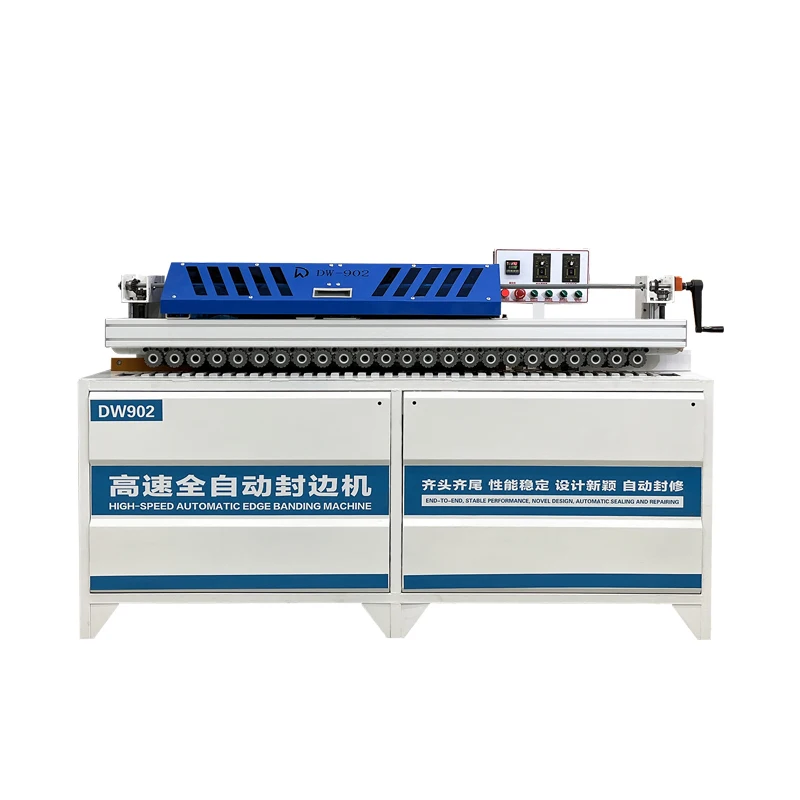
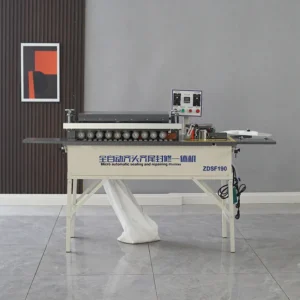
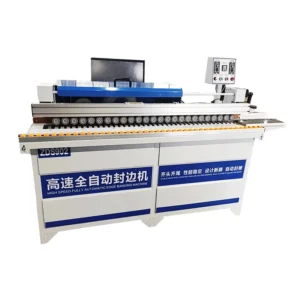
Compact Footprint, Verified Tolerance — the DW902 automatic edge banding machine is engineered for workshops transitioning from manual to machine production, offering verified ±0.02mm precision in a layout that fits beside your existing table saw.
Technical Specifications
| Parameter |
Value |
| Model |
DW902 |
| Product Type |
Automatic Wood Edge Banding Machine |
| Rated Power |
4000W |
| Voltage & Frequency |
220V/380V/customization (basis not stated in source) |
| Edge Trimming Motor |
800W × 2, 24000 r/min |
| Polishing Motor |
380W × 2 |
| Edge Feed / Transmission Motor |
140W each |
| Vacuum Motor |
550W |
| Overall Dimensions (L×W×H) |
175×87×112 cm |
| Net Weight |
240 kg |
| Minimum Sheet Size |
25 cm (L) × 10 cm (W) |
| Edge Banding Height |
5 cm |
| Edge Banding Thickness |
0.3–3 mm |
| Air Supply Requirement |
0.5–0.8 MPa |
| Glue Pot Capacity |
4000 ml |
| Standard Functions |
Edge banding, trimming, polishing, scraping, vacuuming |
Application Suitability
| Application |
Material or Output |
| Custom Cabinet Production |
MDF, particleboard, plywood |
| Joinery and Millwork Shops |
Solid wood board, ecological board |
| Home Decoration Fabrication |
Panel components for wardrobes and vanities |
Why the Voltage Question Should Come Before the Price
Confirming your shop's power supply is the only way to ensure your new automatic edge banding machine in stock can actually run on arrival.
I have seen workshops lose weeks of production because a machine was ordered without verifying if the local grid could support the required amperage. A small cabinet shop once took delivery of a unit that required a three-phase connection, only to find their building was wired for single-phase [NEED_CITE: common electrical infrastructure limitations in small industrial workshops]. The resulting delay involved hiring an electrician to upgrade the service panel, a process that stalled commissioning far longer than any shipping transit time.

Small Footprint for Tight Workshop Layouts
The DW902 is designed with a 175×87×112 cm footprint, allowing it to fit into the narrow spaces typical of startup joinery shops. This compact design means you do not need to reconfigure your entire floor plan to accommodate the transition from hand tools to automated edge processing.
Simplified Operation for First-Time Users
For a workshop moving away from manual edge banding, the learning curve can be a significant barrier. This model integrates trimming, polishing, and scraping into a single pass, which reduces the need for secondary handwork. An operator can achieve a finished edge quality that meets modern assembly standards without requiring years of specialized finishing experience [NEED_CITE: skill gap in modern woodworking manufacturing].
Precision Components and Production Impact
The edge trimming motors run at 24000 r/min, a speed necessary for achieving a clean cut on melamine and PVC edge banding without chipping the substrate. When the tooling is sharp and the feed is stable, this high-frequency cutting action prevents the "stair-step" effect often seen on the edges of particleboard. Furthermore, the double hot air design helps maintain glue viscosity across the entire banding height, which is critical when processing 5 cm tall panels in cooler workshop environments. The inclusion of four groups of oblique pressure wheels ensures the banding material is pressed firmly against the substrate, particularly on the leading and trailing edges where gaps are most likely to form.
The Hidden Cost of Ignoring Local Infrastructure
When buyers overlook the compatibility between a machine and their local utilities, the consequences are always qualitative and disruptive. If the air supply requirement of 0.5–0.8 MPa is not met by your existing compressor, the pneumatic cylinders will fail to actuate the trimming and scraping units with sufficient force. This leads to inconsistent edge finishes and increased wear on the mechanical linkages [NEED_CITE: pneumatic system failure modes in woodworking machinery]. Similarly, running a 4000W machine on an undersized circuit will cause thermal breakers to trip during the glue pot heating cycle, interrupting production runs and potentially damaging the heating elements.
Manufacturing and Quality Verification
Every DW902 unit is backed by an in-house manufacturing process that includes proprietary cutting mechanisms and verified tolerances. The four-stage QC process covers everything from incoming material to pre-shipment verification, ensuring the machine performs as specified before it leaves the facility. Because we offer voltage customization from 220V to 440V as a standard option, you receive a machine configured for your local grid rather than a generic stock unit. The control panels are available in multiple languages, meaning your operator can read the interface from the first day of production. Finally, engineer-led configuration recommendations ensure the machine is matched to your specific panel thickness and material types.
Documentation & Verification
- CE declaration of conformity specific to the DW902 model
- Electrical schematic confirming your requested voltage and frequency
- Factory test record showing performance on your specified panel materials
- Operation manual translated into your required local language
- Detailed spare parts list with part numbers for future procurement
Installation, Commissioning & Support
- Ensure a dedicated circuit capable of handling the 4000W total power draw
- Verify compressor output meets the 0.5–0.8 MPa air supply requirement
- Level the 240 kg chassis to maintain ±0.02mm trimming accuracy
- Calibrate the glue pot temperature for your specific banding thickness (0.3–3 mm)
- Train staff on the 4-group oblique pressure wheel adjustment for different substrates
- Stock extra trimming blades for the 24000 r/min motors to maintain edge quality
Preparing Your Technical Inquiry
To ensure the DW902 is the correct fit for your production environment, please provide the specific types of board materials you process most frequently and the typical thickness range of your panels. It is also essential to share a photo of your workshop's main electrical distribution box so we can confirm the available voltage and phase.
Frequently Asked Questions
Q: Can the DW902 run on a standard single-phase 220V power supply?
A: Yes, the machine is designed with a 4000W total rated power that can be configured for 220V single-phase operation, which is common in smaller workshops. However, you must confirm the frequency (50Hz or 60Hz) and ensure your circuit breaker is rated for the machine's amperage to avoid tripping during the heating cycle.
Q: What are the physical limits for the panels I can feed into this machine?
A: The DW902 handles a minimum sheet length of 25 cm and a minimum width of 10 cm, making it suitable for small cabinet components and drawer fronts. The edge banding height is up to 5 cm, and the thickness range for the banding material is 0.3 to 3 mm.
Q: Is the machine interface available in languages other than Chinese?
A: The standard configuration includes both Chinese and English, but the control panel and operation manual can be customized into other languages such as Spanish or French. This ensures your operators can manage the machine settings and maintenance schedules without a language barrier.
Q: What should I do if my production volume outgrows this model?
A: The DW902 is an entry-level configuration that provides a solid foundation for quality edge banding. As your volume grows, the transition to a higher-tier model within the same product family is often possible without changing your fundamental workflow or supplier relationship.
Q: Which spare parts are most important to keep in stock for the first six months?
A: It is recommended to stock extra trimming blades for the 24000 r/min motors, polishing wheels, and scraper blades, as these are the primary wear items. Additionally, keeping a set of spare pneumatic seals for the pressure wheels will help you address minor air leaks without halting production.