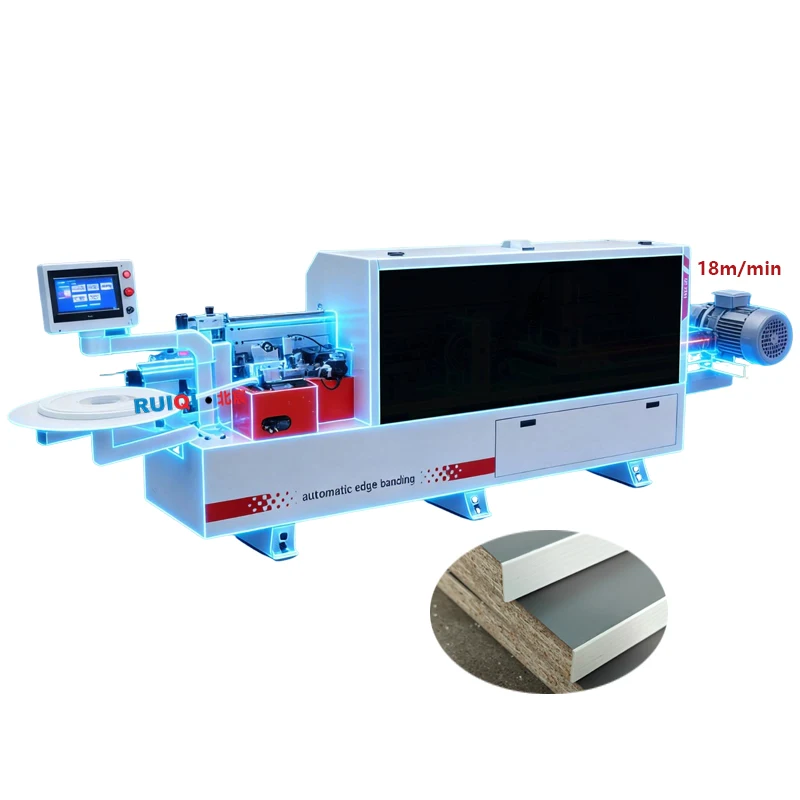
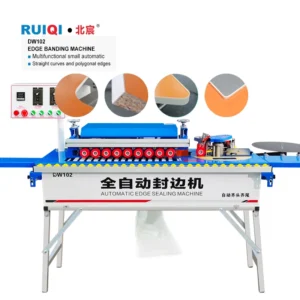
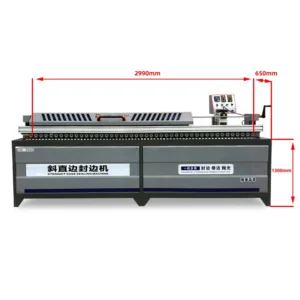
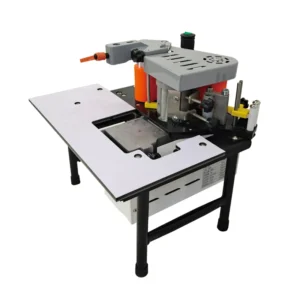
Ready-stock dispatch — every DW330 unit ships with voltage confirmed for your local grid and a PLC panel set to your operator's language before it leaves the factory floor.
Technical Specifications
| Parameter |
Value |
| Model |
DW330 |
| Product Type |
Automatic Edge Banding Machine |
| Conveying Motor |
1.5 kW |
| Trimming Motor |
0.55 kW × 2 |
| Glue Feeding Motor |
0.37 kW × 2 |
| End-to-End Motor |
0.37 kW × 2 |
| Polishing Motor |
0.37 kW × 2 |
| Feeding Speed |
18 m/min |
| Narrowest Sealing Plate Width |
120 mm |
| Minimum Panel Size (L × W × T) |
200 mm × 100 mm × 9 mm |
| Maximum Plate Thickness |
50 mm |
| Edge Banding Thickness Capacity |
Up to 3 mm (PVC) |
| Heating Rod |
380V, 300W × 4 |
| Control System |
7-inch PLC control panel |
| Language Options |
Chinese and English standard; custom language available |
| Transmission Ratio |
1:40 |
| Beam Height Adjustment |
Digital display hand crank (manual) |
| Pressure System |
Double-row pressure rollers, aluminum profile pressure beams |
| Glue Pot |
Enlarged capacity, single-sided board gluing |
| Trimming |
Contour trimming with alloy trimming knife; curved scraper with contouring device |
| Polishing |
Enhanced industrial polishing motor |
| Net Weight |
750 kg |
| Outline Dimensions (L × W × H) |
350 × 71 × 122 cm |
| Assembly State |
Fully assembled |
| Certification |
CE |
Application Suitability
| Application |
Material or Output |
| Cabinet door and drawer front edge finishing |
MDF and particleboard with PVC edge banding |
| Narrow panel components such as drawer sides |
Plywood and melamine-faced board down to 120 mm width |
| Small-batch custom furniture production |
Solid wood panels and veneer edge banding |
| Joinery workshop transitioning from manual edge banding |
Mixed substrate batches with frequent changeovers |
| Shelving and carcass panel processing |
Particleboard and MDF with standard PVC tape up to 3 mm |
Why Voltage Confirmation Must Happen Before You Pay
A machine wired for the wrong frequency will not just underperform — it will burn through motors and heating elements within weeks. The DW330 automatic edge banding machine in stock ships only after your local voltage and frequency are documented on a confirmation sheet, so the 380V heating rods and 1.5 kW conveying motor arrive matched to your grid [NEED_CITE: voltage and frequency standards by export market].
I once watched a cabinet maker in Manila lose two full production days because a supplier sent a 50 Hz machine into a 60 Hz workshop. The glue pot overheated, the feed motor ran hot, and the operator had no way to diagnose it from an English-only error screen. The cost of a return shipment dwarfed whatever savings the original quote offered.
Dispatch Timing and Stock Availability
How "In Stock" Actually Works at This Level
When a workshop commits to its first automatic edge banding machine, waiting eight weeks for a build-to-order unit is not realistic — rent and order deadlines keep running. The DW330 is maintained as an automatic edge banding machine in stock specifically so small shops can pull the trigger and receive a configured unit within a typical multi-week lead time rather than a multi-month one. Stock units still go through full pre-shipment testing against your specified panel thickness and edge material before crating.
What Gets Configured Before the Crate Closes
Even a stocked machine requires site-specific setup before dispatch. The 7-inch PLC panel gets loaded with your operator's language. The voltage confirmation sheet is cross-checked against the heating rod and motor wiring. The operation manual is printed in the agreed language so the person running the machine on day one can read it without a translator standing by [NEED_CITE: CE machinery directive requirements for industrial equipment].
Spec Sheet Breakdown: What the Numbers Mean on the Floor
The 1.5 kW conveying motor paired with a 1:40 transmission ratio delivers an 18 m/min feed speed that keeps the panel moving steadily through all six stations — glue application, end cutting, trimming, scraping, and polishing — without the stutter that causes uneven glue lines on MDF. A weaker motor at this price tier tends to bog down when processing a continuous run of 50 mm thick panels, which is where the DW330's torque margin matters.
The enlarged glue pot with a large gluing shaft addresses a common failure point: on smaller pots, glue viscosity fluctuates as the level drops, leading to thin spots mid-run. The single-sided board gluing design keeps coverage consistent across the full panel edge, reducing the visible glue lines that customers notice on finished cabinet fronts.
The minimum panel size of 200 mm × 100 mm × 9 mm means this machine handles narrow drawer sides and small shelf brackets that larger edge banders simply cannot grip. The double-row pressure rollers and aluminum profile pressure beams hold these small workpieces flat through the trimming and scraping stations, where a single-row system would let a 120 mm wide board twist.
The 7-inch PLC with multilingual support eliminates a commissioning bottleneck I have seen stall production lines for days — operators who cannot read the control panel cannot adjust glue volume, change feed speed, or clear fault codes without external help.
The Hidden Cost of Buying the Wrong First Machine
When a joinery shop buys an entry-level edge bander rated only for light duty and pushes it through sustained small-batch production, the pressure rollers wear unevenly within months and the trimming knives lose alignment [NEED_CITE: edge banding machine maintenance intervals under sustained load]. The result is not a dramatic failure but a slow decline in edge quality — visible glue lines, chipped PVC on curved scraper passes, and panels that fail assembly because the trimmed edge is no longer square. By the time the owner realizes the machine was underspecified, the cost of a replacement plus wasted material exceeds what a properly rated unit would have cost from the start.
Why Procure This Machine Through This Channel
Stocked configurations mean the DW330 is available for dispatch without a build-to-order wait, keeping your workshop conversion timeline intact.
Engineer-led configuration ensures the voltage, plug type, and PLC language are confirmed in writing before production or dispatch, removing the most common source of on-site commissioning failures.
A full function set — pre-milling through polishing — in one compact frame means a startup workshop gets a complete edge finishing cell without coordinating multiple single-purpose machines across different suppliers.
Four-stage quality control with pre-shipment verification means each unit runs your specified panel material and edge banding thickness before it is crated, documented with a factory test record.
OEM and private-label capability is available for distributors who want to stock the DW330 under their own branding with territory-specific documentation packages.

Documentation & Verification
- CE declaration of conformity covering the DW330 automatic edge banding machine
- Factory test record run on your specified panel thickness and PVC edge banding before dispatch
- Electrical schematic with voltage and frequency confirmed for your local grid
- Operation and maintenance manual printed in your operator's agreed language
- Spare parts list with cross-reference numbers for consumable trimming knives and scraper blades
- Packing photographs documenting machine condition before crating
Installation, Commissioning & Support
- The 350 × 71 × 122 cm footprint requires a level concrete floor with clearance on both feed and discharge sides for panel handling
- A dedicated 380V circuit with appropriate breaker rating must be installed before delivery to power the four heating rods and conveying motor
- The machine arrives fully assembled; only dust extraction ducting and the edge banding tape reel require on-site mounting
- First-run commissioning includes setting glue pot temperature for your specific PVC or veneer tape and calibrating the 18 m/min feed speed
- The digital display hand crank for beam height adjustment is walked through with your operator during initial setup
- Consumable spare parts including alloy trimming knives and scraper blades are listed with reorder codes in the included documentation
What to Share When Requesting a Quote
To move from inquiry to dispatch on a stocked DW330, provide your workshop's local voltage and frequency, the primary panel materials you process (MDF, particleboard, plywood, or solid wood), and the edge banding type and thickness you run most often. Include the language your machine operators read, and whether you need a sample processing test on your actual panel stock before committing to shipment.
Frequently Asked Questions
Q: Is the DW330 in stock and ready for immediate dispatch?
A: The DW330 is maintained as stocked inventory for fast dispatch. Each unit still undergoes site-specific configuration before shipping — voltage confirmation, PLC language loading, and a pre-shipment test run on your panel material. This typically adds a short preparation window rather than a multi-month build delay.
Q: Can the voltage and plug be matched to my country before I order?
A: Yes. Before any unit ships, a voltage confirmation sheet is completed and cross-checked against your local grid specifications. The heating rods, motors, and control wiring are verified or reconfigured accordingly so the machine is operational on arrival.
Q: Will the control panel display be in my operator's language?
A: Chinese and English are standard on the 7-inch PLC. Custom language loading is available and confirmed during the order process so your operator can read menus, adjust feed speed, and clear fault codes from day one without a translator.
Q: What is the smallest panel this machine can edge-band?
A: The DW330 handles panels down to 200 mm long, 100 mm wide, and 9 mm thick. The double-row pressure rollers and aluminum profile beams keep narrow components like drawer sides stable through trimming and scraping.
Q: What spare parts come with the machine and how do I reorder?
A: A spare parts list with part numbers for consumables like trimming knives, scraper blades, and pressure roller components is included. Reorders are placed through the same supply channel with reference to the list provided in your documentation package.