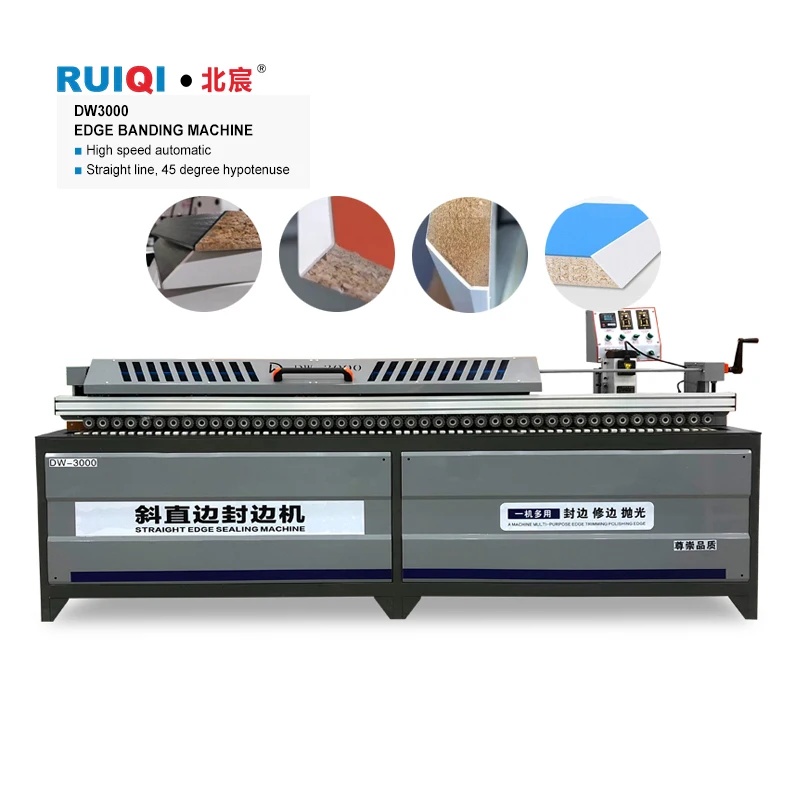
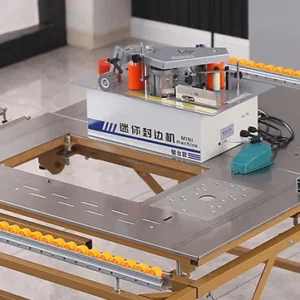
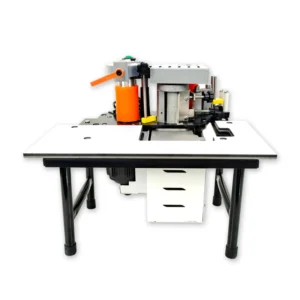
In-house manufacturing with patented cutting mechanisms — verified tolerance and pre-shipment testing on every unit shipped from stock, including this compact automatic edge bander for small workshops.
Technical Specifications
| Parameter |
Value |
| Model |
DW3000 |
| Product Type |
Automatic Edge Banding Machine |
| Total Power |
11 kW |
| Voltage |
380V / 415V (frequency to confirm before dispatch) |
| Feed Speed |
0–12 m/min |
| Edge Banding Thickness Range |
0.3–3 mm |
| Edge Banding Height Range |
0–50 mm |
| Minimum Sheet Length |
30 cm |
| Minimum Sheet Width |
15 cm |
| Pre-milling Motor |
2.2 kW |
| Heating Power |
2.2 kW × 2 (dual heat gun) |
| Trimming Motor |
2.2 kW × 2 (spindle trimming) |
| Polishing Motor |
0.4 kW × 2 |
| Vacuum Power |
550 W |
| Glue Pot Capacity |
4000 ml |
| Pressure Wheels |
8 sets, adjustable 30–90° |
| Overall Dimensions (L×W×H) |
299 × 65 × 130 cm |
| Net Weight |
430 kg |
| Air Source Pressure |
0.5–0.7 MPa |
| Standard Functions |
Pre-milling, 30–90° edge banding, trimming, scraping, polishing, vacuum extraction |
Application Suitability
| Application |
Material or Output |
| Cabinet door panel edge banding |
MDF and melamine-faced particleboard |
| Custom furniture straight edging |
Plywood panels with PVC or ABS banding |
| Small-batch bevel edge work |
45° bevel on MDF and artificial boards |
| Joinery workshop production |
Melamine and veneer edge on particleboard |
Why Voltage Confirmation Matters Before You Click "Order"
A machine wired for the wrong grid is dead weight on your workshop floor until an electrician rewires it at your expense.
When a small furniture maker orders an automatic edge banding machine in stock without checking local frequency, the motors can run hot within the first shift, or the control board may simply refuse to boot. I have seen edge banders of this class sit idle for weeks because the workshop had 220V single-phase and the machine needed 380V three-phase. The DW3000 ships configured for 380V/415V, and frequency is a separate question that must be answered before dispatch. Skipping this step is one of the most common reasons a supposedly fast delivery turns into a slow headache [NEED_CITE: voltage and frequency standards by export market].

What Ready Stock Actually Means for Your Workshop
Most suppliers quote lead times that stretch once an order is placed. This DW3000 automatic edge banding machine in stock is assembled, tested, and available for single-unit dispatch — not a production slot waiting to be scheduled. For a joinery workshop moving from hand-applied banding to its first machine, that difference means weeks of production time recovered.
Sizing the Machine to Your Current Floor Space
At 299 × 65 × 130 cm and 430 kg, this unit fits into a tight bay between a panel saw and an assembly bench without requiring a dedicated zone. The compact footprint matters when a startup is still organizing workflow around existing equipment. Feed speed ranges from 0 to 12 m/min, which suits batch sizes typical of custom cabinet shops rather than high-volume panel plants [NEED_CITE: typical workshop layout planning for small furniture manufacturers].
Reading the Numbers That Affect Daily Output
The dual 2.2 kW heat guns maintain stable glue temperature across the 4000 ml pot, which is important when switching between PVC and melamine banding materials — single-gun setups often struggle to hold temperature when the workshop is cold in early mornings. The 8-set pressure wheel system adjusts from 30 to 90 degrees, allowing one machine to handle both straight and bevel edges without a separate fixture. Pre-milling at 2.2 kW cleans the panel edge before glue application, reducing visible glue lines on particleboard substrates that tend to chip during cutting. Three spindle trimming motors then remove excess banding, and the flexible scraper finishes the joint. Together, these stations determine whether a cabinet door looks factory-finished or hand-applied.
The Hidden Cost of Buying Below Your Actual Workload
Entry-level machines are sometimes sold into production volumes they were never designed to sustain. When a workshop running fifty cabinet doors a day pushes a light-duty bander meant for ten, the glue pot cannot recover temperature between panels, and edge adhesion starts failing silently. The failures show up downstream during assembly, not at the machine. Choosing a unit with pre-milling and full trimming stations from the start avoids buying twice within a year [NEED_CITE: common causes of edge banding delamination in small-batch production].
Why Ordering Through This Channel Works for Small Runs
Single-unit orders ship without minimum quantity requirements, which is the practical reality for a workshop buying its first automatic edge banding machine in stock. Voltage and plug type are configurable per order — EU, USA, AU, or UK plugs are standard options. Pre-shipment testing runs actual panel material through the machine so you see feed behavior before the crate leaves the factory. Control panel language defaults to Chinese and English, with other languages available on request. These are not extras negotiated after the fact; they are part of the standard dispatch process.
Documentation & Verification
- CE declaration of conformity covering this machine class and safety requirements
- ISO 9001 certificate for the manufacturing quality management system
- Factory test record run on your specified panel thickness and banding material
- Electrical schematic with confirmed voltage and frequency for your grid
- Operation and maintenance manual in your agreed language at delivery
- Packing photographs showing crating and securing before container loading
Installation, Commissioning & Support
- Requires a dedicated 380V/415V three-phase circuit rated for at least 11 kW continuous draw
- Floor must support 430 kg static load on a level surface of approximately 3 × 0.7 meters
- Arrives fully assembled — connect power, air supply at 0.5–0.7 MPa, and dust extraction to the 550W vacuum port
- First-run parameter setup covers glue temperature, feed speed, and trimming depth for your specific banding thickness
- Operator training covers pre-milling adjustment and pressure wheel angle changes for straight versus bevel work
- Spare parts list included with consumables identified for first reorder cycle
What We Need to Move Your Order Forward
To match this machine to your actual workflow, share the panel materials and thicknesses you process most often, your local voltage and frequency, and whether your operators need the control interface in a language beyond English. If you are replacing a manual process, let us know your current daily panel count so we can confirm the feed speed range fits your volume.
Frequently Asked Questions
Q: Is the DW3000 in stock and how fast can a single unit ship?
A: This model is held in ready stock and can be dispatched as a single unit. After voltage and plug type are confirmed, a pre-shipment test is run and the machine is crated. Typical dispatch happens within a short window once specifications are locked in — no production queue wait.
Q: Can I order one machine and still get my country's plug and voltage?
A: Yes. Single-unit orders include plug options for EU, USA, AU, or UK standards, and voltage is set to 380V or 415V as required. Frequency must be confirmed separately since it varies by region and affects motor behavior.
Q: What happens when my production volume grows beyond this model?
A: The DW3000 covers straight and 45-degree bevel work for small to medium batches. When volume increases, the next step is a higher-feed-speed model in the same product family, keeping the same supplier relationship and spare parts ecosystem rather than starting over with a different brand.
Q: How do I get help if something goes wrong after installation?
A: Remote guidance covers wiring checks, parameter resets, and mechanical adjustments. The operation manual and spare parts list ship with every unit. For issues that cannot be resolved remotely, support is arranged through the agreed after-sales channel documented at order confirmation.
Q: Can the control panel display my local language instead of English?
A: Chinese and English are standard. Other languages are available on request and configured before dispatch, so operators can read instructions and error codes without translation delays during commissioning.