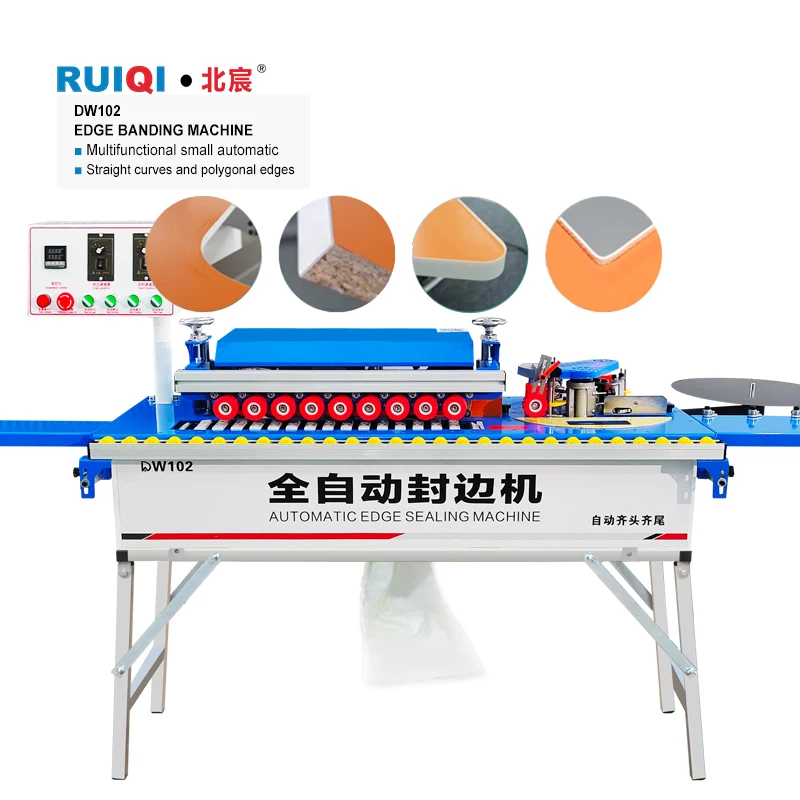
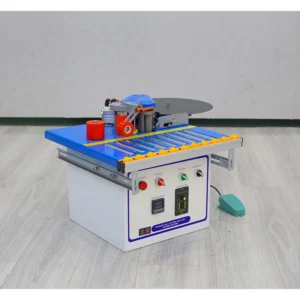
Compact Production Footprint — the DW102 edge banding machine delivers automated gluing, trimming, and polishing within a 128 × 47 × 69 cm frame designed for workshops scaling from manual finishing to consistent machine output.
Technical Specifications
| Parameter |
Value |
| Model |
DW102 |
| Product Type |
Automatic Edge Banding Machine |
| Total Power |
3800W |
| Voltage Options |
220V / 380V / customization (frequency to be confirmed) |
| Edge Banding Thickness |
0.3–3 mm |
| Edge Banding Height |
0–50 mm |
| Minimum Sheet Length |
25 cm |
| Minimum Sheet Width |
5 cm |
| Glue Pot Capacity |
1000 ml |
| Air Source Pressure |
0.5–0.8 MPa |
| Trimming Power |
650W × 2 |
| Polishing Power |
180W × 2 |
| Vacuum Power |
1200W |
| Edge Power |
20W |
| Transmission Power |
60W |
| Product Size (L×W×H) |
128 × 47 × 69 cm |
| Net Weight |
75 kg |
| Control Language Options |
Chinese and English standard; other languages customizable |
| Assembly State |
Fully assembled, wooden box packaging |
| Key Features |
Curved and straight edge banding, automatic head and tail cutting, edge trimming, polishing, vacuum system |
Application Suitability
| Application |
Material or Output |
| Cabinet door and panel edge finishing |
MDF, particleboard, plywood with PVC or melamine edge tape |
| Custom furniture curved-edge components |
Rounded-corner panels in blockboard and solid wood panels |
| Small-batch polymer door production |
Polymer door blanks requiring curved and straight edge coverage |
| Joinery workshop scaling from manual taping |
Standard furniture panels up to 50 mm edge banding height |
Why the Voltage Question Should Come Before the Price on an Edge Banding Machine for Small Workshop
A machine wired for the wrong frequency will stall on startup, not on day thirty. I have watched a shipment of compact edge banders arrive at a Southeast Asian cabinet shop where the local grid ran at a frequency the motor was never wound for. The glue pot reached temperature, but the feed motor pulsed unevenly and the trimming heads left chatter marks across every MDF edge. Two days of production disappeared while engineers confirmed the mismatch and rewound the motor remotely. Now before any DW102 leaves the floor, the voltage and frequency are locked in writing against the buyer's actual supply. [NEED_CITE: voltage and frequency standards by export market]
Fitting a Full Edge Banding Station Into a Tight Workshop Bay
Most small joinery shops do not have the floor space to line up separate gluing, trimming, and polishing machines. The DW102 packs every station into a single frame that sits against a wall or beside a panel saw. At 128 × 47 × 69 cm, this edge banding machine for small workshop footprints leaves enough clearance for an operator to feed panels from one side and collect finished work from the other. The integrated vacuum system captures trim waste at the source, so offcuts do not accumulate around the machine base and interfere with the next board.
Curved and Straight Edges Without Swapping Machines
Rounded-corner cabinet doors and arched shelving normally require a separate curved-edge bander or slow hand-applied tape. The DW102 handles both curved and straight profiles in a single pass, with automatic head-and-tail cutting that trims the tape flush before the panel reaches the polishing station. This means a custom furniture startup can accept orders for radius-corner panels without investing in a second machine or assigning a worker to hand-trim each curve. The edge banding thickness range of 0.3–3 mm covers the PVC and melamine tapes most small furniture makers stock.
How Trimming Power and Glue Pot Capacity Shape Daily Output
The twin 650W trimming motors provide enough torque to shear through 3 mm PVC edge tape cleanly on dense MDF without bogging down or leaving score lines on the panel face. Trimming quality directly affects whether assembled cabinet boxes sit flush at the joints — a visible glue line or proud tape edge forces rework downstream. The 1000 ml glue pot holds enough adhesive for sustained runs through a typical batch of cabinet components, reducing the number of mid-run refills that interrupt workflow. An air source pressure of 0.5–0.8 MPa drives the pneumatic feed rollers and pressure beam, keeping the tape seated firmly against the substrate across both straight and curved profiles. [NEED_CITE: adhesive open time and pot temperature requirements for PVC edge banding]

What Happens When a Compact Edge Bander Is Mismatched to Panel Density
Last year a batch of entry-level edge banders shipped to a furniture maker who ran standard particleboard during the factory test. Once installed, they switched to high-density MDF for a premium cabinet line, and the feed speed could not keep pace with the glue curing rate. Tape lifted at the leading edge, excess adhesive squeezed past the trimming station, and the polishing wheels smeared rather than buffed. The entire line stopped while parameters were adjusted remotely. Every DW102 order now includes a request for the buyer's actual panel samples so the machine is tuned to the substrate it will really process, not a generic test board. [NEED_CITE: MDF density variation and its effect on adhesive bonding in edge banding]
Why Buyers Source This Edge Bander From a Verified Workshop
The DW102 is assembled by a manufacturer with roughly two decades of woodworking machinery experience, and each unit passes through a four-stage quality check covering incoming components, in-process assembly, finished product inspection, and pre-shipment verification. Voltage and control language customization is standard, not an afterthought — the quotation confirms the exact electrical specification and the operator manual language before production begins. Single-unit sample orders ship as readily as multi-machine batches, so a workshop can run trial panels and verify edge quality before committing to a full equipment rollout. Engineer-led configuration recommendations arrive within 24 hours of inquiry, mapping the machine to the buyer's panel types and daily volume.
Documentation & Verification
- CE declaration of conformity covering the DW102 electrical and mechanical safety requirements
- Factory test record run on your specified panel material and edge tape before dispatch
- Electrical schematic confirming the agreed voltage, frequency, and plug configuration
- Operation and maintenance manual delivered in the language your operators read
- Spare parts list with part numbers matching the installed trimming and polishing components
Installation, Commissioning & Support
- Place the DW102 on a level floor with clearance on both sides for panel feeding and retrieval
- Connect to a dedicated circuit matching the confirmed voltage and 3800W total power draw
- Machine arrives fully assembled; connect air supply at 0.5–0.8 MPa and power on
- First-run parameter tuning on your actual MDF or particleboard samples before production begins
- Glue pot refill and trimming blade replacement intervals documented in the supplied manual
- Vacuum port connection to workshop dust extraction to maintain a clean trimming zone
Configuring Your DW102 Order
Send the panel materials you actually cut — MDF grade, particleboard density, plywood type — along with the edge tape brand and thickness you plan to run. Confirm your workshop voltage and frequency so the motor and control transformer are wound correctly before assembly. Let us know the operator language requirement so the control panel labels and maintenance manual match your team. If you want a sample panel processed and returned before committing, request a pretest with your own stock.
Frequently Asked Questions
Q: Is the DW102 sized right for my current daily panel volume, or should I consider a larger model?
A: The DW102 suits workshops moving from hand-applied edge tape to automated finishing on batches typical of custom cabinet and small furniture production. If your daily volume requires continuous high-speed feed rates across full production shifts, the next model in the range offers higher throughput and additional processing stations. Share your typical batch size and panel count so the right tier can be confirmed before you order.
Q: What voltage and plug options are available for my country before I place the order?
A: The machine is built to 220V, 380V, or a custom voltage matched to your local grid. Frequency is confirmed at the quotation stage to ensure the motor and transformer suit your 50Hz or 60Hz supply. The plug type and cable specification are documented in the electrical schematic before production, so the machine connects directly on arrival without adapters.
Q: Can I run a sample panel through the machine before committing to purchase?
A: Yes. Send a selection of your actual panels and edge tape, and the factory will run them through the DW102 under production conditions. You receive photographs and the processed samples back so you can inspect edge adhesion, trimming accuracy, and polishing finish on your own substrates before placing a full order.
Q: How does the upgrade path work when my order volume outgrows this entry-level model?
A: The DW102 covers the essential edge banding stations in a compact frame. When production volume increases, you can move to a larger model in the same product family that adds pre-milling, multi-stage trimming, and higher feed speeds. Because the control logic and edge tape compatibility carry across the range, operators transition without retraining on an entirely different platform.
Q: What is included in the shipment, and what do I need to supply locally?
A: The DW102 ships fully assembled in a wooden crate with the operation manual, spare parts list, and factory test record. You need to provide a compressed air source at 0.5–0.8 MPa, a dedicated electrical circuit at the confirmed voltage, and dust extraction hose for the vacuum port. Edge tape and glue are consumables you source to match your production materials.