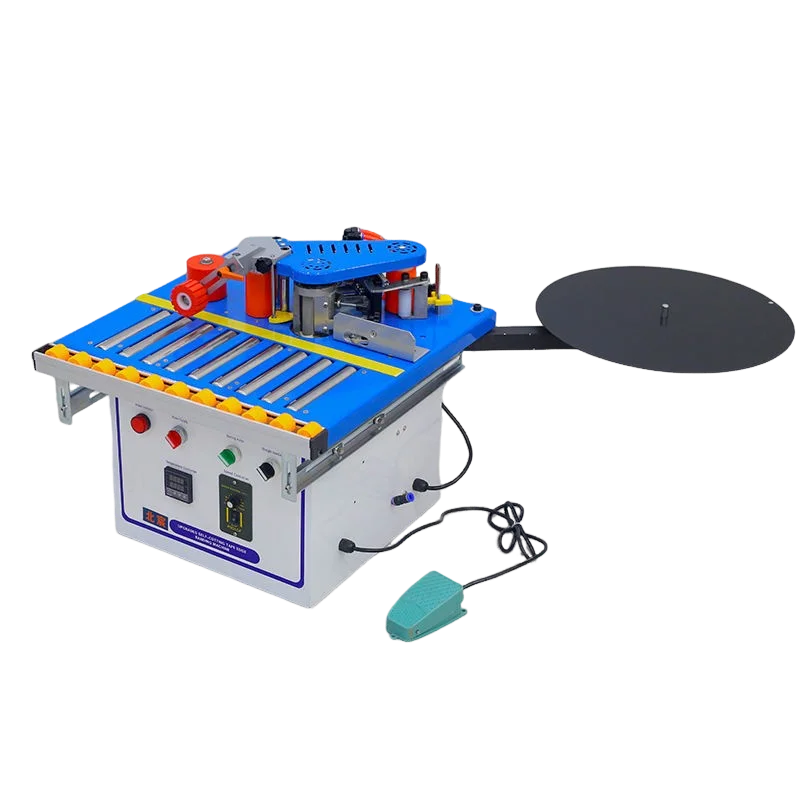
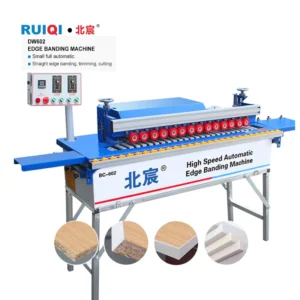
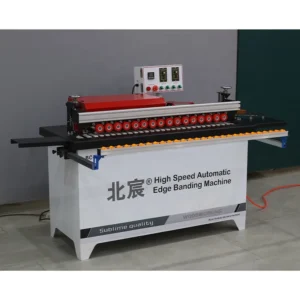
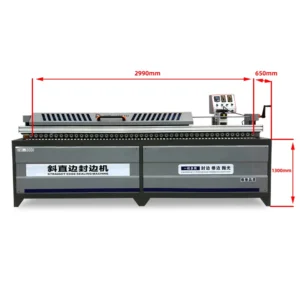
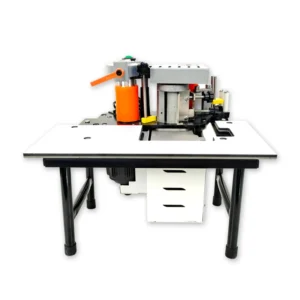
Benchtop Footprint, Factory-Grade Output — the ST-70 portable edge banding machine fits a standard workbench yet handles curved and straight PVC and veneer banding on panels as narrow as 3 cm.
Technical Specifications
| Parameter |
Value |
| Product Type |
Portable Edge Banding Machine |
| Total Power |
1000W |
| Voltage Options |
220V / 380V / customization |
| Edge Banding Height |
0-50 mm |
| Edge Banding Thickness |
0.3-3 mm |
| Minimum Sheet Length |
25 cm |
| Minimum Sheet Width |
3 cm |
| Glue Pot Capacity |
1000 ml |
| Edge Power |
20W |
| Air Source Pressure |
0.5-0.8 MPa |
| Product Size (L×W×H) |
50 × 50 × 47 cm |
| Product Weight |
23 kg |
| Standard Features |
Curved and straight edge banding |
| Language Options |
Chinese and English standard; Spanish and other languages customizable |
| Plug Options |
EU, USA, AU, UK |
Application Suitability
| Application |
Material or Output |
| Cabinet door and drawer front edging |
MDF and particleboard with PVC or melamine banding |
| Small-batch custom furniture runs |
Plywood and ecological board with veneer or PVC strips |
| On-site furniture repair and touch-up |
Solid wood board and pre-laminated panels |
| Curved countertop and radius panel sealing |
MDF and plywood with flexible PVC banding up to 3 mm |
| Home decoration and joinery fitting |
Ecological board and blockboard with thin veneer edging |
Why the Voltage Question Should Come Before the Price Tag
A portable edge banding machine that arrives with the wrong voltage is a 23 kg paperweight until an electrician rewires your shop.
I have watched small workshop owners plug in a newly delivered edge bander only to trip the breaker or, worse, burn out the glue pot heating element. The ST-70 is configurable at 220V or 380V with region-specific plug options, but the correct choice depends on your existing circuit capacity, not the machine label. Confirming frequency and phase before the order locks in prevents a situation where the unit sits idle while you arrange a dedicated line or a step-down transformer. [NEED_CITE: voltage and frequency standards by export market]

One Workbench, Two Edge Profiles
Most joinery shops encounter both straight runs and curved radius cuts daily. The ST-70 handles both profiles without swapping tooling or adding a secondary jig. A 1000 ml glue pot keeps adhesive waste low during short runs, which matters when you are banding five cabinet doors rather than five hundred. This dual-mode capability means a portable edge banding machine in stock fast delivery can cover the full scope of a small shop's output from a single benchtop position.
Moving the Machine Instead of Moving the Panel
At 23 kg, one operator can lift the ST-70 onto a van or carry it between workstations inside a crowded workshop. On-site installers use this portability to edge-seal panels at the job location where cutting has already happened, avoiding a round trip back to the shop floor. The 50 × 50 × 47 cm footprint sits on a standard plywood-topped bench without requiring a dedicated machine bay or floor anchoring. [NEED_CITE: CE machinery directive requirements for portable woodworking equipment]
Reading the Specs That Actually Matter
The 0.3-3 mm edge banding thickness range covers the PVC and veneer stock most small furniture shops buy in bulk. Running 0.3 mm veneer requires a lower glue temperature and lighter feed pressure than 3 mm PVC, so the operator must adjust accordingly — the machine does not auto-switch between material types. The 0-50 mm banding height accommodates standard 18 mm particleboard as well as thicker blockboard and solid wood panels up to around 40 mm. An air source pressure of 0.5-0.8 MPa drives the trimming and pressing mechanism; shops without an existing compressor should factor in a small reciprocating or piston unit rated for continuous duty at that pressure range.
The Hidden Cost of Skipping the Air Supply Check
Workshops that purchase a portable edge bander without verifying compressor capacity often discover inconsistent edge adhesion midway through the first batch. If the air pressure dips below 0.5 MPa during trimming, the cutter leaves burrs on the PVC strip and the operator ends up hand-sanding every panel. I have seen entire Saturday production runs scrapped because the shop compressor was simultaneously feeding a nail gun and the edge bander, starving both. Securing a dedicated air line or scheduling compressor-intensive tasks at different times eliminates this failure mode. [NEED_CITE: compressed air sizing for woodworking pneumatic tools]
How This Purchase Path Differs
Voltage and plug type are confirmed in writing before the order is finalized, so the ST-70 arrives ready to connect to your existing circuit. Control panel language is specified upfront — English is standard, with Spanish and other languages available on request so your operator reads the display without guesswork. Every unit undergoes a pre-shipment test on actual panel material, and packing photographs are shared for your review before the crate leaves the factory. An operation manual and spare parts list ship inside the crate in your confirmed language, reducing the time between unboxing and first production run.
Documentation & Verification
- CE declaration of conformity applicable to portable woodworking machinery
- Voltage and frequency confirmation sheet matched to your local supply
- Pre-shipment test record on your specified panel thickness and banding material
- Operation manual and spare parts list in the agreed control-panel language
- Packing photographs shared before crate closure for visual verification
Installation, Commissioning & Support
- Place the 50 × 50 × 47 cm unit on a level workbench capable of supporting 23 kg plus operator downward force
- Connect to a dedicated 220V or 380V circuit matching the confirmed plug type; avoid shared lines with welders or compressors
- Route a dedicated 0.5-0.8 MPa air line from a compressor rated for continuous duty at that pressure band
- Allow the 1000 ml glue pot to reach full operating temperature before the first test strip — rushing a cold start causes adhesion failure
- Run a scrap panel in both straight and curved mode to verify trim quality before committing production stock
Tell Us What You Are Cutting Before You Order
Share the panel materials you edge most often — MDF, particleboard, plywood, or solid wood — along with the typical thickness range and the banding material you stock. Confirm your workshop voltage, phase, and plug type so the unit ships configured for your circuit. Let us know your preferred control-panel language and whether you need the manual translated beyond English and Chinese.
Frequently Asked Questions
Q: Is the 220V or 380V version right for my workshop's electrical supply?
A: It depends on your existing circuit capacity and whether you already run other 380V equipment. A 220V unit plugs into a standard single-phase outlet, while 380V typically requires a three-phase supply. Confirm your workshop voltage, frequency, and phase configuration with your electrician before placing the order so we match the machine to your infrastructure.
Q: What is the smallest panel this machine can handle, and does it cover my typical offcut sizes?
A: The ST-70 accepts panels as short as 25 cm in length and as narrow as 3 cm in width, which covers most offcut shelving and drawer component sizes found in a custom cabinet shop. For pieces smaller than those minimums, hand-applied iron-on banding remains the practical method.
Q: Can I run both straight and curved edges without changing tooling or accessories?
A: Yes. The machine switches between straight and curved edge banding mode through an adjustment on the guide fence rather than a tooling swap. This means an operator can edge a straight cabinet side panel and then move to a curved radius shelf without pausing to reconfigure the machine.
Q: How long does the glue pot take to heat up for a short repair job?
A: The 1000 ml glue pot requires a warm-up period before the adhesive reaches a consistent working viscosity. For a single repair or a small batch, plan the glue heat-up at the start of the task so the adhesive is fully molten before the first strip is fed through.
Q: When my production volume grows, what is the upgrade path to a full-size automatic bander?
A: A full-size automatic edge bander adds pre-milling, multi-stage trimming, and higher feed speeds suited to daily production runs of several hundred panels. The ST-70 remains useful as a secondary unit for short runs and repairs even after a larger machine is installed on the shop floor.