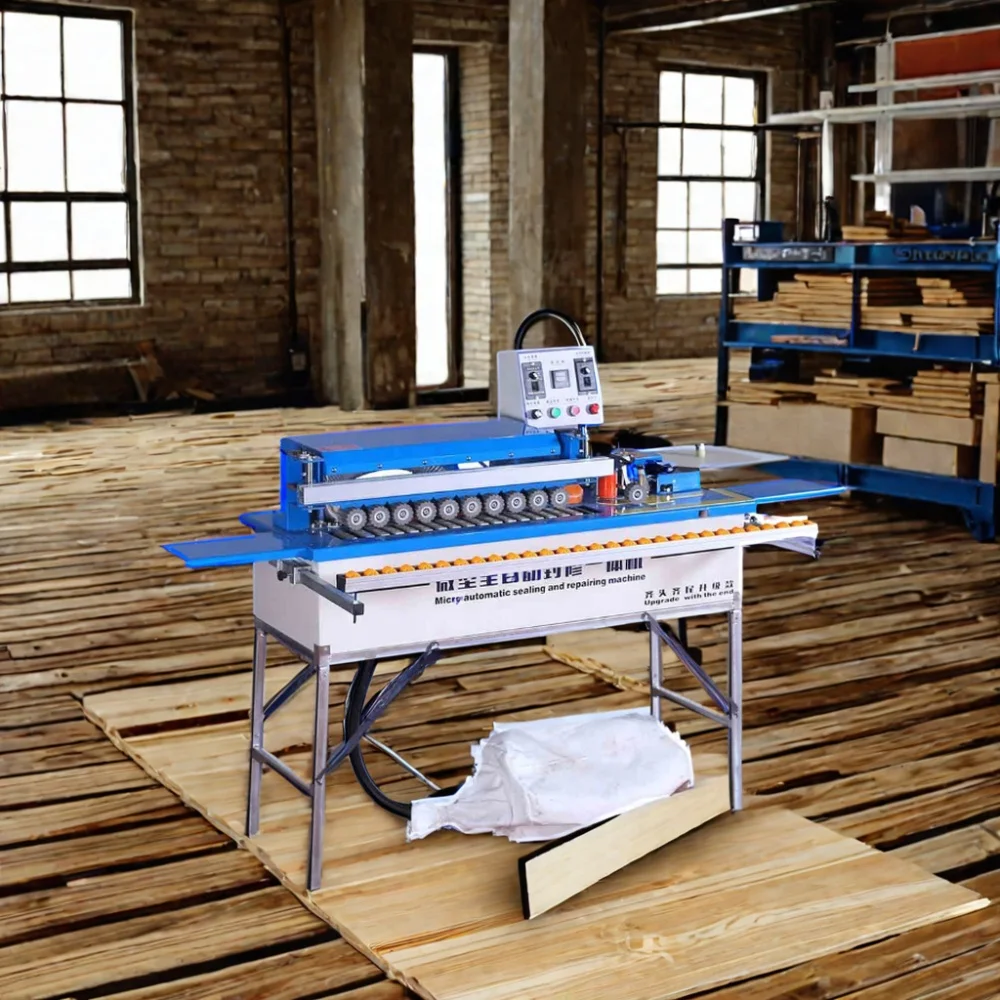
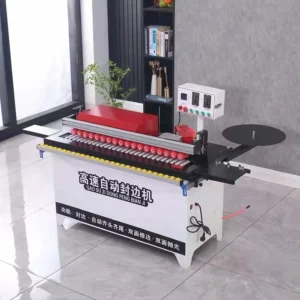
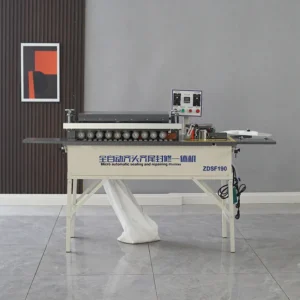
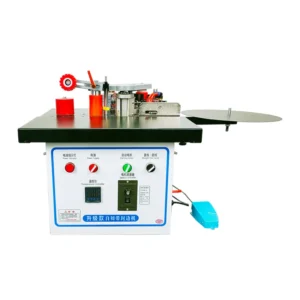
Compact Footprint, Fast Dispatch — stocked for quick shipment to workshops ready to move from manual edging to consistent machine-grade output without waiting weeks for production.
Technical Specifications
| Parameter |
Value |
| Product Type |
Mini Automatic Edge Banding Machine |
| Voltage |
220V (frequency to confirm with local grid) |
| Suction Power |
1200W |
| Belt Power |
25W |
| Transmission Power |
60W |
| Polishing Power |
180W × 2 |
| Trimming Power |
800W × 2 |
| Conveying Speed |
0–15 m/min |
| Edging Speed |
0–6 m/min |
| Edge Banding Height Range |
10–60 mm |
| Edge Thickness Range |
0.3–3 mm |
| Overall Dimensions |
1200 × 540 × 720 mm |
| Control System |
Individual function control panel |
| Glue Application |
Double-sided adhesive |
| Gluing Device Rotation |
180° for curved edge banding |
| Trimming Stations |
Up and down trimming |
| Polishing Stations |
Up and down cross polishing |
| Dust Extraction |
Integrated vacuuming device |
| Feed Mechanism |
Double-row rubber pressure wheels |
| Board Feeding |
Automatic |
Application Suitability
| Application |
Material or Output |
| Startup cabinet shop replacing manual iron-on banding |
Melamine-faced MDF and particleboard panels |
| Small-batch custom furniture with curved components |
PVC and melamine edge banding on plywood and MDF |
| Joinery workshop upgrading from hand tools |
Straight and curved edges on boards 10–60 mm thick |
| Compact workshop with limited floor space |
Single-operator production runs on 220V single-phase supply |
Why the Voltage Question Must Come Before You Order a Mini Edge Bander
A machine wired for the wrong frequency will burn out its motors within the first week — no amount of troubleshooting will fix that.
When a small workshop orders equipment online, the listing often shows 220V and the buyer assumes compatibility. But 220V at 50Hz behaves differently from 220V at 60Hz, affecting motor speed, glue pot heating cycles, and feed rate calibration. I have seen edge banders of this class arrive at a job site only to sit idle while the owner sources a frequency converter that costs nearly as much as the machine itself [NEED_CITE: voltage and frequency standards by export market]. Confirming the mini automatic edge banding machine in stock matches your local grid is the single most important step before dispatch.

Fast Dispatch Without the Spec Guesswork
Stocked inventory means this mini automatic edge banding machine in stock ships quickly, but speed only matters when the configuration is right for your panels. The 10–60 mm edge height range and 0.3–3 mm edge thickness capacity cover the majority of melamine and PVC banding materials used in cabinet and small furniture production. Before dispatch, we verify that your specific edge banding material thickness falls within this range so the trimming and polishing stations can deliver clean results from the first run.
Dual-Purpose Curved and Straight Edging on One Bench
The 180° rotatable gluing device lets you switch between straight panel edges and curved profiles without changing machines or adding secondary tooling. For a small workshop producing custom cabinet doors with radiused corners or shaped shelving, this means one machine handles the full scope of edge finishing. The double-sided adhesive application bonds firmly to both melamine and PVC substrates, reducing the risk of edge lift on curved sections where single-sided glue often fails [NEED_CITE: adhesive bonding performance on curved PVC edge banding].
What the Numbers on the Spec Sheet Actually Mean for Your Panels
The 0–6 m/min edging speed may appear modest compared to industrial lines, but for a workshop processing tens of panels per day, it provides the control needed to monitor glue application and edge alignment in real time. The dual 800W trimming motors handle both top and bottom overhang in a single pass, which matters when you are running 0.3 mm PVC on thin melamine boards where a second pass risks damaging the substrate. The integrated 1200W vacuuming device captures trim waste and dust at the source, keeping the polishing stations clean and maintaining consistent surface finish across a batch. Conveying speed up to 15 m/min supports panel feeding between operations without bottlenecking the edging station.
The Real Cost of Buying a Machine That Does Not Fit Your Workflow
A common mistake is purchasing a bander rated for edge heights your panels do not reach, or one with feed mechanisms too aggressive for thin stock. When the pressure wheels crush a 12 mm melamine shelf board, the resulting edge misalignment shows up as visible glue lines after trimming — and no amount of polishing hides that [NEED_CITE: common edge banding defects from incorrect feed pressure]. Workshops that buy without matching machine capacity to their actual panel range often end up reworking a significant share of their output before discovering the root cause.
Why Sourcing This Machine Through Our Stock Channel Works
Every stocked unit carries the same four-stage quality verification applied to our custom-production lines, covering incoming components, in-process assembly, finished unit testing, and pre-shipment inspection with your specified panel samples. Voltage confirmation happens at the quotation stage, not after packing. The operation manual ships in your agreed language so your operator can read the parameter adjustment instructions on day one. Configuration recommendations come from engineers who have spent years on the assembly floor, not from a catalog algorithm [NEED_CITE: engineer-led equipment configuration for small workshops]. Spare parts lists itemize polishing pads, trimming cutters, and feed rollers specific to this model.
Documentation & Verification
- CE declaration of conformity applicable to this machine class
- Factory test record photographed on your specified edge banding material before dispatch
- Electrical schematic confirming 220V wiring and motor specifications
- Operation and maintenance manual translated into your workshop language
- Spare parts list with polishing pads, trimming cutters, and feed rollers itemized
Installation, Commissioning & Support
- Requires a dedicated 220V circuit rated for the combined 3 kW+ load across all motor stations
- Footprint of 1200 × 540 mm fits standard workshop benches with clearance for panel infeed
- Arrives fully assembled; connect power and dust extraction hose before first run
- Glue pot temperature and pressure wheel settings calibrated during commissioning video call
- Replacement trimming cutters and polishing pads shipped with the initial order for early maintenance cycles
Before You Request a Quote
Tell us the panel materials you run most often — MDF, particleboard, plywood, or solid wood — along with the edge banding type and thickness you source locally. Share your workshop voltage and frequency so we confirm compatibility before the unit leaves stock. If you are replacing a manual process, let us know your current daily panel count so we can advise whether this model covers your near-term growth or if a higher-throughput configuration makes more sense.
Frequently Asked Questions
Q: Is this mini bander rated for the daily volume my workshop is scaling toward?
A: This machine is designed for small workshops and startup cabinet shops transitioning from manual edging. It handles tens of panels per day comfortably at the stated edging speed range. If your volume is moving toward continuous full-day production with hundreds of panels, we recommend discussing your throughput targets so we can advise whether a higher-capacity model from the same product family better matches your trajectory.
Q: Does the 220V supply match my country's frequency, and can I get other voltages?
A: The stocked configuration is 220V, but frequency compatibility — 50Hz versus 60Hz — must be confirmed against your local grid before dispatch. Voltage customization from 110V to 440V is available for production orders. We verify your exact supply specifications at the quotation stage to ensure the motors and heating elements operate correctly on arrival.
Q: What panel thicknesses and edge heights will it handle without constant readjustment?
A: The edge banding height range covers 10–60 mm and edge thickness from 0.3–3 mm, which accommodates most standard PVC and melamine banding used on cabinet panels. Significant deviations in your edge material thickness will require trimming and polishing adjustments. We recommend sending a sample of your actual banding stock so we can run a test and document the settings before shipment.
Q: How do I set up curved versus straight banding — do I need extra tooling?
A: The gluing device rotates 180° to switch between straight and curved edge profiles without additional tooling or attachments. The double-row rubber pressure wheels maintain consistent contact on curved sections. Your operator will adjust feed speed for curved work to allow proper adhesive bonding time, as detailed in the operation manual supplied with the machine.
Q: What is the dispatch lead time from stock, and does it ship with the manual in my language?
A: Stocked units are prepared for dispatch faster than production-order machines, with pre-shipment testing completed before packing. The operation and maintenance manual is supplied in your agreed language, along with a spare parts list and electrical schematic. Confirm your language preference during the inquiry stage so documentation is ready when the machine ships.