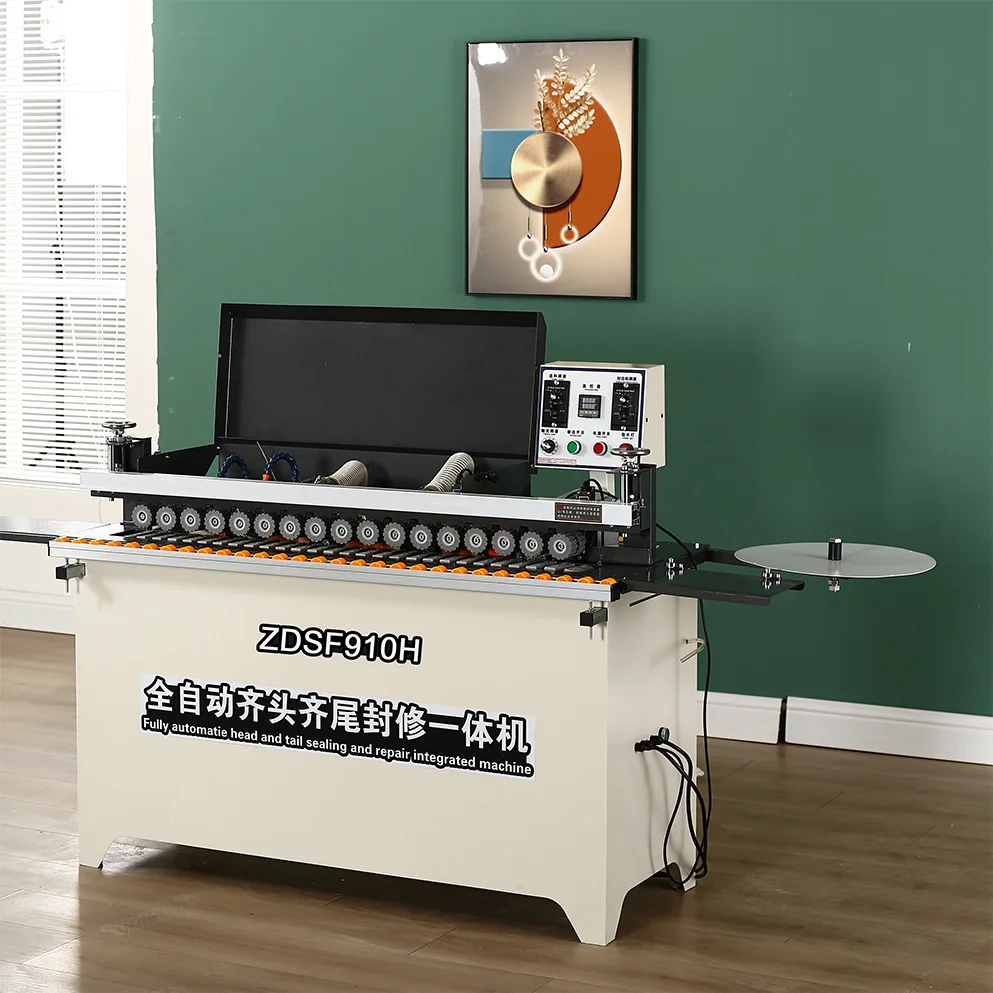
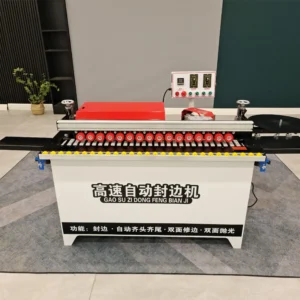
Compact 220V Footprint — single-phase 4kW rated power lets this 910H edge bander run in small workshops without three-phase electrical upgrades or new wiring from the mains panel.
Technical Specifications
| Parameter |
Value |
| Model |
910H Full Automatic Edge Banding Machine |
| Product Type |
Full Automatic Edge Banding Machine |
| Function Stations |
Gluing, End Cutting, Trimming, Vacuuming, Cleaning, Buffing |
| Voltage & Frequency |
220V 50Hz (voltage configurable from 110V to 440V) |
| Rated Power |
4 kW |
| Suction Power |
1200 W |
| Transmission Power |
120 W |
| Heating Power |
800 W |
| Polishing Power |
180 W × 2 |
| Trimming Power |
800 W × 2 |
| Edging Speed |
0–7 m/min |
| Rated Air Pressure |
0.6 MPa |
| Sheet Thickness Range |
10–50 mm |
| Strip Thickness Range |
0.5–2.5 mm |
| Min Board Width |
25 mm |
| Glue Pot Capacity |
1000 ml |
| Overall Dimensions (L×W×H) |
1300 × 560 × 1090 mm |
| Net Weight |
186 kg |
| Trimming Motors |
2 high-speed units |
| Feed System |
Double-row rubber pressure wheels |
| Pressure Beam |
Adjustable aluminum alloy |
| Edge Banding Mode |
Straight; curved after rotating 180° |
| Edge Strip Cutting |
Pneumatically controlled |
| Cutter Head |
4-edge arc-shaped alloy |
| Control Panel |
Multi-function button operation |
Application Suitability
| Application |
Material or Output |
| Cabinet door and carcass edging |
MDF and particleboard with PVC or melamine strip |
| Drawer side and shelf strip finishing |
Narrow components down to 25 mm board width |
| Small custom furniture parts |
Plywood panels with veneer edge banding |
| Joinery workshop transition production |
Mixed substrate batches in low-to-medium daily volume |
| Curved panel edge finishing |
Contoured furniture elements after 180° machine rotation |
Why the Voltage Question Comes Before the Price
Confirm your workshop supply matches the machine winding before the order is placed, not after it arrives.
I have watched small joinery shops in the Pearl River Delta take delivery of an Edge Banding Machine in stock from a trading company, only to find the motor was wound for 380V three-phase while their workshop ran on single-phase 220V. The machine sat wrapped on the floor for weeks while they arranged a dedicated line or a transformer. Some never recovered the lost commissioning time because their first customer order was already late. This unit ships configured for 220V 50Hz as standard and runs on a 4kW total draw [NEED_CITE: voltage and frequency standards by export market], which means a small workshop can plug it into an existing circuit without calling an electrician for a panel upgrade. If your local supply differs, the voltage can be confirmed and adjusted before the machine leaves the factory floor.

Single-Phase Power Without the Workshop Rewire
Most entry-level edge banders on the export market still assume a three-phase supply, leaving buyers in regions with predominantly single-phase light industrial power scrambling for solutions. The 910H pulls a total rated load of 4kW across all six function stations — heating, trimming, polishing, suction, and feed — which keeps it within the capacity of a standard 220V single-phase circuit. For a startup furniture maker moving from hand-held routers and manual PVC application, this removes one of the most common installation blockers and lets the Edge Banding Machine in stock start producing finished panels within the first day on site.
Six Stations in a 1.3-Meter Footprint
Workshop floor space is expensive, and every extra meter of machine length means less room for panel storage and assembly benches. This model packs gluing, end cutting, rough and fine trimming, vacuuming, glue line cleaning, and top-and-bottom buffing into a 1300×560 mm footprint at just 186 kg. The adjustable aluminum alloy pressure beam and double-row rubber feed wheels keep the panel stable through each station without requiring a heavy cast-iron frame. For a two-person workshop cutting and edging cabinet components in MDF and particleboard, the compact layout means one operator can manage both the infeed and the outfeed end without walking the length of a production-line machine [NEED_CITE: typical floor space allocation for small-scale panel processing workshops].
Reading the Numbers That Actually Matter
The sheet thickness range of 10–50 mm and strip thickness of 0.5–2.5 mm define what this machine can physically pass through its feed gap and glue roller. If your production includes 18 mm melamine-faced chipboard with 2 mm PVC edging — the most common cabinet specification — you sit well within the working envelope. The 1000 ml glue pot holds enough hot-melt adhesive for a sustained run without frequent refills, which matters when you are edging forty or fifty cabinet sides in a single session. The two 800W high-speed trimming motors with 4-edge arc-shaped alloy cutter heads shear the overhang flush on both faces in one pass, and the cross-polishing wheels remove residual adhesive haze so panels move directly to boring or assembly without a hand-finishing step. Edging speed is adjustable from 0 to 7 m/min [NEED_CITE: relationship between feed speed and glue adhesion on melamine substrates], allowing slower passes on difficult substrates like thin melamine where the adhesive needs slightly longer contact time to bond without visible glue lines.
What Happens When the Wrong Spec Gets Shipped
A control panel printed in a language your operator cannot read turns a simple machine into a commissioning puzzle. An edge bander configured for a feed height that does not match your panel thickness range means the pressure beam cannot hold the workpiece firmly, and the trimming station leaves a visible lip on every edge. I have seen workshops buy a machine rated for 3 mm strip thickness, then try to run 0.5 mm veneer through it — the result is chatter marks along the entire edge because the cutter head and feed speed were never designed for thin, brittle material. These are not manufacturing defects; they are specification mismatches that only surface once production starts and panels fail quality checks at the assembly bench.
What This Supplier Brings to the Order
The factory behind the 910H runs a four-stage QC process covering incoming material inspection, in-process checks, finished product testing, and pre-shipment verification with sample panel output photographs sent to the buyer. Voltage is confirmed in writing against your local supply before production begins, so the motor winding, heating element, and control transformer all match the destination country [NEED_CITE: CE machinery directive requirements for industrial equipment]. The operation and maintenance manual is prepared in the language agreed at order stage, and the spare parts list includes part numbers, diagrams, and recommended stock quantities so you can plan consumables for the first six months. Engineer-led configuration means the quotation addresses your actual panel materials and daily volume rather than shipping a default build and hoping it fits.
Documentation & Verification
- CE declaration of conformity covering the 910H automatic edge banding machine
- ISO 9001 certificate from the manufacturing facility
- Electrical schematic with confirmed 220V or agreed voltage and frequency
- Factory test record on your specified panel thickness and strip material before dispatch
- Operation and maintenance manual in the agreed language with spare parts diagram
Installation, Commissioning & Support
- Place on a level floor with 1300×560 mm clear footprint and 1090 mm overhead clearance
- Connect to a dedicated 220V single-phase circuit rated for at least 4 kW continuous draw
- Supply compressed air at 0.6 MPa to the pneumatic strip cutter and pressure beam
- Set glue roller volume and pressure beam height on your first panel batch during commissioning
- Stock replacement 4-edge arc-shaped alloy cutter heads and buffing wheels from the supplied spare parts list
- Clean the 1000 ml glue pot after each production run to prevent adhesive carbonization
Before You Send the Inquiry
Share the primary board material you will be edging — MDF, particleboard, plywood, or solid wood — along with the typical sheet thickness and the strip material and thickness range. Confirm your workshop voltage and frequency so the motor and heating elements can be wound to match. If you are also ordering upstream panel saws or downstream boring machines, mention the model or feed height so the line can be matched for throughput and panel handling compatibility.
Frequently Asked Questions
Q: Is this model currently in stock and what is the dispatch lead time?
A: The 910H is built to stock configuration and can typically be prepared for dispatch within a short lead time after order confirmation. Voltage customization or language-specific control panels may add a brief production step. Request current stock status and estimated shipping dates when you submit your inquiry with your panel specification.
Q: Can the voltage be customized to match my local supply?
A: Yes. The standard build is 220V 50Hz single-phase, but the motor winding, heating element, and control transformer can be configured for voltages from 110V to 440V. Provide your local supply voltage and frequency at inquiry stage so the factory confirms the correct electrical specification before production begins.
Q: What is the minimum order quantity for this machine?
A: Single-unit orders are accepted. The 910H is designed for workshops and small factories that may only need one edge bander to start. There is no requirement to purchase multiple units or bundle with other machinery, though line configuration support is available if you are planning a full panel processing setup.
Q: How do I handle curved edge banding on this machine?
A: The 910H supports curved edge banding by rotating the machine 180 degrees, which reorients the feed path for contoured panel edges. The adjustable pressure beam and double-row rubber feed wheels maintain contact on curved workpieces. Confirm your typical curve radius at inquiry stage so the factory can advise on suitable strip materials.
Q: What spare parts and consumables should I order with the machine?
A: The recommended first-order spares include replacement 4-edge arc-shaped alloy cutter heads for the trimming stations, buffing wheels for the polishing unit, and pneumatic cutter blades. The supplied spare parts list provides part numbers and diagrams so you can plan reorder intervals based on your daily production volume.