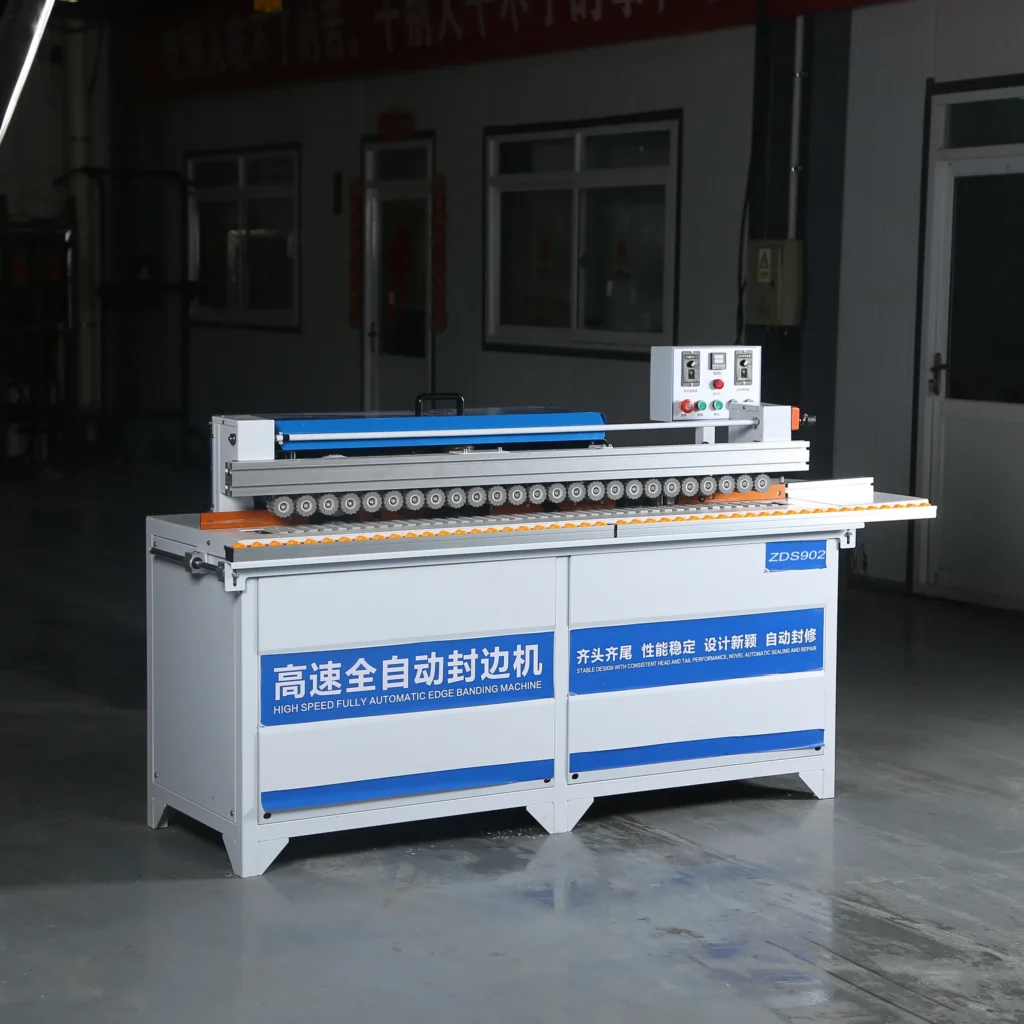
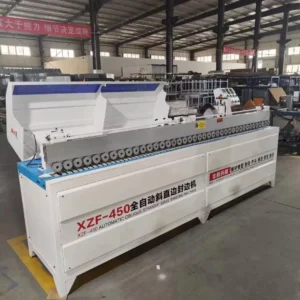
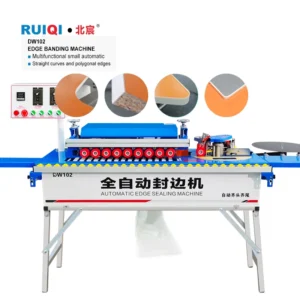
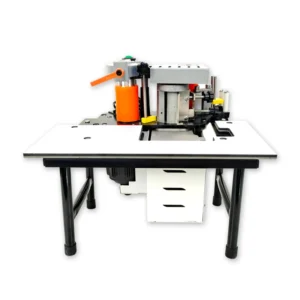
Compact Footprint, Fast Dispatch — stocked for quick delivery, this 220V edge bander arrives as a complete, self-contained unit so small workshops can begin production immediately without sourcing separate stations.
Technical Specifications
| Parameter |
Value |
| Product Type |
Automatic Edge Banding Machine |
| Voltage |
220V |
| Overall Dimensions (L×W×H) |
207×60×122 cm |
| Total Power |
4200W |
| Machine Type |
Linear Edge Banding Machine |
| Net Weight |
245 kg |
| Edge Band Height Range |
0–35 mm |
| Edge Band Thickness Range |
0.5–2.5 mm |
| Glue Pot Capacity |
4000 ml |
| Pressure Beam |
Integrated, double rows of pressure wheels |
| Pressure Beam Adjustment |
Manual handle for board height |
| Conveyor Belt Material |
Silicone |
| Edge Strip Cutting Device |
Pneumatically controlled |
| Polishing Stations |
Up and down dual polishing motors |
| Trimming Stations |
Double high-speed trimming motors, up and down |
| Key Features |
High-speed sealing and repair, double-sided gluing, independent operating platform, intelligent temperature control, top and bottom polishing and trimming |
Application Suitability
| Application |
Material or Output |
| Custom cabinet door edge banding |
MDF panels with PVC edge banding |
| Small-batch wardrobe side panel processing |
Particleboard with 0.5–2.5 mm melamine or PVC strips |
| Compact workshop shelving production |
Plywood panels with veneer edge banding |
| Joinery startup batch runs |
Mixed substrate panels requiring frequent changeover |
Why the Voltage Question Should Come Before the Price
Confirming your local supply before ordering avoids weeks of idle equipment on the workshop floor.
I once helped a buyer who had already purchased an edge bander rated for 380V three-phase, only to find their workshop ran a single-phase 220V supply. The machine sat unpowered for nearly a month while an electrician installed a new circuit and transformer [NEED_CITE: voltage and frequency standards by export market]. This Automatic Edge Banding Machine in stock fast delivery is configured for 220V as standard, which suits the majority of small workshops and joinery startups operating on common single-phase supplies. Asking about voltage compatibility early in the conversation eliminates the most frequent cause of delayed commissioning.

Ready-to-Run Configuration for Immediate Dispatch
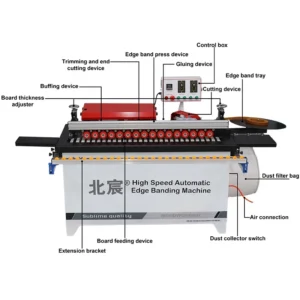
Workshops moving from manual edge banding need equipment that arrives complete and operational. This Automatic Edge Banding Machine in stock fast delivery ships as a single integrated unit — pressure beam, glue pot, trimming, and polishing stations are all mounted and wired within the 207 cm footprint. There is no need to source a separate feed table, glue applicator, or trimmer. For a joinery startup renting a modest industrial space, that consolidated footprint means the machine can be positioned against a wall with room left for a panel saw and assembly bench alongside it.
Double-Sided Gluing and Intelligent Temperature Control
The 4000 ml glue pot with intelligent temperature control holds enough adhesive for extended production runs without constant refilling. Double-sided gluing applies adhesive to both the panel edge and the strip simultaneously, which improves bond consistency across MDF and particleboard substrates. The temperature system adjusts to the specific hot-melt adhesive in use, reducing the risk of cold glue lines on porous boards or scorching on thin PVC strips [NEED_CITE: hot-melt adhesive temperature ranges for PVC and veneer edge banding].
How Specs Translate to Edge Quality on the Shop Floor
The integrated pressure beam with double rows of pressure wheels holds panels firmly against the conveyor belt during the banding cycle, which matters when processing thin particleboard that can shift under single-row pressure. The manual handle for board height adjustment lets operators switch between 18 mm MDF shelving panels and thicker plywood cabinet sides without reaching for tools. Pneumatically controlled edge strip cutting trims the banding to length cleanly at the end of each pass, removing the need for manual snipping that often leaves uneven overhangs. Up and down dual polishing motors paired with double high-speed trimming motors produce a finished edge in one pass — the trimming motors remove excess material while the polishing stations smooth the transition between strip and panel face.
The Hidden Cost of Skipping Configuration Checks
A machine quoted without confirming local voltage and frequency can arrive completely unusable. Single machines bought piecemeal sometimes show up with feed heights that do not align with existing saws or sanders, forcing workshops to rebuild their material flow around one mismatched station [NEED_CITE: production line throughput matching in small woodworking shops]. Entry-level edge banders pushed beyond their intended daily volume wear through bearings and conveyor belts prematurely, which means more downtime than a properly specified machine would require. Control panels printed in a language the operator cannot read stall commissioning entirely until translated overlays are sourced and applied.
Why Procure This Machine Here
Every unit ships with a factory test record that verifies trimming and polishing output quality on the buyer's specified panel thickness range before dispatch. Voltage and control panel language are confirmed during the specification stage, not after the machine is crated. The four-stage QC process covers incoming material inspection, in-process assembly checks, finished product testing, and pre-shipment verification. Engineers configure the machine based on the buyer's actual substrate types and daily processing volume rather than quoting a generic package. The product family includes upgrade paths, so a growing workshop can add capacity later without switching suppliers.
Documentation & Verification
- Machine specification sheet confirming all dimensional and functional parameters for this unit
- Electrical schematic with voltage confirmation matching your local 220V supply standard
- Factory test record on your specified panel thickness and edge banding material before dispatch
- Operation and maintenance manual provided in the buyer's agreed language
- Spare parts list with part numbers for trimming blades, polishing wheels, and conveyor segments
Installation, Commissioning & Support
- Requires a dedicated 220V circuit rated for the 4200W total power draw with appropriate breaker sizing
- Arrives as a single 245 kg unit; position on level concrete flooring within the 207×60×122 cm footprint
- Manual handle pressure beam adjustment must be calibrated to your panel thickness range during first startup
- Pneumatic edge strip cutting device requires connection to a workshop air supply at the specified pressure
- Silicone conveyor belt tension should be checked after the initial warm-up cycle before production begins
- Dual polishing and trimming motors need alignment verification against your specific edge band thickness range
What We Need to Move Forward
Share the panel substrates you work with most frequently — MDF, particleboard, or plywood — along with typical board thicknesses and the edge banding materials you prefer. Confirm your workshop's voltage and frequency so we can verify electrical compatibility before quoting. Let us know your approximate daily panel count so we can assess whether this model fits your volume or if a higher-throughput configuration would serve you better.
Frequently Asked Questions
Q: What panel thickness and edge band materials can this machine handle?
A: The edge band height range covers 0–35 mm with strip thickness from 0.5 to 2.5 mm, accommodating standard PVC, melamine, and veneer banding. The integrated pressure beam with manual height adjustment handles common panel thicknesses used in MDF, particleboard, and plywood furniture production. For specific thickness limits on your substrate, confirm with our engineering team before ordering.
Q: Is the 220V configuration compatible with my local voltage and frequency?
A: The machine is built for 220V single-phase supply as standard. We confirm your local voltage and frequency during the specification stage and can configure the unit accordingly if adjustments are needed. Providing your exact supply details early prevents commissioning delays caused by electrical mismatches on arrival.
Q: What is the current stock availability and dispatch lead time?
A: This Automatic Edge Banding Machine in stock fast delivery is held in ready-to-ship inventory for prompt dispatch. Lead times depend on destination port and any pre-shipment customization such as language configuration or voltage adjustment. Share your requirements and we will provide a confirmed dispatch date within one business day.
Q: Does the machine arrive fully assembled or is on-site assembly required?
A: The unit ships as a single integrated machine weighing 245 kg with all stations mounted and wired. No sub-assembly of trimming or polishing stations is needed on site. You will need to connect the pneumatic supply for the edge strip cutting device, plug into your 220V circuit, and calibrate the pressure beam to your panel thickness before first production run.
Q: What spare parts are included and how are replacements sourced?
A: Each shipment includes a spare parts list with specific part numbers for consumables such as trimming blades, polishing wheels, and conveyor belt segments. Replacement parts can be ordered directly using those numbers. The operation manual covers routine maintenance intervals to help you plan spare part consumption across your production schedule.