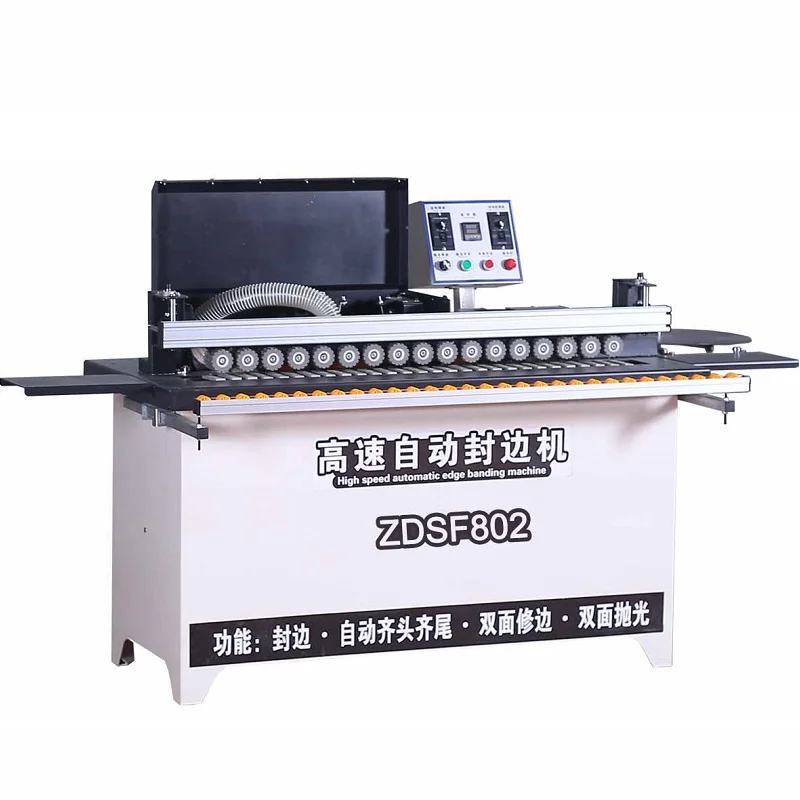
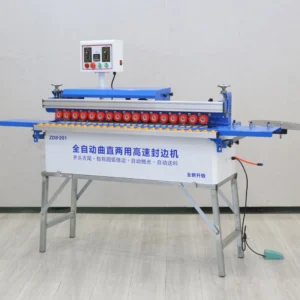
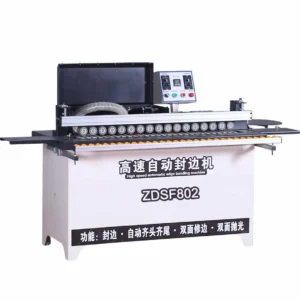
Stocked for fast dispatch — ZDSF802 units ship from ready inventory with voltage and control language matched to your market before they leave the factory floor, so your first powered run happens on arrival day, not after weeks of troubleshooting.
Technical Specifications
| Parameter |
Value |
| Model |
ZDSF802 |
| Product Type |
Automatic Edge Banding Machine |
| Edge Type |
Straight line |
| Rated Voltage |
220V |
| Rated Power |
4 kW |
| Trimming Power |
800 W × 2 |
| Polishing Power |
180 W × 2 |
| Suction Power |
1200 W |
| Heating Power |
1000 W |
| Strip Thickness Range |
0.5–2.5 mm |
| Sheet Thickness Range |
10–50 mm |
| Feed Speed |
0–10 m/min |
| Glue Pot Capacity |
4000 ml |
| Rated Air Pressure |
0.4–0.6 MPa |
| Overall Dimensions |
130 × 65 × 75 cm |
| Machine Weight |
150 kg |
| Gluing Method |
Double-sided gluing |
| Trimming Stations |
Upper and lower trimming, automatic end trimming |
| Polishing Stations |
Upper and lower polishing |
| Control Panel |
Digital display for glue pot temperature, independent switches |
| Pressure Beam |
Integrated pressure beam, double-row pressure wheels |
| Conveyor Belt Material |
Silicone |
| Band Breaking Method |
Pneumatically controlled |
| Auxiliary Support |
Extendable fluent strips for large plates |
| Assembly State |
Requires on-site assembly per user manual |
Application Suitability
| Application |
Material or Output |
| Small custom cabinet shops |
MDF and particleboard with PVC edge banding |
| Joinery workshop startup |
Plywood panels with melamine or thin veneer strips |
| Bespoke furniture maker |
Solid wood panels requiring straight-line edge finishing |
| Limited-space production unit |
Board processing within 10–50 mm thickness on 220V supply |
Why the Voltage Question Must Come Before the Dispatch Date
A machine wired for the wrong frequency will run, but the heater and feed motor will drift outside their design envelope within the first production hour.
I spent two days on a service call last year where an entry-level edge bander had been shipped to a 60 Hz market on a 50 Hz configuration. The glue pot reached temperature, but the thermal mass balance was off, and veneer strips were peeling at the ends while PVC held fine. The workshop owner lost a full week of production waiting for a replacement heating element and transformer. That automatic edge banding machine in stock looked like a bargain until the downtime cost more than the unit itself [NEED_CITE: voltage and frequency standards by export market]. When you are buying a compact machine for a small shop, there is no redundant line to fall back on while the fault is diagnosed.

Ready Stock Means Your Configuration Is Checked Before Crating
Ordering an automatic edge banding machine in stock should not mean accepting whatever default configuration was last on the assembly bench. For the ZDSF802, stock units are held at the factory, and before crating, the heating element, motor winding, and control panel language are matched to the destination market. A 220V single-phase supply is standard, but the internal wiring and thermal cutoff thresholds are verified against the buyer's stated frequency. This step eliminates the most common commissioning stall I see in small workshops where the first powered run reveals a mismatch.
Lead Time That Respects a Small Shop's Production Gap
A compact workshop scaling from manual edge banding to its first automatic unit does not have months of buffer inventory. The ZDSF802 ships from ready stock, which means the dispatch window is measured in days rather than production cycles. For a joinery startup taking on its first fitted kitchen contract, that timing difference is the gap between meeting the installer's schedule and paying penalties. The 150 kg machine weight and 130 cm footprint also mean standard LCL freight is viable, avoiding the wait for a full container consolidation [NEED_CITE: LCL shipping consolidation timelines for machinery].
Heat-Up Time and Glue Pot Capacity for Short-Run Flexibility
The 1000 W heating element brings the 4000 ml glue pot to working temperature in five to ten minutes. In a small workshop running short batches, that rapid heat-up means the machine is not idling all morning waiting for thermal stability. The 4L pot capacity is large enough to handle a full day of straight-line PVC banding without mid-shift refill interruptions, yet small enough that glue does not degrade from prolonged holding when the shop switches to a different task in the afternoon. Double-sided gluing ensures adhesive contacts both the panel edge and the strip backing, which matters when transitioning between 0.5 mm PVC and thicker veneer materials.
Trimming, Polishing, and the Straight-Line Finish Chain
The ZDSF802 carries upper and lower trimming stations at 800 W each, followed by upper and lower polishing at 180 W per station. The automatic end trimming cuts the strip flush at both panel ends before the longitudinal trim cleans the top and bottom overhang. For MDF and particleboard in the 10–50 mm thickness range, this sequence produces a clean edge ready for assembly without secondary hand finishing. The integrated pressure beam with double-row pressure wheels holds the strip against the panel edge through the glue setting zone, while the silicone conveyor belt protects the panel face from scuff marks during transport through each station.
Spec Interpretation: What the Numbers Mean on the Shop Floor
The 0–10 m/min feed speed is variable, and for a small shop this matters more than a single rated speed figure. Thicker veneer strips in the 2.0–2.5 mm range need slower feed to allow the glue film to set under pressure; thin 0.5 mm PVC can run toward the upper end of the range without edge lift. The 0.4–0.6 MPa air pressure requirement is standard for workshop compressors, but the pneumatically controlled band breaking mechanism depends on consistent supply — a compressor running other tools on the same line can cause pressure dips that result in uneven end cuts. The extendable fluent strips support large plates that overhang the 65 cm machine width, preventing the panel from tipping and dragging the strip off alignment before it reaches the trimming stations [NEED_CITE: compressed air supply requirements for pneumatic edge bander functions]. The digital temperature display gives the operator a direct read on glue pot state rather than relying on timed estimation, which is where I have seen most veneer adhesion failures originate when operators assume heat-up is complete before the thermal mass has actually stabilized.
What Happens When a Compact Machine Is Chosen on Price Alone
I have serviced workshops where the buyer selected the smallest, cheapest edge bander available, only to discover that the glue pot was too small to maintain temperature across a forty-panel run. The glue viscosity drifts as the pot empties and refills, and the last ten panels of a batch show visible glue lines that fail quality checks. With the ZDSF802, the 4000 ml pot is sized for sustained short-run production, but if your daily volume exceeds what a single-operator compact unit was designed for, the machine will show its limits through thermal inconsistency rather than mechanical failure [NEED_CITE: glue pot thermal recovery in small-capacity edge banders]. The cost of reworking panels with failed edge bonds is not just material waste — it is the installer standing on a job site waiting for replacement cabinet sides.
Why Sourcing This Unit From Ready Stock Reduces Commissioning Risk
The ZDSF802 is manufactured in a facility with proprietary cutting mechanism patents and a four-stage QC process covering incoming material through pre-shipment verification. Every stocked unit carries a factory test record documenting actual run performance before it is crated. Voltage confirmation is captured in writing against the buyer's stated supply, not assumed from a regional default. The operation and maintenance manual is produced in the language agreed at order, so the operator can follow commissioning steps without translation delays. Spare parts lists ship with the machine, meaning the first replacement trimming blade or polishing wheel is identified before the original wears through.
Documentation & Verification
- CE declaration of conformity covering the ZDSF802 electrical and mechanical safety requirements
- Factory test record showing glue temperature stability and trimming accuracy on your specified panel thickness
- Electrical schematic with confirmed voltage and frequency for your local supply before dispatch
- Operation manual in your agreed language with step-by-step commissioning sequence for the 220V configuration
- Spare parts list identifying consumable trimming blades, polishing wheels, and heating element part numbers
Installation, Commissioning & Support
- Requires a level floor within the 130 × 65 cm footprint with clearance for the extendable fluent strips on the infeed side
- Dedicated 220V single-phase circuit rated for the 4 kW total draw, separate from compressor and dust extraction lines
- On-site assembly per the supplied manual and video, with pressure beam alignment as the critical first step
- Initial heat-up run of five to ten minutes to stabilize the 4000 ml glue pot before the first panel is fed
- Compressor must maintain 0.4–0.6 MPa at the machine inlet to ensure consistent pneumatic band breaking
- First batch run should use scrap MDF at your production thickness to verify trimming and polishing station alignment
What to Include With Your Inquiry
To confirm configuration and dispatch timing, provide the panel materials and thickness range you will process most frequently, the edge strip types and thicknesses in your current projects, and your local voltage and frequency. If your workshop shares a compressor with other machines, note the total air demand on that line. This information allows the engineer to verify that the ZDSF802 feed speed, glue pot temperature profile, and pneumatic supply requirements align with your production environment before the unit leaves stock.
Frequently Asked Questions
Q: Is the ZDSF802 in stock and what is the dispatch lead time?
A: Units are held in ready inventory at the factory. Dispatch lead time depends on configuration confirmation — specifically voltage, frequency, and control panel language matching your market. Once those are verified in writing, crating and freight handover follow within days rather than weeks, which matters when a small workshop has a contract deadline and no backup production line.
Q: Can the voltage and control panel language be matched to my country before shipping?
A: Yes. The ZDSF802 is configured for 220V single-phase supply, and the internal wiring and thermal cutoff settings are verified against your stated frequency before dispatch. The digital control panel and operation manual are produced in your agreed language so that commissioning does not stall on translation gaps when the machine arrives on your floor.
Q: What panel thickness and edge strip thickness does this model handle?
A: The ZDSF802 processes sheet thickness from 10 to 50 mm and edge strip thickness from 0.5 to 2.5 mm. This covers standard MDF, particleboard, and plywood used in cabinet and furniture production. For thicker solid wood panels or strips outside this range, a higher-tier model with extended feed clearance would be required.
Q: How much floor space and air supply do I need for installation?
A: The machine footprint is 130 × 65 × 75 cm, with additional clearance needed on the infeed side for the extendable fluent strips when processing large plates. Your compressor must deliver 0.4–0.6 MPa at the machine inlet. If other pneumatic tools share the same line, pressure regulation is necessary to prevent uneven band breaking during operation.
Q: What spare parts are included and how are replacements supplied under the warranty?
A: The initial shipment includes a spare parts list identifying consumables such as trimming blades, polishing wheels, and the heating element. The one-year warranty covers factory defect spare part replacement. Replacement parts are dispatched from the factory with the same documentation and configuration verification applied to the original machine.