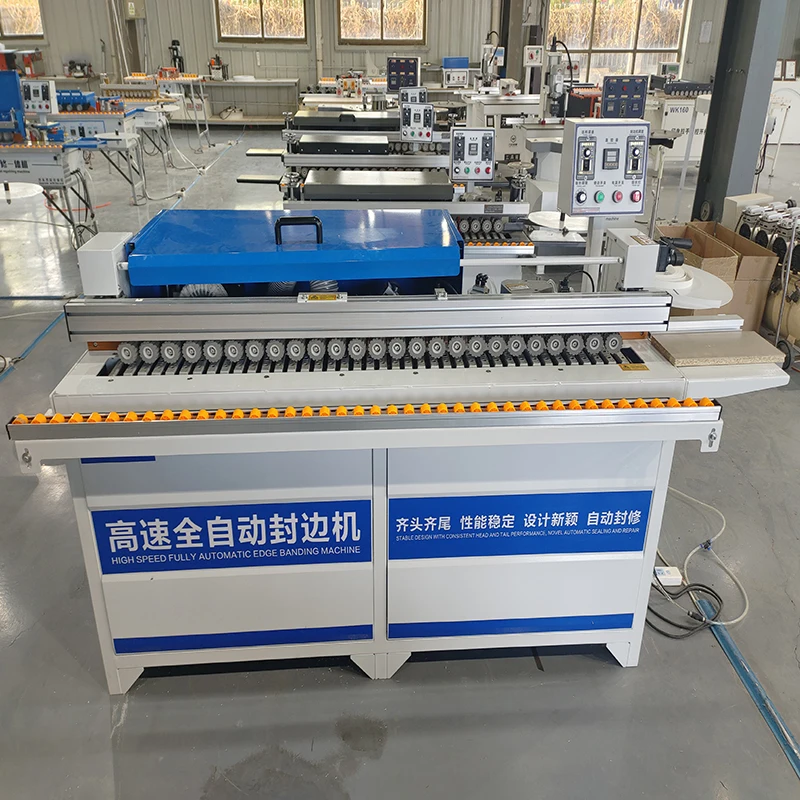
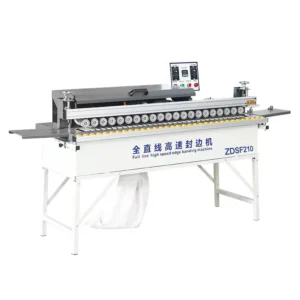
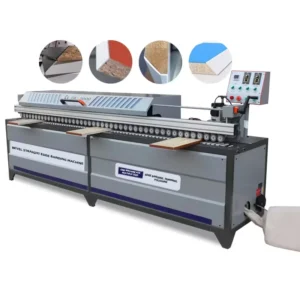
Compact Footprint, Ready to Run — this automatic edge bander ships configured for 220V single-phase supply, eliminating the transformer delay that stalls small workshop installations.
Technical Specifications
| Parameter |
Value |
| Product Type |
Automatic Edge Banding Machine |
| Voltage |
220V |
| Total Power |
4200W |
| Equipment Dimensions |
207 × 60 × 122 cm |
| Weight |
245 kg |
| Edge Band Height Range |
0 – 35 mm |
| Edge Band Thickness Range |
0.5 – 2.5 mm |
| Glue Pot Capacity |
4000 ml |
| Conveyor Belt Material |
Silicone |
| Pressure System |
Integrated beam with double rows of pressure wheels |
| Edge Strip Cutting |
Pneumatically controlled |
| Trimming Configuration |
Double high-speed motors, up and down action |
| Polishing Configuration |
Up and down two polishing motors |
Application Suitability
| Application |
Material or Output |
| Custom cabinet door edging |
MDF and melamine-faced particleboard |
| Small-batch wardrobe panel finishing |
Plywood with PVC or veneer edge banding |
| Joinery workshop straight-line processing |
Melamine board and laminate substrates |
| Startup furniture production runs |
Particleboard shelving and carcass panels |
Why the Voltage Question Must Come Before the Purchase Decision
Confirming your workshop supply against machine requirements prevents weeks of idle floor space.
I once watched a small joinery operation in the Pearl River Delta take delivery of an entry-level edge bander only to discover the shop ran on 220V single-phase while the machine demanded 380V three-phase. The Automatic Edge Banding Machine for Small Workshop sat wrapped on the floor for over two weeks waiting for a step-up transformer, burning rent and delaying every committed order. That single mismatch cost more in lost time than any price difference between models [NEED_CITE: voltage and frequency standards by export market]. This unit ships at 220V, matching the single-phase supply most compact workshops already have on site, so you plug in and begin commissioning the day the crate comes off.

Ready-Stock Positioning for Entry-Level Buyers
When a workshop is moving from hand-applied edge banding to mechanized output, the priority is getting a working machine on the floor fast. This Automatic Edge Banding Machine for Small Workshop is held in stock configuration specifically for that transition — a single-unit order dispatched without waiting for a production slot. The 220V setup, compact 207 cm footprint, and sub-250 kg weight mean one person with a pallet jack can position it, and a standard workshop circuit can power it.
Simplified Operation Without Sacrificing Edge Quality
The integrated pressure beam with double rows of pressure wheels holds panels flat against the silicone conveyor belt throughout the feed path. Pneumatically controlled edge strip cutting removes the manual snip-and-trim step that slows output on purely manual stations. Up-and-down polishing motors finish the edge in one pass, so a single operator can manage the complete straight-line edging cycle without a second set of hands at the outfeed.
What the Spec Sheet Means on the Shop Floor
The 4000 ml glue pot capacity is sized so a full shift of intermittent panel runs does not require mid-batch refills — a practical concern when one operator is managing both loading and quality checks. The 0.5–2.5 mm edge band thickness range covers PVC, ABS, and thin veneer strips commonly stocked by regional board suppliers. Trimming via double high-speed motors working up and down addresses the top and bottom edge overhang simultaneously, which directly affects how cleanly a banded panel seats into dowel or confirmat assembly downstream. The 0–35 mm band height range accommodates standard 16 mm and 18 mm board thicknesses with enough headroom for thicker stock used in worktop edging [NEED_CITE: common panel thickness standards in furniture manufacturing]. Manual handle adjustment on the pressure beam lets the operator reset for different board heights without tooling changes, which matters when a custom shop switches between wardrobe carcasses and drawer fronts through the same day.
The Cost of Skipping Configuration Verification
Ordering an edge bander without confirming local voltage and frequency is the most common reason a new machine sits idle after delivery. Control panels set to a language the operator cannot read stall the commissioning process further, because feed speed and temperature parameters remain at factory defaults rather than being tuned to the specific board stock on hand [NEED_CITE: operator interface language requirements in machinery directives]. An entry-level model pushed beyond its intended daily volume will show wear on the conveyor belt and pressure wheels sooner than expected, and glue pot residue builds faster when the machine runs continuous shifts it was never spec'd for.
Why Source This Machine Through This Channel
In-house manufacturing with patented cutting mechanisms means the trimming precision is built into the head assembly rather than relying on third-party components. Voltage and control panel language customization is handled as a standard order parameter, not a special request. A four-stage quality check — incoming material, in-process assembly, finished product, and pre-shipment verification — catches tolerance drift before the crate closes. Engineer-led configuration review happens before the quotation is issued, so the machine that ships matches the panel materials and daily volume the buyer described. Factory visits are open to any buyer who wants to see the assembly line and run test panels on the actual unit being ordered.
Documentation & Verification
- Machine specification sheet confirming 220V and 4200W rated for your local supply
- Factory test record run on your specified panel thickness before dispatch
- Electrical schematic with wiring diagram for your workshop electrician
- Operation manual in your agreed language covering temperature and feed settings
- Spare parts list with consumable and wear-part references at time of shipment
- CE declaration of conformity and ISO 9001 certificate for customs clearance
Installation, Commissioning & Support
- Floor area of roughly 2.5 × 1.5 m including operator standing space at infeed and outfeed
- Dedicated 220V circuit rated above 4200W to prevent breaker trips during glue pot heat-up
- Machine ships partially assembled; pressure beam and conveyor require on-site alignment
- First-run guidance covers glue temperature calibration for your specific edge band material
- Silicone conveyor belt inspection schedule based on your daily panel throughput
- Pneumatic cutter and trimming motor wear parts identified in the included spare parts list
What We Need to Match the Right Configuration
Tell us the board materials you run most often — MDF, particleboard, plywood, or melamine — along with typical panel dimensions and your current daily edging volume. Confirm your workshop voltage and frequency, and let us know the preferred language for the control panel and documentation. If you are feeding this machine from an existing panel saw or boring station, share those models so we verify throughput compatibility across your line.
Frequently Asked Questions
Q: What panel thickness and edge band dimensions does this machine handle?
A: The pressure beam adjusts via manual handle to accommodate board heights up to the machine's working range. Edge band height spans 0–35 mm and thickness covers 0.5–2.5 mm, which includes standard PVC and veneer strips used on 16 mm and 18 mm furniture panels in most small workshop production.
Q: Is the 220V configuration compatible with my local power supply?
A: This model ships at 220V single-phase, matching typical small workshop supply. If your region uses a different voltage or frequency, the manufacturer configures alternatives from 110V to 440V before dispatch. Always confirm your exact supply with your electrician before placing the order.
Q: How do I know if this entry-level model matches my production volume?
A: This Automatic Edge Banding Machine for Small Workshop suits low-to-medium batch straight-line edging. Share your typical daily panel count and batch size with the engineering team, and they will confirm whether this tier or the next model up is the right fit for sustained operation.
Q: What upgrade path exists if my workshop volume grows?
A: The manufacturer offers a full product family from entry-level to full-function pre-milling edge banders within one platform. When your volume outgrows this model, you can move to a higher-throughput unit from the same supplier without retraining operators on a different control system.
Q: What assembly is required on arrival, and is installation guidance provided?
A: The machine arrives partially assembled; the pressure beam, conveyor section, and pneumatic connections require on-site setup. Installation guidance covers alignment, glue pot first heat-up, and initial test runs, with operation and maintenance documentation in your agreed language included in the crate.