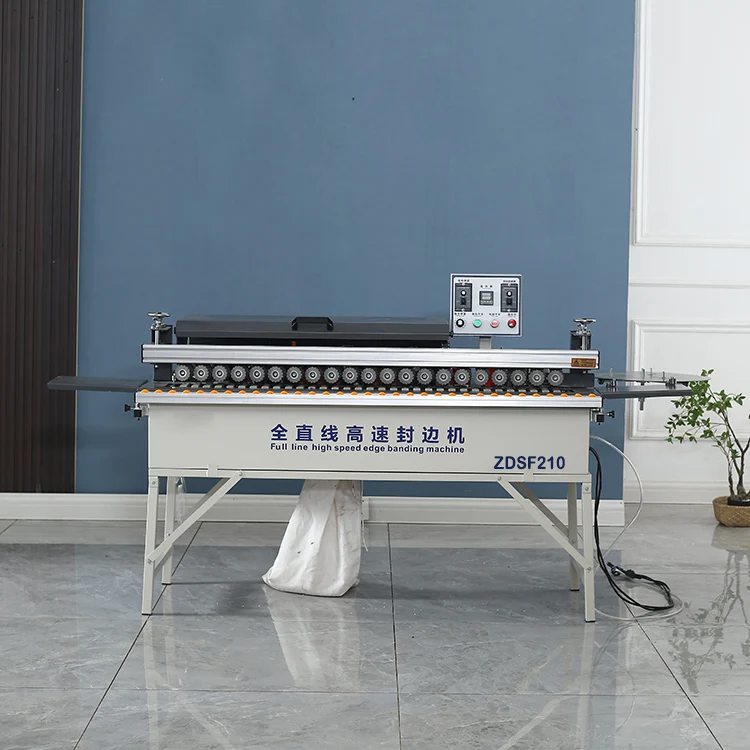
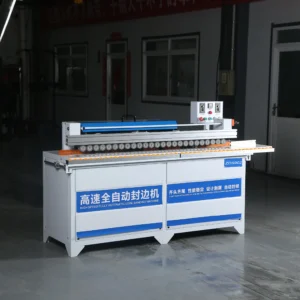
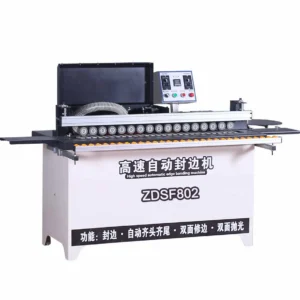
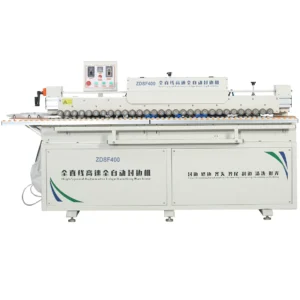
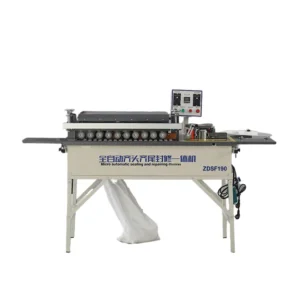
Compact Shop Floor Footprint — verified at 2100 × 570 × 1120 mm overall dimensions, this unit fits into tight joinery workshops without requiring facility reconfiguration.
Technical Specifications
| Parameter |
Value |
| Model |
ZDS210 |
| Product Type |
Portable Automatic Edge Banding Machine |
| Function Sequence |
Automatic plate feeding, Double-sided gluing, Upper and lower polishing, Automatic trimming, Wood cleaning system up and down |
| Edge Profile |
Straight lines |
| Voltage & Frequency |
220V 50Hz |
| Rated Power |
4 kW |
| Heating Power |
800 W |
| Trimming Power |
800 W × 2 |
| Polishing Power |
180 W × 2 |
| Suction Power |
1200 W |
| Transmission Power |
120 W |
| Belt Power |
25 W |
| Rated Air Pressure |
0.4–0.6 MPa |
| Feed Speed |
0–14 m/min |
| Panel Thickness Range |
10–50 mm |
| Edge Strip Thickness Range |
0.5–2.5 mm |
| Glue Pot Capacity |
1000 ml |
| Trimming Cutter |
4-edge arc-shaped alloy cutter head |
| Pressure Beam |
Integrated all-aluminum, adjustable via rotating hand crank with precision scales |
| Feed Mechanism |
Double rows of inner inclined pressure rollers |
| Dust Extraction |
Large diameter closed dust collector |
| Overall Dimensions (L×W×H) |
2100 × 570 × 1120 mm |
| Net Weight |
140 kg |
Application Suitability
| Application |
Material or Output |
| Small joinery workshop production |
MDF, plywood, and particleboard panels with PVC edge banding |
| Custom cabinet one-off runs |
Solid wood panels with veneer edge strips |
| Site-based furniture installation |
Pre-cut boards requiring on-site straight-line edge finishing |
| Startup workshop transition from manual tools |
Low-to-medium volume panel edge treatment |
Why the Voltage Question Must Come Before the Portable Edge Bander Order
A machine built for the wrong grid is a machine that never runs.
Small workshops frequently discover after delivery that their new portable edge banding machine in stock was configured for a voltage standard their facility cannot support. Single-phase 220V requirements differ fundamentally from three-phase industrial supplies, and running a 4 kW system on an undersized circuit causes thermal trips mid-production. The ZDS210 ships at a confirmed 220V/50Hz configuration, meaning the heating elements, trimming motors, and feed transmission all receive the electrical profile they were engineered for [NEED_CITE: voltage and frequency standards by export market].

Single-Phase Readiness for Workshops Without Industrial Power
Most joinery startups and small cabinet shops operate in commercial units or converted spaces that lack three-phase electrical infrastructure. The ZDS210 runs entirely on 220V single-phase supply, drawing 4 kW total across all active stations. This means a workshop can plug the unit into a dedicated standard circuit without commissioning an electrical panel overhaul or installing a phase converter. The 800 W heating element reaches glue melting temperature on this same single-phase feed, keeping the glue pot at working temperature throughout a production run without voltage sag affecting adhesion consistency.
Floor Space Constraints in Small Production Environments
A 2100 mm length and 570 mm width allows this portable edge banding machine in stock to sit against a wall or between existing workstations without disrupting material flow through the shop. The 140 kg net weight means two people can reposition it during layout changes, and the 1120 mm height keeps the operator sightline clear across the rest of the workshop floor. For a small team processing custom cabinet orders where every square meter counts, this footprint preserves space for panel storage and assembly benches [NEED_CITE: typical small workshop floor space constraints].
Feed Rate Flexibility for Mixed Workloads
The 0–14 m/min variable feed speed lets operators slow down for delicate veneer edge strips on thin plywood, then increase throughput when running standard PVC banding on MDF shelving batches. A small shop handling both one-off bespoke pieces and repeat cabinet runs benefits from this range because it eliminates the need to choose between a slow precision machine and a fast production machine. The double rows of inner inclined pressure rollers maintain panel stability across this entire speed envelope, preventing board drift that causes uneven trimming.
Spec Interpretation: What the Numbers Mean for Daily Production
The 10–50 mm panel thickness range covers the vast majority of materials a custom furniture shop encounters, from 10 mm thin back panels up to 50 mm solid wood worktops. The integrated all-aluminum pressure beam with precision scales means operators can dial in exact thickness settings for each batch without trial-and-error test runs. The 0.5–2.5 mm edge strip range accommodates both thin PVC for cost-effective cabinet interiors and thicker banding for exposed furniture edges that face impact wear. The 1000 ml glue pot capacity sustains continuous operation through a typical small-batch run without mid-job refills, and the 4-edge arc-shaped alloy trimming cutter produces a clean radius profile that reduces downstream sanding time. The large diameter closed dust collector interface connects to standard workshop extraction systems, keeping fine MDF and PVC particulate off the glue roller and out of the operator breathing zone.
What Happens When the Wrong Configuration Lands on Your Shop Floor
Buying an edge bander without confirming air pressure requirements leads to weak trimming cylinder force and incomplete edge cuts on harder PVC materials. The ZDS210 requires 0.4–0.6 MPa, which falls within standard small compressor output, but shops running undersized compressors experience pressure drops that stall the feed mechanism mid-panel. Similarly, choosing a machine with a glue pot too small for the batch size forces operators to stop production for refills, letting the pot temperature drop and compromising adhesion on the next series of panels [NEED_CITE: common edge banding defects from temperature fluctuation].
Why Procurement Through This Channel Works for Small Shops
In-house manufacturing with verified assembly tolerances means each ZDS210 leaves the factory with documented test records rather than generic compliance paperwork. Voltage and specification customization operates as a standard pre-dispatch step, so the 220V/50Hz confirmation happens before crating, not after delivery. The engineer-led configuration process matches the machine to actual panel materials and daily volume rather than defaulting to the base model. Four-stage quality control with pre-shipment verification ensures the trimming motors, heating element, and feed transmission all pass functional tests before the unit ships. Factory visits are welcomed for buyers who want to see the assembly line and test the unit on their own material samples.
Documentation & Verification
- Factory test record confirming glue temperature stability on your specific PVC or veneer material
- Electrical schematic matching the confirmed 220V/50Hz single-phase wiring configuration
- Operation manual in the agreed language covering pressure beam adjustment and feed speed calibration
- Spare parts list with part numbers for trimming cutters, glue rollers, and pressure belt consumables
- Packing photographs showing crate condition and component placement before dispatch
Installation, Commissioning & Support
- Dedicated 220V circuit with appropriate breaker rating for the 4 kW total draw to prevent thermal trips
- Partial assembly required on arrival with KD-packed spare components clearly labeled for install sequence
- Compressed air supply at 0.4–0.6 MPa connected to the rated inlet before first power-on
- First-run parameter setting for glue temperature, feed speed, and trimming depth using sample panel material
- Large diameter dust extraction port connected to shop vacuum system before MDF or particleboard processing begins
- Glue pot cleaning schedule established for the 1000 ml capacity to prevent cured adhesive buildup between shifts
Preparing Your Inquiry for Accurate Configuration
Share the primary panel materials and thickness range the workshop processes most frequently, along with the edge banding type and strip thickness. Confirm the available electrical supply voltage and frequency at the installation site, and note whether the shop runs on single-phase or three-phase power. Indicate the typical daily panel count and whether the workflow involves one-off custom pieces or repeat batch runs. If existing upstream saws or downstream boring machines are already in place, provide their feed heights so the ZDS210 integrates without material handling bottlenecks.
Frequently Asked Questions
Q: Is the ZDS210 currently in stock and ready to dispatch?
A: The portable edge banding machine in stock configuration ships from the factory on a standard lead time. Single-unit orders are accepted without minimum quantity requirements, and dispatch timing is confirmed at the point of order placement based on current inventory levels.
Q: Will the 220V configuration work with my local power supply?
A: The unit ships confirmed at 220V/50Hz single-phase, suitable for standard commercial electrical supplies in many export markets. Voltage and frequency requirements should be confirmed during the inquiry stage so the correct heating element and motor windings are installed before dispatch.
Q: What assembly is required when the machine arrives?
A: The ZDS210 ships partially assembled with certain spare components in knock-down packing for transport protection. The main frame, feed mechanism, and trimming stations arrive pre-aligned, requiring connection of electrical supply, compressed air, and dust extraction before first operation.
Q: Which edge banding materials can this unit handle?
A: The machine processes PVC and veneer edge strips in the 0.5–2.5 mm thickness range on MDF, plywood, particleboard, and solid wood panels. The double-sided gluing system and 800 W heating element maintain consistent adhesion across both porous and non-porous substrates.
Q: What spare parts should I order alongside the machine?
A: The recommended initial spare package includes replacement 4-edge arc-shaped alloy trimming cutters, glue application rollers, and pressure belt sections. A complete spare parts list with part numbers is supplied with every unit to support ongoing consumable ordering.