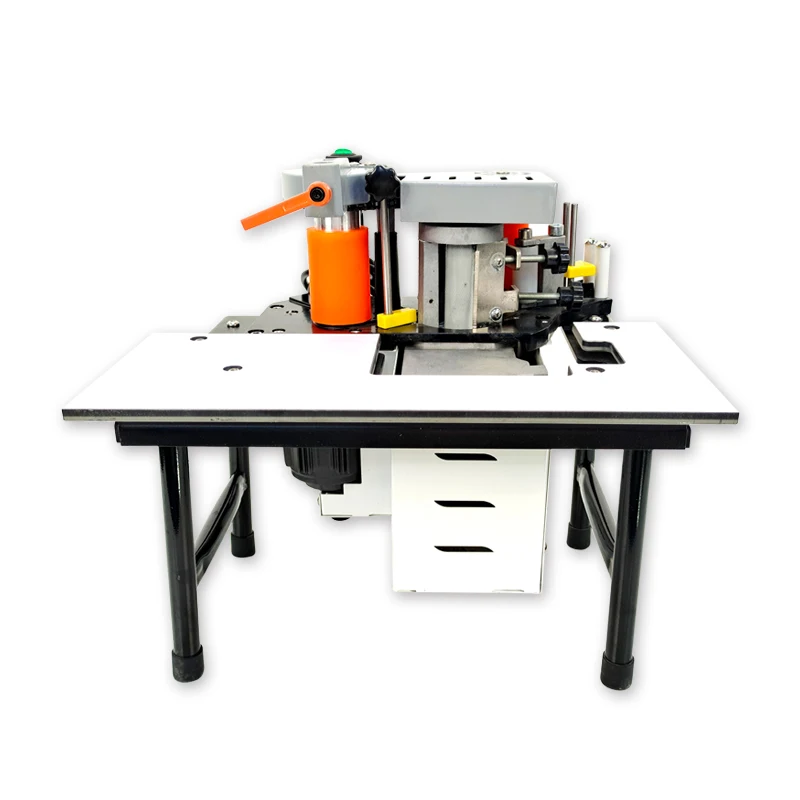
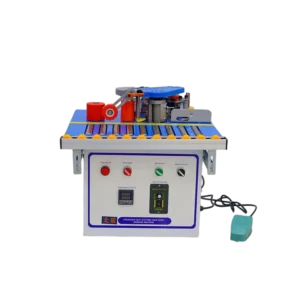
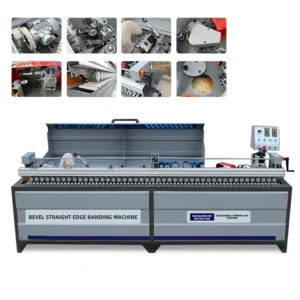
Compact readiness — voltage and language confirmed against your local grid and operator before dispatch, so the machine runs on arrival.
Technical Specifications
| Parameter |
Value |
| Product Type |
Portable Edge Banding Machine |
| Model |
ST-30 |
| Rated Power |
1000W |
| Voltage & Frequency |
220V / 380V / Customized |
| Control System |
Operation panel in Chinese and English; Spanish and other languages on request |
| Overall Dimensions (L×W×H) |
38 × 35 × 35 cm |
| Net Weight |
12 kg |
| Minimum Sheet Length |
25 cm |
| Minimum Sheet Width |
3 cm |
| Edge Banding Height Range |
0–50 mm |
| Edge Banding Thickness Range |
0.3–3 mm |
| Compatible Edge Banding Materials |
ABS, PVC, Melamine, Veneer |
| Edge Type |
Straight and curve edge |
| Edge Power |
20W |
| Air Source Pressure |
0.5–0.8 MPa |
| Glue Pot Capacity |
1000 ml |
| Assembly State |
Portable, handheld / tabletop configuration |
| Plug Options |
EU, USA, AU, UK |
| Standards |
CE, ISO 9001 |
Application Suitability
| Application |
Material or Output |
| Small joinery workshop first-machine transition |
MDF, particleboard, plywood panels with PVC or ABS tape |
| Custom cabinet maker low-volume runs |
Melamine-faced board with matching melamine edge tape |
| Interior decoration contractor on-site use |
Solid wood panels with veneer edge banding on curved edges |
| Furniture manufacturing startup |
Straight and curved panel edges across mixed substrates |
Why the Voltage Question Should Come Before the Price
Confirming local voltage and frequency before production prevents a machine from sitting idle on arrival.
I once watched a small automatic edge bander sit in a customer's workshop for three weeks because the local transformer could not match the machine's electrical requirements. The buyer had focused entirely on price and edge quality during negotiation, and the voltage mismatch only surfaced when the operator plugged it in. For a portable edge banding machine for small workshop use, the footprint and power draw are modest — but the electrical interface with your local grid is non-negotiable. Every export market has different frequency standards, and a 220V unit built for 50Hz behaves differently on a 60Hz supply [NEED_CITE: voltage and frequency standards by export market]. Getting this right at the quotation stage, not at the commissioning stage, is what separates a smooth install from a stalled one.

Moving Off Hand Tools Without Overcommitting
A joinery startup rarely needs a full automatic line on day one. This portable edge banding machine for small workshop environments gives operators a first step away from manual trimming — handling straight and curved edges on panels as small as 25 cm long and 3 cm wide. The 12 kg weight and 38 × 35 × 35 cm footprint mean it sits on an existing bench without dedicated floor space. As production volume grows, the same operator skills transfer directly to larger machines in the same product family.
Language and Controls That Match the Operator
Commissioning stalls when the person running the machine cannot read the control panel. This unit ships with Chinese and English interfaces as standard, and Spanish or other languages can be specified before production. For a small team where only one operator handles edge banding, having the interface in their working language reduces setup errors and shortens the learning curve on glue temperature, feed positioning, and edge thickness adjustment.
How the Core Parameters Shape Daily Output
The 0.3–3 mm edge thickness range covers the tapes most small workshops use — thin PVC for melamine cabinet carcasses, thicker ABS for impact resistance on shelf edges, and real wood veneer for visible furniture faces. The 0–50 mm height range handles standard 18 mm board as well as thicker solid wood panels up to 50 mm. The 1000 ml glue pot holds enough adhesive for a typical small-shop run without constant refilling, while the 0.5–0.8 MPa air pressure requirement means the machine connects to a standard workshop compressor rather than a dedicated pneumatic supply [NEED_CITE: pneumatic pressure requirements for small woodworking machinery].
What Happens When You Skip the Configuration Check
Buying a portable bander without verifying electrical compatibility, air supply capacity, or edge material range leads to quiet failures — the machine powers on but the glue does not reach temperature, the tape peels after a few days, or the compressor cannot maintain pressure during continuous runs. These issues are not defects; they are mismatches between the machine's configuration and the workshop's infrastructure [NEED_CITE: common commissioning faults in imported woodworking equipment]. A unit that costs less upfront but arrives without voltage confirmation or language-matched controls will consume far more in lost production time.
Why This Source Works for Small Workshop Buyers
In-house manufacturing means the voltage, plug type, and control language are set during build — not adapted after arrival. The four-stage quality process covers incoming material inspection through pre-shipment verification, so the unit that arrives matches the specification sheet confirmed at order. Engineer-led configuration recommendation ensures the machine matches your actual panel sizes and edge materials rather than a generic catalog entry. A formal quotation is provided within 24 hours of receiving your workshop details. Factory visits are welcomed for buyers who want to see the assembly bench before committing.
Documentation & Verification
- CE declaration of conformity matching the portable edge bander category
- Electrical schematic confirming your specified voltage and plug type
- Factory test record using panel thickness and edge material matching your application
- Operation and maintenance manual in your agreed language
- Spare parts list covering glue pot elements, edge trimming blades, and feed rollers
- Pre-shipment photographs of the configured unit before crating
Installation, Commissioning & Support
- Place on a stable bench; the 38 × 35 × 35 cm footprint requires no dedicated floor pad
- Connect to a dedicated circuit matching the confirmed voltage and frequency rating
- Air supply must deliver 0.5–0.8 MPa from a compressor with adequate tank reserve
- First run includes glue temperature calibration for your specific tape material
- Operator training covers tape loading, edge alignment, and curve-edge technique
- Spare glue pot elements and trimming blades included for early-stage replacements
- Daily cleaning of the glue roller and edge guide after each shift
What We Need to Configure Your Machine
Send your workshop's local voltage and frequency, the plug type used in your country, and the primary language for the control panel. Let us know the panel materials you cut most often, the edge tape types and thicknesses you plan to run, and whether your work is mostly straight edges or includes curved profiles. If you have a specific edge banding tape supplier, share a sample specification so we can run a test before production.
Frequently Asked Questions
Q: How do I choose the right entry-level edge bander for my current volume and future growth?
A: Start with your typical panel size and the edge tape materials you use most. This portable unit handles panels from 25 cm long and edges from 0.3 to 3 mm thick, covering standard PVC, ABS, melamine, and veneer. As volume increases, the same operator skills transfer to larger machines in the same product family, so you scale without changing supplier.
Q: How is voltage and plug type confirmed for my country's electrical standard?
A: During the quotation stage, we verify your local supply voltage, frequency, and plug format — EU, USA, AU, or UK. The machine is built to that specification, and an electrical schematic is provided for your records. This confirmation happens before production, not after dispatch.
Q: Can I get the control panel in a language other than Chinese or English?
A: Yes. Spanish and other languages are available on request. You specify the language at the order stage, and the operation panel and manual are both produced in that language so your operator can read all settings and maintenance instructions from day one.
Q: What are the minimum sheet sizes and edge thicknesses this machine can handle?
A: The minimum sheet length is 25 cm and the minimum width is 3 cm. Edge banding thickness ranges from 0.3 mm to 3 mm, and edge height from 0 to 50 mm. Both straight and curved edges are supported across all compatible tape materials including ABS, PVC, melamine, and veneer.
Q: Can I request a sample processing test before placing an order?
A: Yes. You can send your own edge banding tape and panel samples, and we run a processing test to verify glue adhesion, edge alignment, and finish quality. A factory test record documenting the results is included with the shipment documentation.